
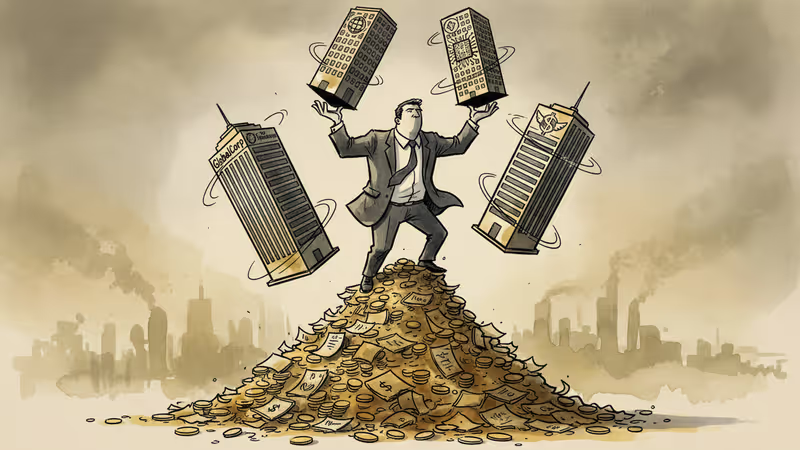
Elon Musk's Empire: The Making of a Modern Robber Baron
Musk's potential merger of Tesla, SpaceX, and xAI could create a conglomerate rivaling GE's peak. But history shows the risks of concentrated corporate power.
$800 billion. That's Elon Musk's net worth—bigger than 97% of S&P 500 companies. Now he's reportedly trying to merge his empire into one mega-corporation.
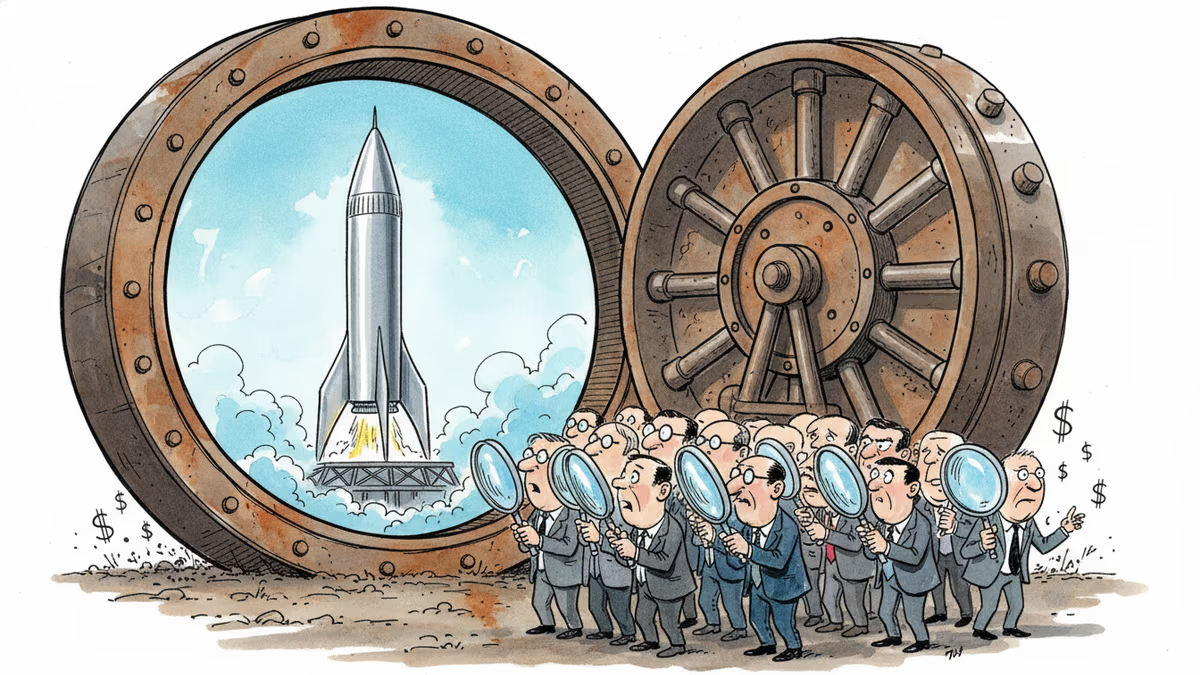
Talks are underway to combine Tesla, SpaceX, and xAI into a single conglomerate, according to recent reports. If successful, this wouldn't just be another corporate merger. It would mark the rise of a modern robber baron—a concentration of power not seen since the Gilded Age.
The Ghost of GE Past
Thirty years ago, we'd be talking about General Electric. At its peak, GE was the world's most valuable company, making everything from light bulbs to jet engines, home appliances to TV shows. It was the everything company.
Jack Welch took over GE in 1981 when the company was adrift, having lost a fifth of its market cap. His solution? Massive layoffs—over 100,000 employees in his first few years, earning him the nickname "Neutron Jack." With the savings, he went on an acquisition spree that included buying NBC in 1986.
Sound familiar? Musk's purchase of X (formerly Twitter) follows a similar playbook—acquiring influence in media to complement his industrial empire.
Welch transformed GE from $14 billion to over $400 billion by 2001. But the cracks eventually showed. During the 2008 financial crisis, GE's conglomerate structure revealed fatal flaws. The company needed a $139 billion government bailout, and five years ago, it announced it would split into three separate companies.
The Robber Baron Comparison
"I think it's much more of a robber baron story than a GE conglomerate story," says David Yoffie, professor at Harvard Business School. He draws parallels to Gilded Age titans like J.P. Morgan and John D. Rockefeller, who controlled vast empires through direct ownership and board influence.
The comparison is apt. Rockefeller's wealth equaled 1-2% of U.S. GDP—roughly the same proportion as Musk's today. Both operated in eras of limited regulation, though today's regulatory pullback creates new opportunities for concentrated power.

Like his Gilded Age predecessors, Musk is attempting to influence the rules of the game, spending over $300 million on elections in the U.S. and abroad.
The Everything App Meets Everything Company
Musk's empire spans radically different industries: electric vehicles, space exploration, artificial intelligence, social media, brain implants, and underground tunnels. Until recently, these companies operated largely independently. But Tesla and SpaceX's separate investments in xAI signal a new phase of integration.
If the merger proceeds, we'd see unprecedented vertical and horizontal integration. Imagine Tesla cars powered by SpaceX satellites, running xAI software, promoted through X, with data flowing through Neuralink interfaces. It's a vision of technological convergence that makes Apple's ecosystem look quaint.
The Conglomerate Discount
But there's a reason conglomerates fell out of favor. "Most of that strategy and approach was debunked in subsequent decades," Yoffie notes. Investors typically prefer specialized companies that can operate more efficiently.
Conglomerates face what finance calls the "conglomerate discount"—they're worth less than the sum of their parts because:
- Cross-subsidization masks poor performance in individual divisions
- Complex structures make accurate valuation difficult
- Management attention gets diluted across diverse businesses
- One division's problems can contaminate the whole enterprise
Warren Buffett'sBerkshire Hathaway remains a notable exception, but it operates more as a holding company than an integrated conglomerate.
The Regulatory Reckoning
The biggest constraint on Musk's empire may ultimately be regulation. The original robber barons saw their power checked by Progressive Era antitrust laws. Standard Oil was broken up in 1911. AT&T was dismantled in 1984.
Today's regulatory environment is more complex. While antitrust enforcement has been relatively weak, growing concerns about tech concentration could change that. Musk's political activities and controversial statements have already drawn regulatory scrutiny.
The question isn't whether regulation will come, but when—and whether Musk's companies will be strong enough to withstand it.
Authors
Related Articles
American Airlines just signed Starlink for 500+ aircraft. It's not just about faster inflight internet — it's a calculated move in the run-up to what could be the largest IPO in history.
SpaceX's upgraded Starship V3 completed its first test flight, deploying 20 Starlink simulators but losing the Super Heavy booster. With an IPO weeks away, the stakes just got higher.
SpaceX's IPO filing puts AI at the center, claiming a $26.5 trillion market opportunity. But can Grok compete with OpenAI and Anthropic for enterprise customers?
SpaceX filed a nearly 400-page S-1 with the SEC, targeting an IPO as early as June 12. Here's what the filing reveals—and what it doesn't.
American Airlines just signed Starlink for 500+ aircraft. It's not just about faster inflight internet — it's a calculated move in the run-up to what could be the largest IPO in history.
SpaceX's upgraded Starship V3 completed its first test flight, deploying 20 Starlink simulators but losing the Super Heavy booster. With an IPO weeks away, the stakes just got higher.
SpaceX's IPO filing puts AI at the center, claiming a $26.5 trillion market opportunity. But can Grok compete with OpenAI and Anthropic for enterprise customers?
SpaceX filed a nearly 400-page S-1 with the SEC, targeting an IPO as early as June 12. Here's what the filing reveals—and what it doesn't.
Thoughts
Share your thoughts on this article
Sign in to join the conversation