
Why OpenAI's Free Science Tool Has Researchers Worried
OpenAI launched Prism, a free AI writing tool for scientists, but researchers fear it will flood journals with low-quality papers. What's really behind this controversial move?
What happens when you give scientists a powerful AI writing assistant for free? OpenAI is about to find out, and the research community isn't entirely thrilled about the experiment.
On Tuesday, the AI giant launched Prism, a specialized workspace designed specifically for researchers. But rather than celebrating this technological gift, many scientists are raising red flags about what it might unleash.
The Science Writing Revolution
Prism integrates OpenAI's latest GPT-5.2 model into a LaTeX-based text editor—the gold standard for academic document formatting. The tool promises to help researchers draft papers, generate citations, transform whiteboard sketches into professional diagrams, and collaborate in real-time with co-authors.
The kicker? It's completely free for anyone with a ChatGPT account. In a world where specialized academic software typically comes with hefty price tags, this generosity seems almost suspicious.
OpenAI carefully positions Prism as a "writing and formatting tool," insisting it's not meant for conducting research itself. But critics argue the company's broader messaging blurs this crucial distinction, potentially encouraging researchers to treat AI as more than just a writing assistant.
The AI Slop Crisis
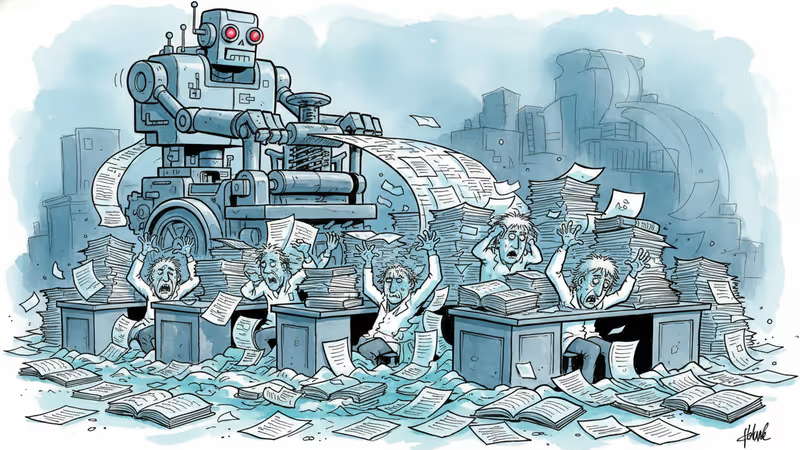
The timing couldn't be more controversial. Academic publishers are already grappling with what they've dubbed "AI slop"—a flood of low-quality, AI-generated papers that threaten to overwhelm peer review systems and dilute scientific literature.
Journals report unprecedented submission volumes, with many papers showing telltale signs of AI generation: repetitive phrasing, generic conclusions, and suspiciously perfect grammar from non-native English speakers. Some publications have implemented AI detection tools, but the technology remains imperfect.

Researchers worry that Prism will democratize paper production to the point where quantity completely overwhelms quality. If writing becomes effortless, will the incentive shift from conducting meaningful research to simply churning out publications?
The Data Play Behind Free Access
Why would OpenAI give away such a sophisticated tool? The answer likely lies in data strategy. Scientists represent some of the world's most educated users, and their interactions with Prism could generate invaluable training data for future AI models.
Every citation generated, every diagram created, every collaborative edit becomes a data point that could improve OpenAI's understanding of scientific writing and reasoning. In essence, researchers become unpaid contributors to the company's AI development.
There's also the credibility factor. If Prism-assisted papers start appearing in prestigious journals like Nature or Science, it would provide powerful validation for OpenAI's technology in the most rigorous intellectual arena.
The Peer Review Dilemma
The real challenge isn't the tool itself—it's the human systems that validate scientific work. Peer review, already strained by increasing submission volumes and declining reviewer availability, faces an existential crisis in the AI age.
How do reviewers distinguish between AI-assisted insights and AI-generated fluff? Should journals require disclosure of AI tool usage? And if everyone has access to the same AI assistant, how do we measure genuine scientific contribution?
Some researchers argue for embracing AI tools while strengthening verification processes. Others advocate for stricter disclosure requirements or even AI-free publication tracks.
The question isn't whether AI will transform scientific publishing—it already has. The question is whether we can adapt our verification systems fast enough to preserve the integrity that makes science trustworthy.
Authors
Related Articles
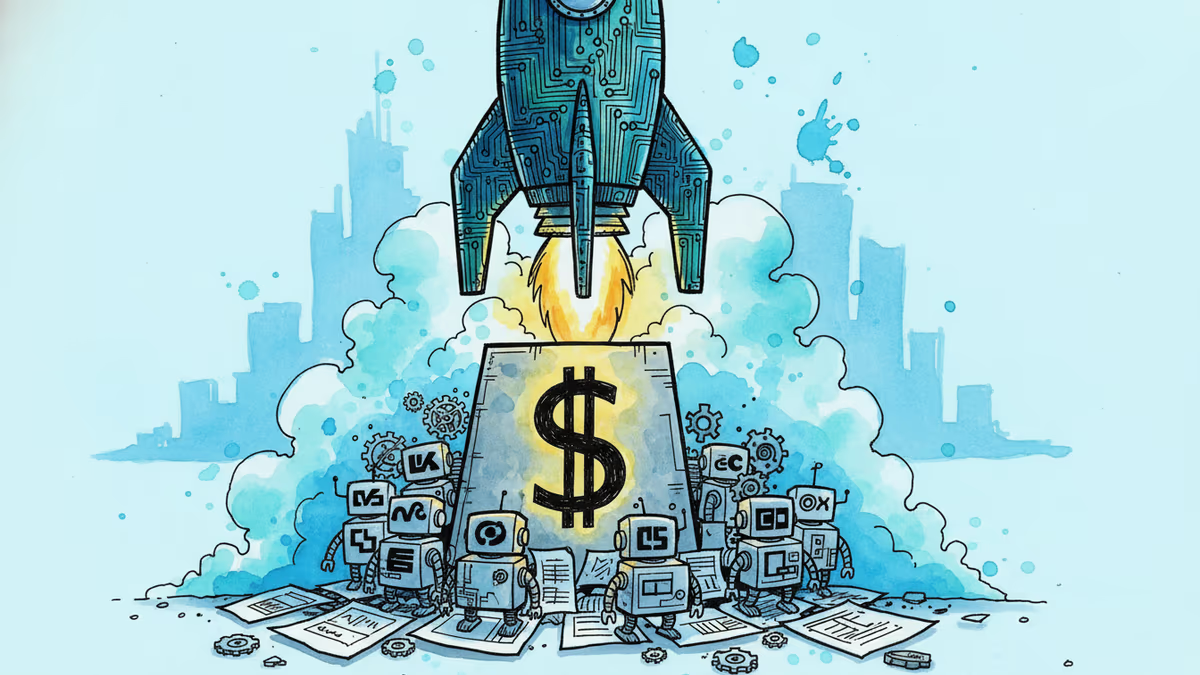
SpaceX's IPO filing puts AI at the center, claiming a $26.5 trillion market opportunity. But can Grok compete with OpenAI and Anthropic for enterprise customers?

OpenAI has reorganized for the second time in a month, merging ChatGPT and Codex into a single agentic platform under president Greg Brockman's unified product leadership.
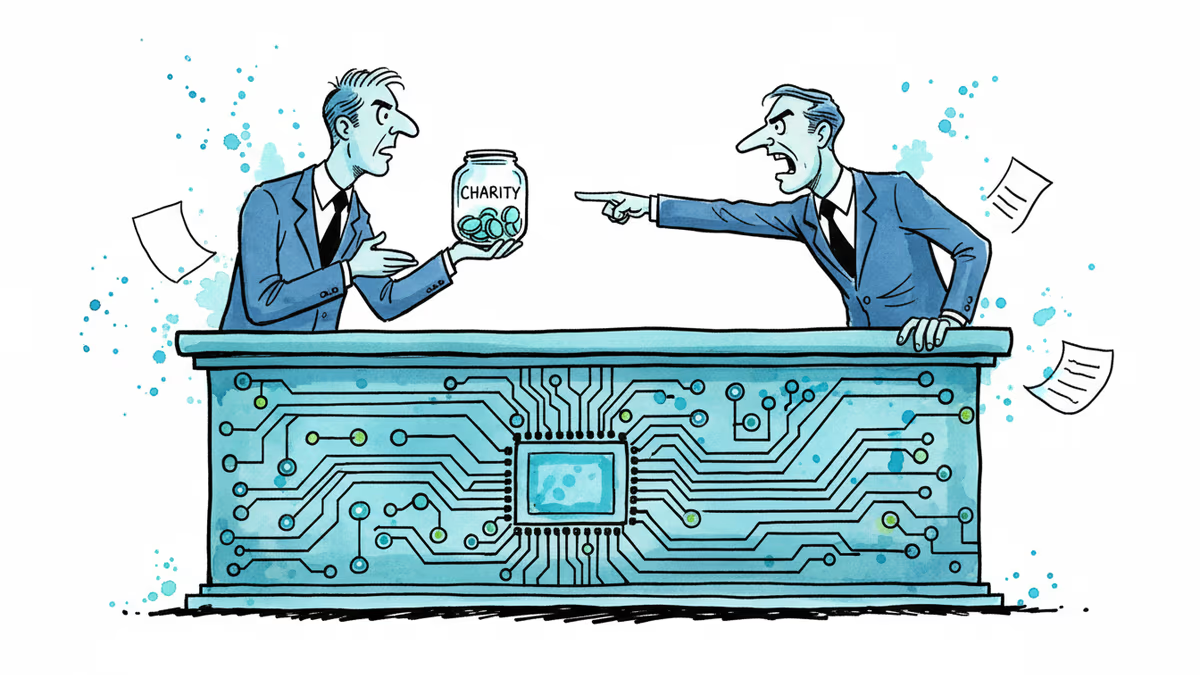
After two weeks of witnesses calling him a liar, OpenAI CEO Sam Altman testified in his own defense, claiming Elon Musk tried to kill the company twice.
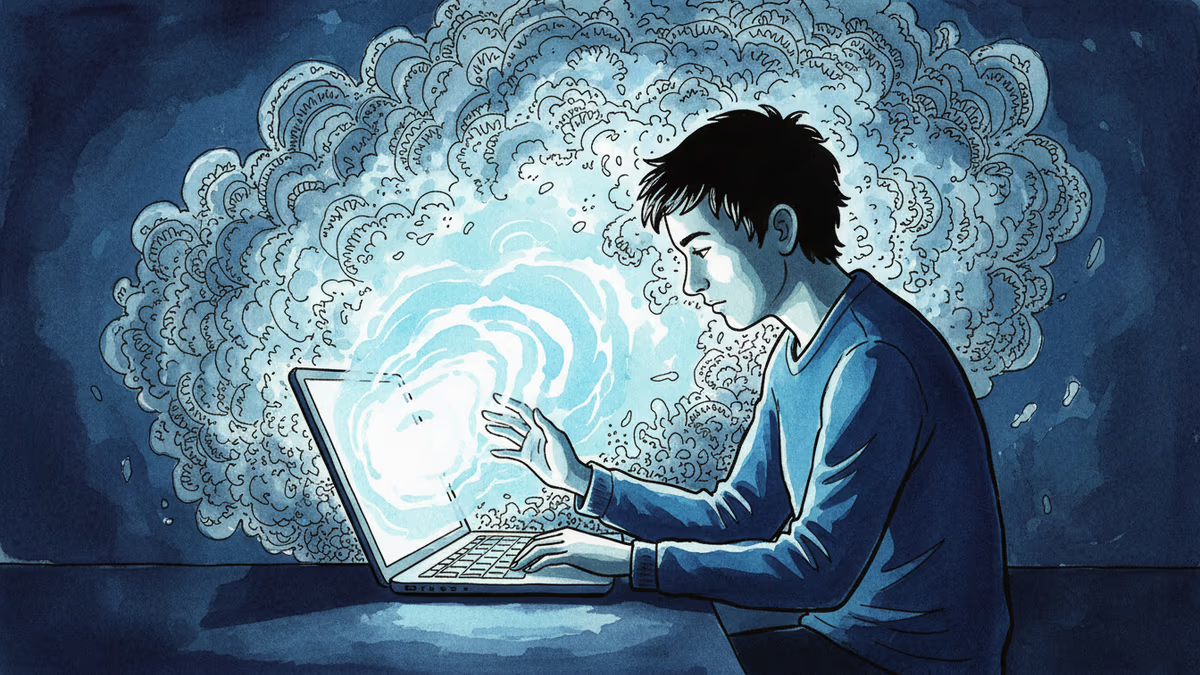
Sam Nelson, 19, died after following ChatGPT's advice to mix Kratom and Xanax. His parents are suing OpenAI for wrongful death, raising urgent questions about AI trust, liability, and design.
SpaceX's IPO filing puts AI at the center, claiming a $26.5 trillion market opportunity. But can Grok compete with OpenAI and Anthropic for enterprise customers?
OpenAI has reorganized for the second time in a month, merging ChatGPT and Codex into a single agentic platform under president Greg Brockman's unified product leadership.
After two weeks of witnesses calling him a liar, OpenAI CEO Sam Altman testified in his own defense, claiming Elon Musk tried to kill the company twice.
Sam Nelson, 19, died after following ChatGPT's advice to mix Kratom and Xanax. His parents are suing OpenAI for wrongful death, raising urgent questions about AI trust, liability, and design.
Thoughts
Share your thoughts on this article
Sign in to join the conversation