
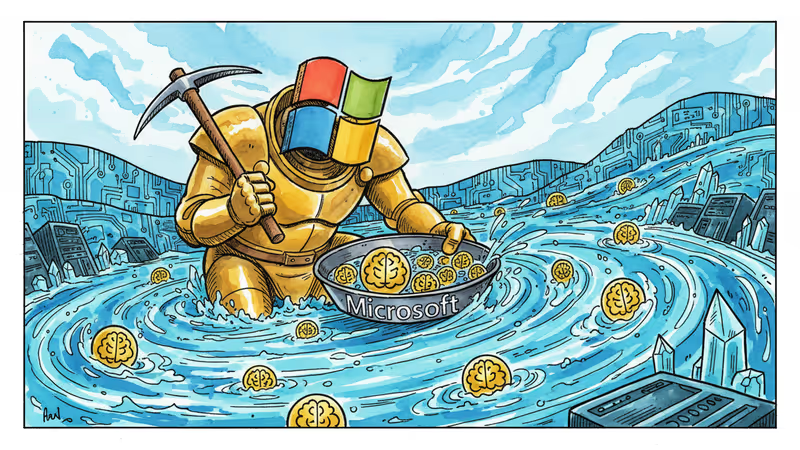
Microsoft's $7.6B OpenAI Windfall Reveals the Real AI Gold Rush
Microsoft's massive OpenAI investment pays off with $7.6B quarterly gain, while $625B in future contracts reshape the AI economy landscape
While everyone debates whether AI will replace human workers, Microsoft just proved that betting on AI companies might be the most lucrative job of all. The tech giant's latest quarterly earnings revealed a staggering $7.6 billion boost to net income from its OpenAI investment alone—a windfall that's reshaping how we think about the AI economy.
The Numbers Behind the AI Bet
Microsoft's gamble on OpenAI is paying off spectacularly. The company has invested more than $13 billion in the AI lab, reportedly securing a 20% revenue share agreement that neither company has publicly confirmed. But the real eye-opener isn't just the current returns—it's what's coming next.
The software giant's "commercial remaining performance obligations" jumped to $625 billion from $392 billion in just one quarter. Nearly half of that—$281 billion—comes from OpenAI alone, following a renegotiated deal where the AI lab committed to purchasing $250 billion worth of Azure services.
To put this in perspective, Microsoft's total quarterly revenue was $81.3 billion. The OpenAI contract alone represents more than three years' worth of current quarterly revenue, locked in and waiting to be delivered.

The Infrastructure Arms Race
But this windfall comes with a price tag. Microsoft spent $37.5 billion on capital expenditures in the quarter, with two-thirds dedicated to what it calls "short-lived" assets—primarily GPUs and CPUs for Azure to serve AI workloads. This massive infrastructure investment reveals a fundamental truth about the AI economy: the real money isn't just in building AI models, but in controlling the compute that powers them.
Anthropic also got a mention in the earnings, contributing to a 230% growth in commercial bookings after Microsoft invested $5 billion and secured $30 billion in Azure commitments. The pattern is clear: Microsoft isn't just investing in AI companies—it's creating a closed-loop ecosystem where its investments drive demand for its own cloud services.
The Platform Play Unveiled
What we're witnessing isn't just successful venture investing—it's the emergence of a new business model that blurs the lines between investor, customer, and platform provider. Microsoft's strategy creates multiple revenue streams from a single relationship: equity appreciation, revenue sharing, and massive cloud service contracts.
This approach fundamentally changes the AI competitive landscape. While companies like Google and Amazon compete primarily through their own AI models, Microsoft has positioned itself as the infrastructure backbone for the most successful independent AI labs. It's the difference between being a player in the game and owning the stadium.
Authors
Related Articles
Snowflake's new $6 billion AWS contract is about more than cloud spending. It signals a shift in AI infrastructure—away from Nvidia GPUs and toward cheaper, homegrown chips for the agent era.
GitHub confirmed hackers stole data from 3,800 internal repositories via a poisoned VS Code extension. Here's why developer tools are now the most dangerous attack surface in tech.

OpenAI has reorganized for the second time in a month, merging ChatGPT and Codex into a single agentic platform under president Greg Brockman's unified product leadership.
After two weeks of witnesses calling him a liar, OpenAI CEO Sam Altman testified in his own defense, claiming Elon Musk tried to kill the company twice.
Snowflake's new $6 billion AWS contract is about more than cloud spending. It signals a shift in AI infrastructure—away from Nvidia GPUs and toward cheaper, homegrown chips for the agent era.
GitHub confirmed hackers stole data from 3,800 internal repositories via a poisoned VS Code extension. Here's why developer tools are now the most dangerous attack surface in tech.
OpenAI has reorganized for the second time in a month, merging ChatGPT and Codex into a single agentic platform under president Greg Brockman's unified product leadership.
After two weeks of witnesses calling him a liar, OpenAI CEO Sam Altman testified in his own defense, claiming Elon Musk tried to kill the company twice.
Thoughts
Share your thoughts on this article
Sign in to join the conversation