
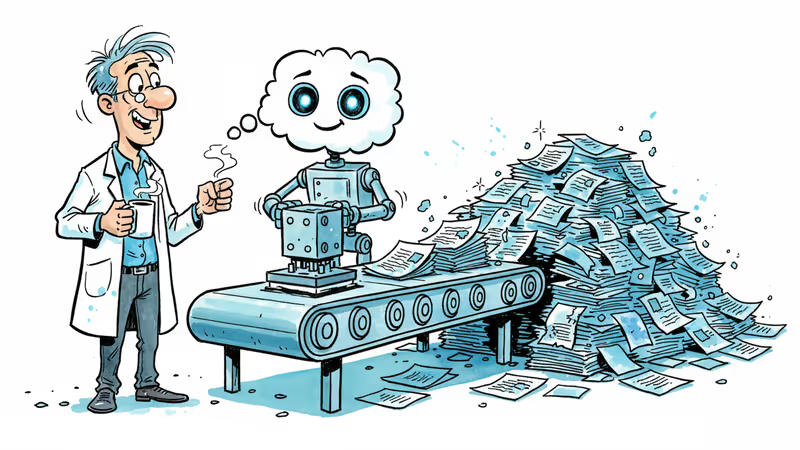
OpenAI Embeds ChatGPT Into Scientific Writing
OpenAI launches Prism, a free tool that integrates ChatGPT into LaTeX editors for scientific writing, following 1.3 million scientists already using AI weekly
1.3 million scientists are already asking ChatGPT advanced questions every week. Now OpenAI wants to move from their search bar into their word processor.
The company just unveiled Prism, a free tool that embeds ChatGPT directly into LaTeX editors—the coding language scientists use to format research papers. Think of it as autocomplete for academia, where researchers can draft text, summarize articles, manage citations, or even convert whiteboard scribbles into proper equations without leaving their document.
"I think 2026 will be for AI and science what 2025 was for AI in software engineering," said Kevin Weil, head of OpenAI for Science, at yesterday's press briefing. "We're starting to see that same kind of inflection."
From Curiosity to Core Workflow
The numbers tell a compelling story. Those 1.3 million scientists submit more than 8 million queries weekly to ChatGPT on advanced science and math topics—a signal that AI has moved from experimental tool to daily necessity.
Roland Dunbrack, a biology professor at Fox Chase Cancer Center who isn't connected to OpenAI, describes his typical usage: "I mostly use GPT-5 for writing code. Occasionally, I ask LLMs a scientific question, basically hoping it can find information in the literature faster than I can."
The tool addresses a real pain point. Nikita Zhivotovskiy, a statistician at UC Berkeley, notes that GPT-5 "sometimes helps polish the text of papers, catching mathematical typos or bugs, and provides generally useful feedback. It is extremely helpful for quick summarization of research articles."
Prism incorporates GPT-5.2, the company's latest model optimized for mathematical and scientific problem-solving. A chat interface sits below the document view, ready to assist with everything from hypothesis refinement to citation management.

The Incremental Revolution Strategy
But here's where expectations might diverge from reality. Despite weeks of social media buzz from OpenAI researchers about GPT-5's mathematical prowess, Prism isn't positioned as the breakthrough discovery machine many anticipated.
Weil is refreshingly honest about this approach: "I would love to see GPT-5 make a discovery. But I don't think that's what will have the biggest impact on science, at least not in the near term."
Instead, he's betting on compound effects. "There's going to be 10,000 advances in science that maybe wouldn't have happened or wouldn't have happened as quickly, and AI will have been a contributor to that. It won't be this shining beacon—it will just be incremental, compounding acceleration."
This philosophy reflects a broader shift in AI deployment—from revolutionary disruption to embedded productivity enhancement. Prism follows the same pattern as OpenAI's Atlas browser integration and Microsoft's office tools: make AI invisible by making it indispensable.
The Double-Edged Efficiency
The productivity gains seem obvious, but they come with familiar concerns. Science is already grappling with AI-generated content flooding journals and conferences. Will tools like Prism accelerate this trend, making it even harder to distinguish human insight from algorithmic assistance?
The competitive dynamics are equally intriguing. By offering Prism for free, OpenAI is essentially subsidizing scientific productivity to lock researchers into its ecosystem. As rival chatbots from Google, Anthropic, and others compete for mindshare, scientific workflows become another battleground.
For researchers, the calculation is pragmatic. If Prism can cut hours from literature reviews and citation management, the productivity boost might outweigh concerns about AI dependence. But institutions will need to grapple with questions about originality, attribution, and the changing nature of scholarly work.
Authors
Related Articles

OpenAI has reorganized for the second time in a month, merging ChatGPT and Codex into a single agentic platform under president Greg Brockman's unified product leadership.

After two weeks of witnesses calling him a liar, OpenAI CEO Sam Altman testified in his own defense, claiming Elon Musk tried to kill the company twice.

Sam Nelson, 19, died after following ChatGPT's advice to mix Kratom and Xanax. His parents are suing OpenAI for wrongful death, raising urgent questions about AI trust, liability, and design.
OpenAI's new Daybreak initiative uses the Codex AI agent to find and patch security vulnerabilities before attackers do—putting it in direct competition with Anthropic's secretive Claude Mythos.
OpenAI has reorganized for the second time in a month, merging ChatGPT and Codex into a single agentic platform under president Greg Brockman's unified product leadership.
After two weeks of witnesses calling him a liar, OpenAI CEO Sam Altman testified in his own defense, claiming Elon Musk tried to kill the company twice.
Sam Nelson, 19, died after following ChatGPT's advice to mix Kratom and Xanax. His parents are suing OpenAI for wrongful death, raising urgent questions about AI trust, liability, and design.
OpenAI's new Daybreak initiative uses the Codex AI agent to find and patch security vulnerabilities before attackers do—putting it in direct competition with Anthropic's secretive Claude Mythos.
Thoughts
Share your thoughts on this article
Sign in to join the conversation