
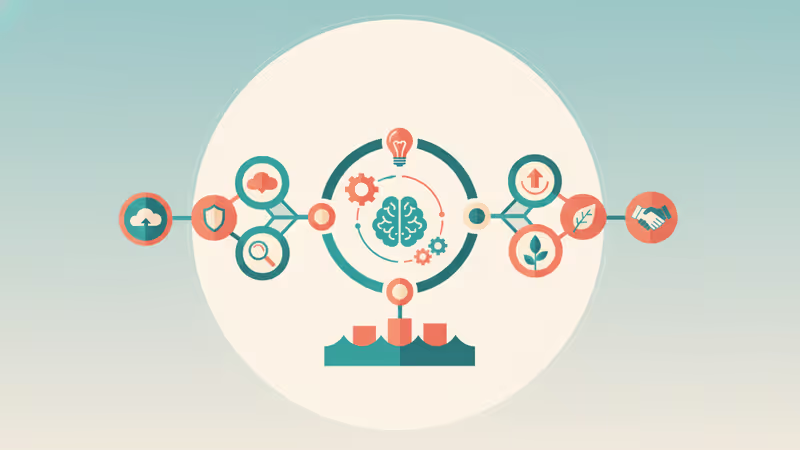
When AI Writes Code: Fast Magic, Fragile Reality
OpenAI reveals how Codex CLI works internally as AI coding agents reach their ChatGPT moment. But beneath the impressive speed lies a more complex reality of limitations and human oversight.
What used to take days now happens in hours. OpenAI engineer Michael Bolin's detailed breakdown of Codex CLI's internal workings, published Friday, reveals how AI coding agents write code, run tests, and fix bugs under human supervision—and why that supervision remains crucial.
AI coding agents are having their "ChatGPT moment." Tools like Claude Code with Opus 4.5 and Codex powered by GPT-5.2 have reached a new threshold of practical usefulness. They're not just generating boilerplate code anymore—they're designing interfaces, building prototypes, and handling complex development workflows that once required extensive manual work.
The timing of Bolin's technical deep-dive is no coincidence. As these tools transition from experimental curiosities to everyday development aids, understanding their internal "agentic loop"—how they plan, execute, and iterate—becomes essential for developers who want to work effectively alongside AI.
The Magic and the Reality
The initial experience feels genuinely magical. Describe what you want in plain English, and watch as the agent rapidly scaffolds a project structure, writes functional code, and even handles basic testing. The rough framework emerges with astonishing speed, creating an almost euphoric sense of productivity.
But then reality sets in. OpenAI has acknowledged to Ars Technica that the company uses Codex to help develop Codex itself—a fascinating recursive loop of AI building AI. Yet even with this self-improvement cycle, the limitations become apparent in real-world use.
The devil, as always, is in the details. Once you move beyond the initial framework, the tedious work begins: debugging edge cases, handling scenarios outside the training data, and implementing the kind of nuanced business logic that requires deep domain understanding. The agent excels at the 80% of straightforward implementation but struggles with the 20% that often determines whether a project succeeds or fails.

A Controversial Transformation
The developer community remains split. Some embrace the liberation from repetitive tasks, seeing AI agents as powerful productivity multipliers. Others worry about skill atrophy and the potential devaluation of programming expertise. The concern isn't unfounded—if AI can handle routine coding, what happens to junior developers who traditionally cut their teeth on exactly these tasks?
The controversy extends beyond individual careers to broader questions about software quality and maintainability. Code written by AI agents can be functionally correct but lack the architectural elegance and long-term maintainability that experienced developers bring. It's fast food versus fine dining—both serve their purpose, but the nutritional value differs significantly.
The Agentic Loop Explained
Bolin's technical breakdown centers on what he calls the "agentic loop"—the cycle of planning, execution, evaluation, and refinement that allows AI to work more autonomously. Unlike simple code completion tools, these agents can set goals, break them into steps, execute those steps, and adjust based on results.
This represents a fundamental shift from reactive to proactive AI tools. Instead of waiting for specific prompts, the agent can maintain context across an entire development session, learning from mistakes and adapting its approach. It's the difference between a smart autocomplete and a junior developer who can actually think through problems.
Yet even this sophisticated loop has boundaries. Complex architectural decisions, performance optimization, and security considerations still require human judgment. The agent might write functional code, but it doesn't understand the broader implications of technical debt or the subtle trade-offs that experienced developers navigate instinctively.
Authors
Related Articles
Anthropic shipped Claude Sonnet 5, its mid-tier agent model, on June 30. Behind the 'Opus-class power, budget price' headline sits a tokenizer catch and a three-horse race that's only half real. Here's what developers should actually run the numbers on.

OpenAI has reorganized for the second time in a month, merging ChatGPT and Codex into a single agentic platform under president Greg Brockman's unified product leadership.

After two weeks of witnesses calling him a liar, OpenAI CEO Sam Altman testified in his own defense, claiming Elon Musk tried to kill the company twice.

Sam Nelson, 19, died after following ChatGPT's advice to mix Kratom and Xanax. His parents are suing OpenAI for wrongful death, raising urgent questions about AI trust, liability, and design.
Anthropic shipped Claude Sonnet 5, its mid-tier agent model, on June 30. Behind the 'Opus-class power, budget price' headline sits a tokenizer catch and a three-horse race that's only half real. Here's what developers should actually run the numbers on.
OpenAI has reorganized for the second time in a month, merging ChatGPT and Codex into a single agentic platform under president Greg Brockman's unified product leadership.
After two weeks of witnesses calling him a liar, OpenAI CEO Sam Altman testified in his own defense, claiming Elon Musk tried to kill the company twice.
Sam Nelson, 19, died after following ChatGPT's advice to mix Kratom and Xanax. His parents are suing OpenAI for wrongful death, raising urgent questions about AI trust, liability, and design.
Thoughts
1 thoughts
Share your thoughts on this article
Sign in to join the conversation