
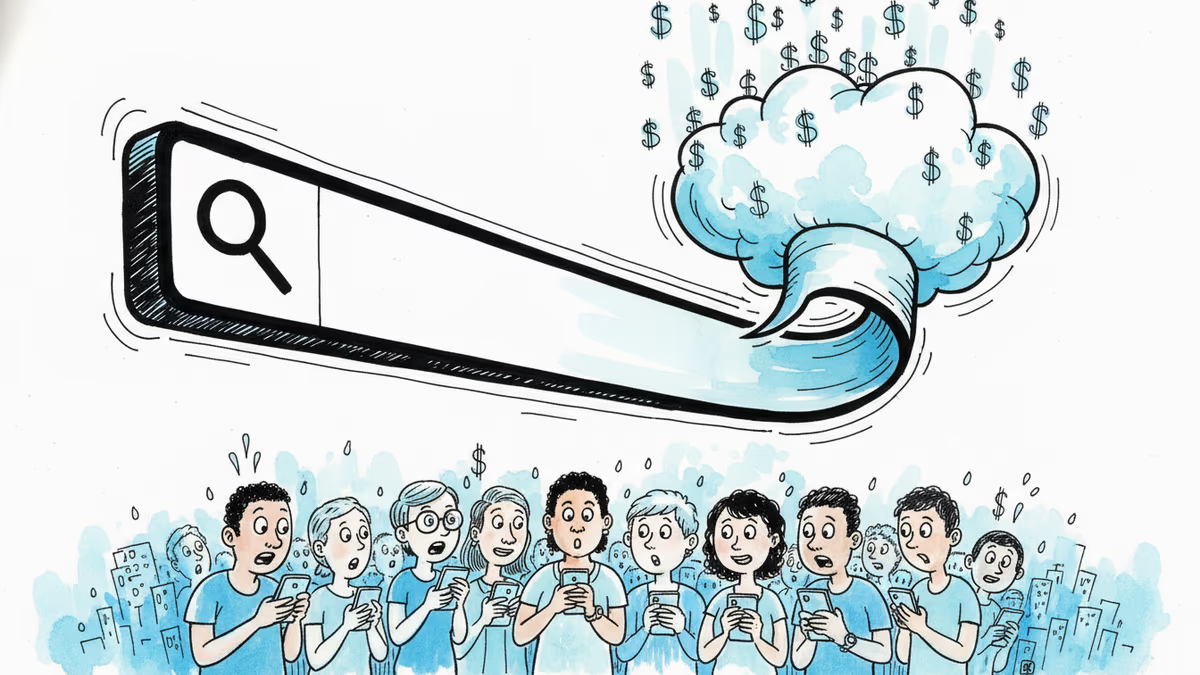
Google Just Admitted Gemini Ads Are Coming
Google SVP Nick Fox confirmed ads in Gemini are "not ruled out," two months after DeepMind's CEO said the opposite. Here's what that shift means for users, advertisers, and the AI industry.
Two Months, Two Very Different Answers
In January, at Davos, Google DeepMind CEO Demis Hassabis told reporters the company had "no plans" to put ads in Gemini. Last week, Google's Senior Vice President of Knowledge and Information, Nick Fox, told WIRED something else entirely: "We're not ruling them out."
Four words. But in the context of a $400 billion-a-year business navigating the most competitive moment in AI history, they carry a lot of weight.
To understand why this matters, start with the numbers. Gemini has grown from 350 million monthly active users in March 2025 to 750 million today — more than doubling in under a year. OpenAI doesn't publish monthly figures, but claims 900 million weekly active users for ChatGPT. Both companies are now sitting on enormous free user bases with a shared problem: how do you monetize them without killing the product people love?
Google's Play: Patience as Strategy
Google's approach is deliberately indirect, and Fox's interview makes the logic clear. Rather than dropping ads into Gemini directly, the company is running its experiments inside AI Mode and AI Overviews — the AI-powered layers built into traditional Search, where users already expect to see ads. The idea is to gather data in a familiar context first, then carry those learnings into Gemini "down the road."
This is a position only a company with Google's financial cushion can afford. 2025 was the first year Google crossed $400 billion in annual revenue. Fox was candid about the advantage this creates: "Because the business is so strong and healthy, that's a luxury we have." OpenAI, by contrast, is reportedly targeting more than double its $30 billion 2025 revenue in 2026, with advertising expected to be a meaningful part of that growth. It already started testing ads in ChatGPT's free tier in the US.
Fox didn't criticize OpenAI's timing directly, but the implication was clear: "It's less a question of timing and more a question of doing it right." His point being that Google has over 20 years of search advertising experience — knowing when an ad helps versus when it annoys — and that expertise is a genuine moat.
The Piece Everyone's Watching: Personal Intelligence

The most consequential part of Fox's interview wasn't the ad admission itself — it was what he said about Personal Intelligence.
Launched in January, Personal Intelligence allows Gemini to pull from a user's Gmail, Google Photos, and Calendar to generate contextually rich responses. Fox described asking a vague question about ski goggle lenses while on the slopes. Gemini identified his resort from his email, checked the weather forecast, and found a forwarded receipt from his wife showing he already had a spare lens. "It's like subtle magic," he said.
Now add advertising to that picture. Fox acknowledged the obvious question — would advertisers get access to that personal data? His answer was careful: "We don't sell data to advertisers." But on whether Personal Intelligence would inform ad targeting within Gemini, he said it's "TBD." He even sketched out what it might look like: an ad that knows the specific brand of goggles you own, served at the exact moment you're asking about them.
The line between "useful" and "unsettling" has rarely been thinner.
Where the Industry Is Splitting
| Ad Approach | Current Status | Financial Pressure | |
|---|---|---|---|
| Testing in AI Mode/Overviews; Gemini TBD | Active experiments | Low — $400B+ revenue | |
| OpenAI | Ads in ChatGPT free tier | US testing underway | High — 2x revenue target |
| Anthropic | Actively anti-ad (ran Super Bowl campaign against AI ads) | No ads | Moderate |
| Perplexity | Paused ad experiments | Halted over user trust concerns | Moderate |
Anthropic took the most theatrical stance — running a Super Bowl ad that highlighted the dangers of over-relying on AI, implicitly criticizing ad-supported models. Perplexity went further, pulling back from ad experiments entirely after concluding the trust cost was too high. The AI industry is placing very different bets on what users will actually tolerate.
Three Groups Watching This Closely
For users, the question is what "free" actually costs. If Gemini eventually reads your emails and calendar to serve you targeted ads — even without sharing your data with advertisers — the product becomes something qualitatively different from a neutral assistant. Fox emphasized that Personal Intelligence is opt-in, and that Google "wouldn't do that in a way that's uncomfortable for users." But who decides what's comfortable?
For advertisers, this is potentially the most precise targeting environment ever built. An AI that knows your upcoming travel plans, recent purchases, and daily schedule could serve ads with a relevance that keyword-based search never achieved. The question is whether users will accept it — or whether the backlash will force Google to pull back, as it did Perplexity.
For regulators, the timing is notable. The EU's AI Act is in early enforcement stages. The FTC under the current administration has signaled interest in AI data practices. A Google product that combines personal email data with ad targeting — even with privacy guardrails — will attract scrutiny. Fox's repeated emphasis on privacy protections reads partly as a legal hedge.
Authors
Related Articles
In a post-Google I/O interview, Sundar Pichai acknowledged flawed search results, real AI anxiety, and an AGI timeline that makes the label irrelevant. Here's what he said — and what it means.
Google is building AI agents that search the web proactively, without user prompting. That's not just a product update — it's a fundamental shift in who controls the information you receive.

OpenAI has reorganized for the second time in a month, merging ChatGPT and Codex into a single agentic platform under president Greg Brockman's unified product leadership.

Google unveiled the 'Googlebook' platform to replace Chromebook and ChromeOS—but revealed zero hardware specs. What's the strategy, and what does it mean for users, manufacturers, and the education market?
In a post-Google I/O interview, Sundar Pichai acknowledged flawed search results, real AI anxiety, and an AGI timeline that makes the label irrelevant. Here's what he said — and what it means.
Google is building AI agents that search the web proactively, without user prompting. That's not just a product update — it's a fundamental shift in who controls the information you receive.
OpenAI has reorganized for the second time in a month, merging ChatGPT and Codex into a single agentic platform under president Greg Brockman's unified product leadership.
Google unveiled the 'Googlebook' platform to replace Chromebook and ChromeOS—but revealed zero hardware specs. What's the strategy, and what does it mean for users, manufacturers, and the education market?
Thoughts
Share your thoughts on this article
Sign in to join the conversation