
The Jury Can't Stand Elon Musk. That's Now a Legal Problem.
The Musk vs. Altman OpenAI trial opened with a jury selection crisis. Prospective jurors called Musk a 'world-class jerk' on official court forms. What does that tell us?
On an official U.S. federal court jury questionnaire, a prospective juror wrote: "Elon Musk is a greedy, racist, homophobic piece of garbage." Another: "a world-class jerk." These weren't tweets. They were sworn statements submitted to a federal judge.
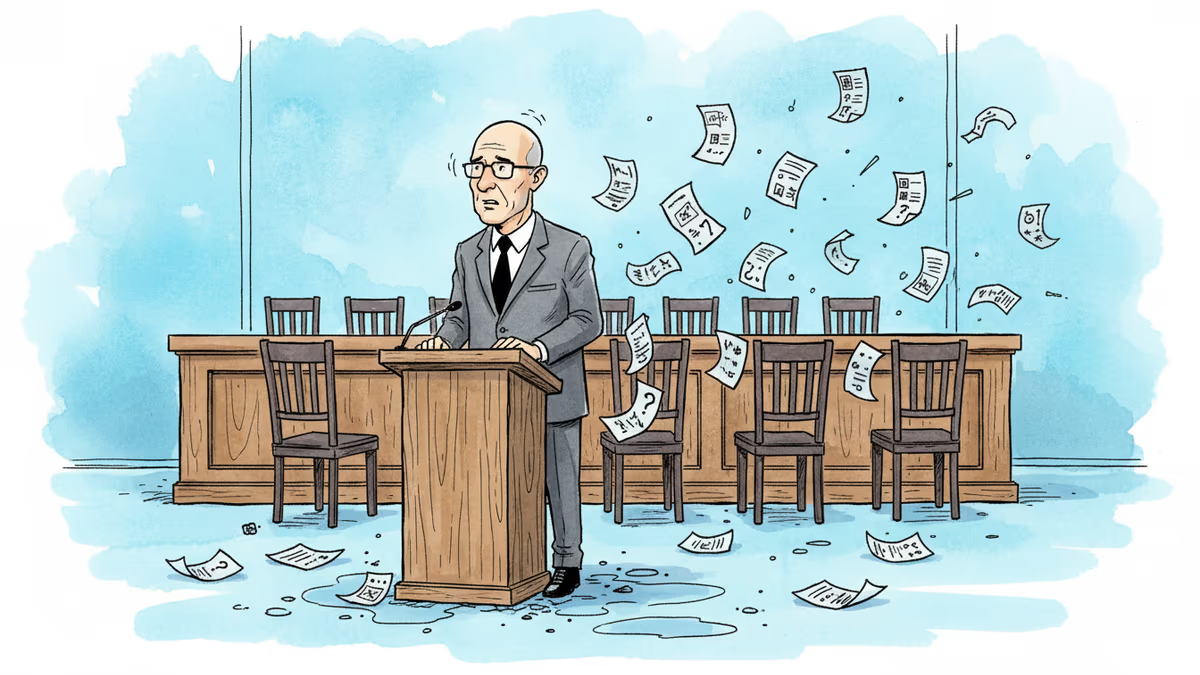
The Musk vs. Altman trial over OpenAI's alleged broken promises opened on Monday — and it couldn't even get past day one without a problem that no legal team fully anticipated: finding twelve Americans in San Francisco who can set aside what they think of Elon Musk.
What the Lawsuit Is Actually About
Strip away the celebrity noise and the core claim is this: Musk says that when he co-founded OpenAI in 2015 and donated hundreds of millions of dollars to it, there was an understanding — a promise — that it would remain a nonprofit AI research lab dedicated to humanity's benefit. What OpenAI became instead is a company now valued at roughly $157 billion, backed by Microsoft and a constellation of venture investors, selling ChatGPT subscriptions to hundreds of millions of users worldwide.
Musk left the OpenAI board in 2018. He has since founded his own AI company, xAI, making him a direct competitor to Altman. That fact hangs over every argument his lawyers will make. Is this a principled stand against mission drift? Or is it a well-funded legal campaign to destabilize a rival? The jury — once one is actually seated — will have to decide.
Why Jury Selection Is the First Battlefield
In American civil trials, jurors are the ultimate arbiters of fact. The system depends on their impartiality. But impartiality requires something increasingly scarce in 2026: a person who has formed no strong opinion about one of the most polarizing public figures on the planet.

The Verge's reporter Elizabeth Lopatto, covering the proceedings from the courthouse, noted that the juror questionnaires revealed a pattern of deep personal animosity toward Musk. One prospective juror, a woman of color, wrote that she was "very aware of the damaging statements and actions Elon Musk has enacted." San Francisco, where Musk carried out mass layoffs after acquiring Twitter (now X) and has led DOGE's federal workforce reductions, is not fertile ground for neutral observers.
None of this means Musk can't get a fair trial. Courts manage this routinely. But the sheer volume of strongly worded responses signals something worth noting: the legal system is now being asked to adjudicate disputes involving figures whose public personas have become inseparable from political identity.
The Bigger Question Behind the Lawsuit
Whatever the verdict, this trial forces a question that the entire AI industry has been quietly avoiding.
OpenAI was founded with an explicit public-benefit mission. Its early pitch to donors and researchers was that it would be a counterweight to profit-driven AI development at Google and others. That framing attracted talent, credibility, and money — including Musk's. The transition to a capped-profit and now increasingly commercial structure may have been legally permissible. But was it a betrayal of the people who bought into the original vision?
This isn't just OpenAI's problem. Anthropic was founded by former OpenAI researchers partly on concerns about mission drift, yet it too has taken billions from Amazon. Google DeepMind has always operated inside a for-profit parent. The tension between "AI for humanity" and "AI for shareholders" is the industry's original sin — and this courtroom is the first place it's being examined under oath.
For investors, the implications are concrete. If a court rules that founding-era nonprofit commitments created legally enforceable obligations, every AI organization that has made similar public-benefit claims faces new scrutiny. Term sheets, governance documents, and donor agreements across the sector could look very different after this verdict.
This content is AI-generated based on source articles. While we strive for accuracy, errors may occur. We recommend verifying with the original source.
Related Articles
OpenAI has reorganized for the second time in a month, merging ChatGPT and Codex into a single agentic platform under president Greg Brockman's unified product leadership.
After two weeks of witnesses calling him a liar, OpenAI CEO Sam Altman testified in his own defense, claiming Elon Musk tried to kill the company twice.
Sam Nelson, 19, died after following ChatGPT's advice to mix Kratom and Xanax. His parents are suing OpenAI for wrongful death, raising urgent questions about AI trust, liability, and design.
OpenAI's new Daybreak initiative uses the Codex AI agent to find and patch security vulnerabilities before attackers do—putting it in direct competition with Anthropic's secretive Claude Mythos.
OpenAI has reorganized for the second time in a month, merging ChatGPT and Codex into a single agentic platform under president Greg Brockman's unified product leadership.
After two weeks of witnesses calling him a liar, OpenAI CEO Sam Altman testified in his own defense, claiming Elon Musk tried to kill the company twice.
Sam Nelson, 19, died after following ChatGPT's advice to mix Kratom and Xanax. His parents are suing OpenAI for wrongful death, raising urgent questions about AI trust, liability, and design.
OpenAI's new Daybreak initiative uses the Codex AI agent to find and patch security vulnerabilities before attackers do—putting it in direct competition with Anthropic's secretive Claude Mythos.
Thoughts
Share your thoughts on this article
Sign in to join the conversation