
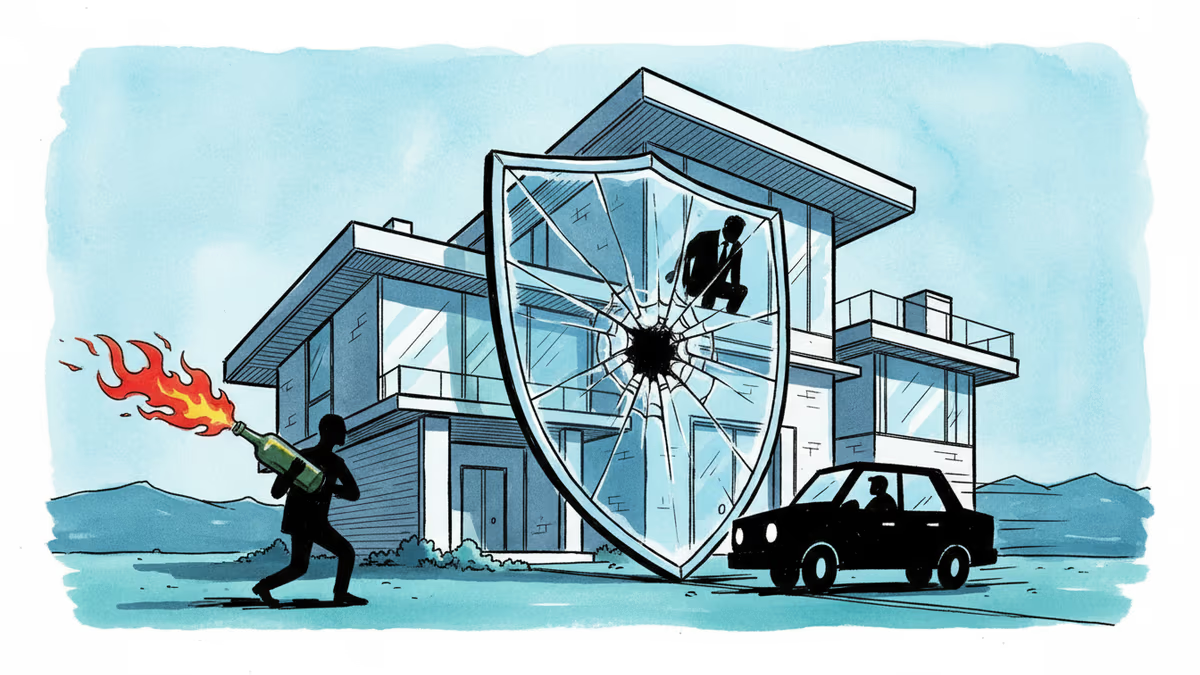
Sam Altman's Home Hit Twice in 72 Hours
OpenAI CEO Sam Altman's San Francisco residence was attacked twice in three days — first a Molotov cocktail, then a shooting. What does this say about tech power, public anger, and the real-world risks facing AI leaders?
First a Molotov cocktail. Then, 48 hours later, gunshots.
The San Francisco home of OpenAI CEO Sam Altman was targeted in two separate attacks over a single weekend, according to reports from The San Francisco Standard and The Verge. On Sunday morning, surveillance footage reportedly captured a vehicle passenger firing a weapon at Altman's Russian Hill residence. Two suspects were arrested and charged with negligent discharge of a firearm.
This came just two days after a 20-year-old man was arrested Friday for allegedly throwing a Molotov cocktail at the same property. Both investigations remain ongoing, and police have not publicly confirmed whether the two incidents are connected.
Two Attacks, One Address, Zero Answers
The facts are stark, but the motive is murky. San Francisco police have not released information about what drove either suspect. The two incidents may be entirely unrelated — urban crime in a city that has struggled with public safety for years. Or they may point to something more deliberate.
Sam Altman is not just a tech CEO. He is arguably the most publicly visible face of the AI era — a figure who has testified before Congress, appeared on global magazine covers, and openly discussed the possibility that OpenAI is building one of the most transformative — and potentially dangerous — technologies in human history. That visibility cuts both ways.

The Anger Is Not New
San Francisco's relationship with Big Tech has been fraying for over a decade. Rising rents, displacement of long-term residents, the spectacle of private shuttle buses blocking public stops — the resentment toward the tech industry is structural, not incidental. Altman and OpenAI have become symbols of a new, faster, more opaque wave of technological change that many people feel is happening to them, not for them.
But resentment and targeted violence are different things. What's notable here is not just that attacks happened, but that they happened twice, within days, at the same address. Whether that's coincidence, copycat behavior, or something more coordinated is a question investigators are still working to answer.
Three Ways to Read This
From inside Silicon Valley, the reaction is one of alarm. Threats and harassment of AI researchers and executives have been quietly escalating for years — mostly online, occasionally in person. The normalization of physical targeting of tech leaders represents a line being crossed that many in the industry hoped would hold.
From a civil society perspective, there's a harder question underneath the immediate condemnation of violence: when a small number of individuals hold enormous, largely unaccountable influence over systems that affect billions of people, what legitimate channels exist to express dissent? Protests, lawsuits, and regulatory pressure have moved slowly. That doesn't justify violence — nothing does — but ignoring the underlying frustration won't make it disappear.
From a national security lens, the concentration of critical AI development in a handful of individuals and companies creates structural vulnerabilities. If Altman, Demis Hassabis, or a handful of other figures were incapacitated, the ripple effects on global AI development timelines would be significant. Some analysts have quietly argued that key AI leaders should be treated with the same security protocols afforded to senior government officials.
Authors
Related Articles
Indian venture capital has quietly displaced Silicon Valley in its own backyard. Only one American VC made India's top 10 investor list last year. Here's why that matters beyond India.

OpenAI has reorganized for the second time in a month, merging ChatGPT and Codex into a single agentic platform under president Greg Brockman's unified product leadership.
After two weeks of witnesses calling him a liar, OpenAI CEO Sam Altman testified in his own defense, claiming Elon Musk tried to kill the company twice.
Sam Nelson, 19, died after following ChatGPT's advice to mix Kratom and Xanax. His parents are suing OpenAI for wrongful death, raising urgent questions about AI trust, liability, and design.
Indian venture capital has quietly displaced Silicon Valley in its own backyard. Only one American VC made India's top 10 investor list last year. Here's why that matters beyond India.
OpenAI has reorganized for the second time in a month, merging ChatGPT and Codex into a single agentic platform under president Greg Brockman's unified product leadership.
After two weeks of witnesses calling him a liar, OpenAI CEO Sam Altman testified in his own defense, claiming Elon Musk tried to kill the company twice.
Sam Nelson, 19, died after following ChatGPT's advice to mix Kratom and Xanax. His parents are suing OpenAI for wrongful death, raising urgent questions about AI trust, liability, and design.
Thoughts
Share your thoughts on this article
Sign in to join the conversation