
OpenAI's Own Investors Are Eyeing Anthropic
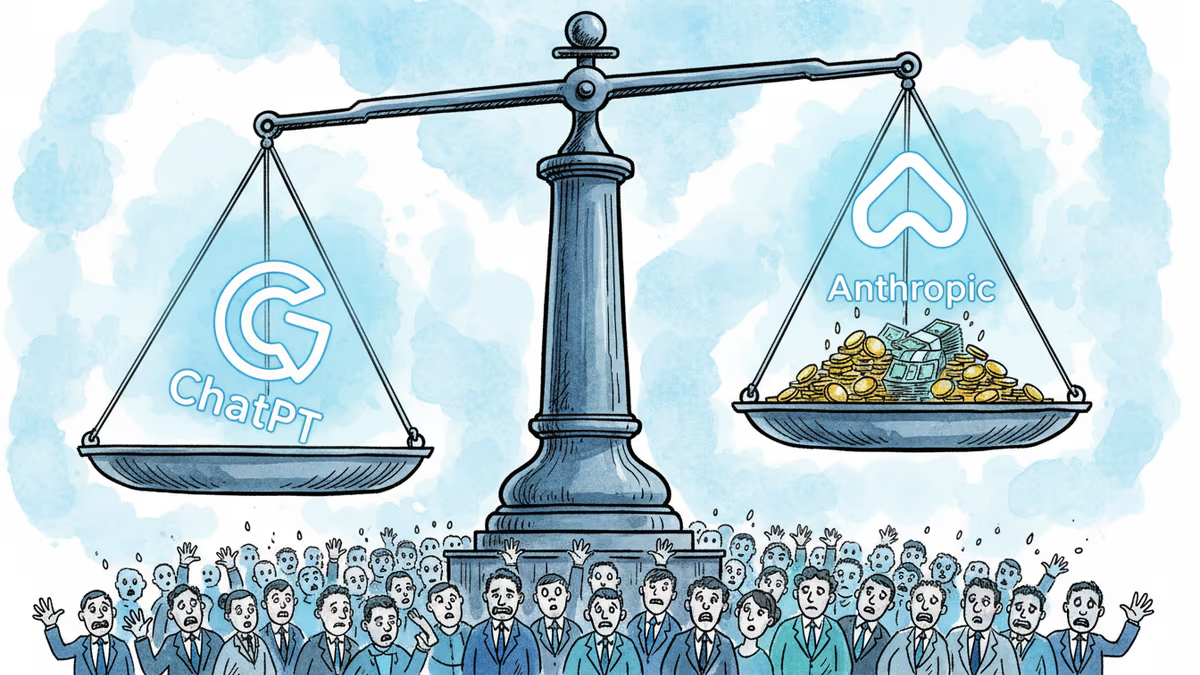
OpenAI's $852B valuation is drawing skepticism from its own backers as Anthropic's ARR tripled in three months. The secondary market is already voting with its feet.
Somewhere in Silicon Valley, an investor is holding shares in both OpenAI and Anthropic — and telling the Financial Times that the latter looks like the better deal.
That's not a rounding error. That's a signal.
The Numbers That Rattled the Room
Anthropic's annualized revenue jumped from $9 billion at the end of 2025 to $30 billion by the end of March 2026. In three months. The engine behind that growth: coding tools. Enterprises are quietly, rapidly, embedding Claude into their development workflows — and the revenue is following.
Meanwhile, OpenAI closed what it called the largest private fundraising in history at $122 billion, implying a valuation of $852 billion. CFO Sarah Friar pointed to that raise as proof of investor confidence. But one investor who backed both companies told the FT that justifying OpenAI's round required assuming an IPO valuation of $1.2 trillion or more — making Anthropic's $380 billion tag look, by comparison, like a relative bargain.
The secondary market is already rendering its verdict. Demand for Anthropic shares has grown nearly insatiable. OpenAI shares are trading at a discount.
The Netscape Problem
Jai Das, president of Sapphire Ventures — who has no stake in either company — offered the sharpest framing: he sees OpenAI as "the Netscape of AI." Netscape invented the commercial web browser. It dominated. Then Microsoft came. Then AOL absorbed what was left.
The analogy is uncomfortable because it's historically grounded. First movers in technology don't automatically become permanent winners. They set the category, then get outmaneuvered by players who learn from their mistakes and enter with sharper focus.

Sam Altman has navigated valuation turbulence before. During his time running Y Combinator, aggressive valuation inflation left some portfolio companies stranded — while others grew into their price tags and then some. The question is which outcome OpenAI resembles.
Two Different Games
Here's what the revenue divergence might actually reflect: OpenAI and Anthropic are increasingly playing different games.
OpenAI built its brand on consumer reach — ChatGPT became a household name. But consumer attention is fickle, and monetizing it at scale is hard. Enterprise contracts, by contrast, are sticky, predictable, and high-margin. Anthropic entered the market with enterprise trust as a core design principle — safety-focused, less flashy, more auditable. That positioning is paying off precisely when enterprise buyers are getting serious about AI governance and reliability.
OpenAI isn't standing still. It's actively reorienting toward enterprise. But reorienting a consumer-first brand toward institutional buyers is a slower, harder pivot than it sounds. The acquisition of AI personal finance startup Hiro hints at the breadth of bets it's placing simultaneously.
What Investors Are Actually Pricing In
For VCs and growth-stage investors, this moment surfaces a classic tension: backing the brand or backing the trajectory.
OpenAI has the name recognition, the developer ecosystem, and the Microsoft partnership. Anthropic has the growth rate, the enterprise momentum, and — increasingly — the regulatory credibility. (Its co-founder recently confirmed the company briefed the Trump administration on its Mythos project, signaling a deliberate play for government trust.)
At $852 billion, OpenAI needs to become one of the most valuable companies in human history to justify its current private price. At $380 billion, Anthropic needs to keep doing what it's already doing — and accelerate.
Neither outcome is guaranteed. But the math of expectations is very different.
Authors
Related Articles
Anthropic shipped Claude Sonnet 5, its mid-tier agent model, on June 30. Behind the 'Opus-class power, budget price' headline sits a tokenizer catch and a three-horse race that's only half real. Here's what developers should actually run the numbers on.
Samsung and SK unveiled a chip and AI investment package worth thousands of trillions of won on June 29. The headline number swings wildly by outlet, but the real contest isn't capital — it's water and power.

A small but growing group of developers has gone all-in on AI coding agents like Claude Code and OpenClaw. History suggests the rest of us won't be far behind.
Lucra Sports CEO Dylan Robbins landed Cathie Wood's ARK Invest as a Series B lead without building AI. The story behind his unconventional fundraising playbook.
Anthropic shipped Claude Sonnet 5, its mid-tier agent model, on June 30. Behind the 'Opus-class power, budget price' headline sits a tokenizer catch and a three-horse race that's only half real. Here's what developers should actually run the numbers on.
Samsung and SK unveiled a chip and AI investment package worth thousands of trillions of won on June 29. The headline number swings wildly by outlet, but the real contest isn't capital — it's water and power.
A small but growing group of developers has gone all-in on AI coding agents like Claude Code and OpenClaw. History suggests the rest of us won't be far behind.
Lucra Sports CEO Dylan Robbins landed Cathie Wood's ARK Invest as a Series B lead without building AI. The story behind his unconventional fundraising playbook.
Thoughts
Share your thoughts on this article
Sign in to join the conversation