
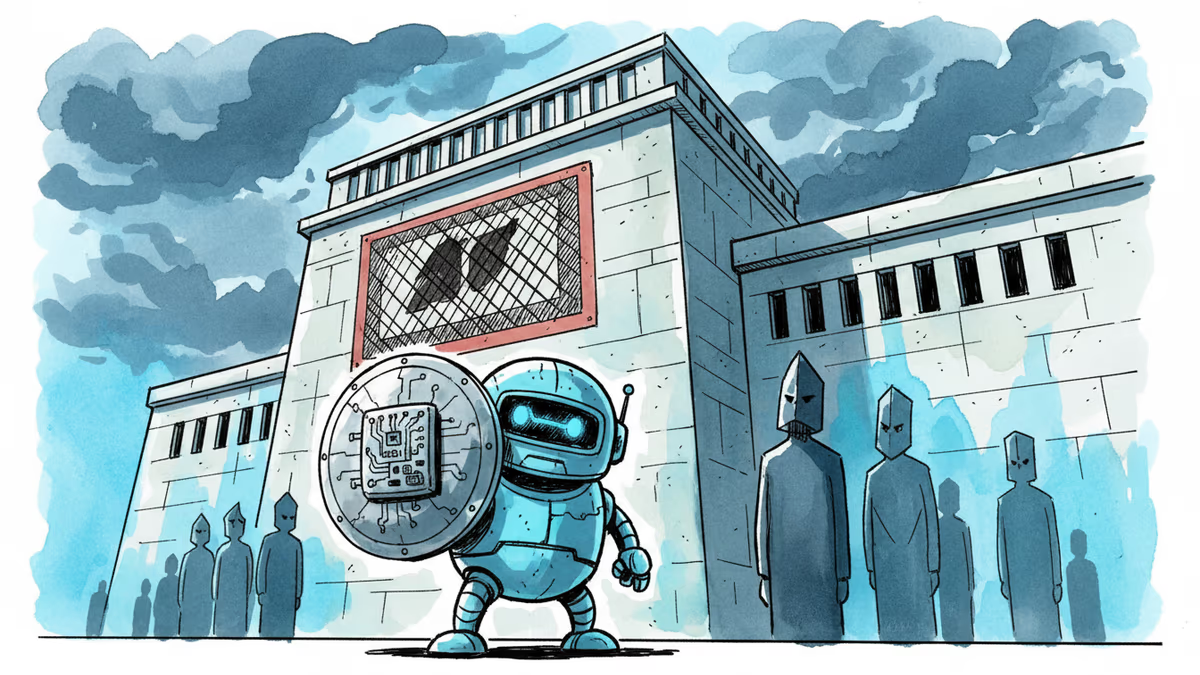
When Washington Calls a US AI Startup a Security Threat
Anthropic sued the Department of Defense after being labeled a supply chain risk. Forty employees from OpenAI and Google filed in support. What this fight reveals about AI, power, and the limits of innovation.
The label "supply chain risk" was built for Huawei. Washington just used it on a San Francisco AI lab.
What Happened
On Monday, Anthropic filed a lawsuit against the U.S. Department of Defense, challenging the Trump administration's decision to designate the company a supply chain risk — a classification typically reserved for foreign entities deemed threats to national security. The designation carries real teeth: it can block a company from federal contracts and procurement pipelines.
Hours after the filing, something unusual happened. Nearly 40 employees from OpenAI and Google — competitors, not allies — submitted an amicus brief in support of Anthropic's lawsuit. Among the signatories: Jeff Dean, Google's chief scientist and the lead on the Gemini project. Rival AI researchers, standing together in federal court, is not a scene Silicon Valley produces often.
Why Anthropic? Why Now?
The administration has not publicly detailed its reasoning. But the context matters.
Anthropic was founded in 2021 by former OpenAI researchers, with AI safety as its stated core mission. It has since raised more than $4 billion from Amazon alone, with additional capital from international sovereign wealth funds, including from Saudi Arabia. For an administration focused on supply chain integrity and foreign capital flows, that structure may have raised flags.
There's also an ideological dimension. Anthropic co-founder Dario Amodei has been one of the more vocal advocates for meaningful AI regulation — a position that sits awkwardly alongside the current administration's deregulatory posture. Whether that tension played a role in the designation is unknown, but it hasn't gone unnoticed.
Why Competitors Showed Up

The amicus brief from OpenAI and Google employees isn't corporate altruism. It's a calculated signal.
Their stated concerns are substantive: the designation, they argue, could chill AI safety research at a moment when it matters most, and set a precedent for government agencies to sideline companies based on opaque criteria. Jeff Dean's name on that brief is notable precisely because of his stature — this isn't a junior engineer tweeting his opinion. It's a senior technical leader at a direct competitor putting his name on a legal document.
The implicit message: if this can happen to Anthropic today, it can happen to anyone tomorrow.
The Competing Arguments
This isn't a simple good-versus-bad story. Both sides have coherent positions.
The government's case rests on a reasonable premise: AI is now critical infrastructure. Models trained on sensitive data, integrated into defense and intelligence workflows, and funded by opaque international capital represent a genuine surface area for risk. Scrutinizing supply chains isn't paranoia — it's standard practice in semiconductors, telecoms, and aerospace.
Anthropic's case is equally coherent: the supply chain risk designation was designed for adversarial foreign technology, not domestic startups. Applying it here without transparency or due process is an overreach that could be weaponized against any company the government finds inconvenient. The chilling effect on AI safety research — arguably the most important work in the field right now — would be a costly side effect.
Investors and the market are watching something else entirely: the moment when a government designation becomes a line item in AI startup risk assessments. If federal contract access can evaporate based on a classification that isn't fully explained or appealable, the entire calculus of building an AI company in the United States shifts.
The Bigger Frame
This lawsuit is, at its core, a fight over who gets to define "safe" AI — and who has the authority to enforce that definition.
For years, the debate around AI safety was largely internal to the industry: researchers arguing about alignment, capabilities, and deployment norms. Now that debate has moved into federal court, with the government asserting the right to remove players from the field entirely.
The timing matters. The EU AI Act is taking effect. China is accelerating its own AI governance frameworks. The U.S. is navigating this without a comprehensive federal AI law — which means executive designations like this one fill the vacuum. That's a governance gap with consequences that extend well beyond Anthropic.
Authors
Related Articles
Anthropic shipped Claude Sonnet 5, its mid-tier agent model, on June 30. Behind the 'Opus-class power, budget price' headline sits a tokenizer catch and a three-horse race that's only half real. Here's what developers should actually run the numbers on.
China is restricting AI researchers and startup founders from traveling abroad as the U.S.-China AI performance gap narrows to just 2.7%. What Beijing's talent lockdown means for the global AI race.
A small but growing group of developers has gone all-in on AI coding agents like Claude Code and OpenClaw. History suggests the rest of us won't be far behind.
OpenAI has reorganized for the second time in a month, merging ChatGPT and Codex into a single agentic platform under president Greg Brockman's unified product leadership.
Anthropic shipped Claude Sonnet 5, its mid-tier agent model, on June 30. Behind the 'Opus-class power, budget price' headline sits a tokenizer catch and a three-horse race that's only half real. Here's what developers should actually run the numbers on.
China is restricting AI researchers and startup founders from traveling abroad as the U.S.-China AI performance gap narrows to just 2.7%. What Beijing's talent lockdown means for the global AI race.
A small but growing group of developers has gone all-in on AI coding agents like Claude Code and OpenClaw. History suggests the rest of us won't be far behind.
OpenAI has reorganized for the second time in a month, merging ChatGPT and Codex into a single agentic platform under president Greg Brockman's unified product leadership.
Thoughts
Share your thoughts on this article
Sign in to join the conversation