
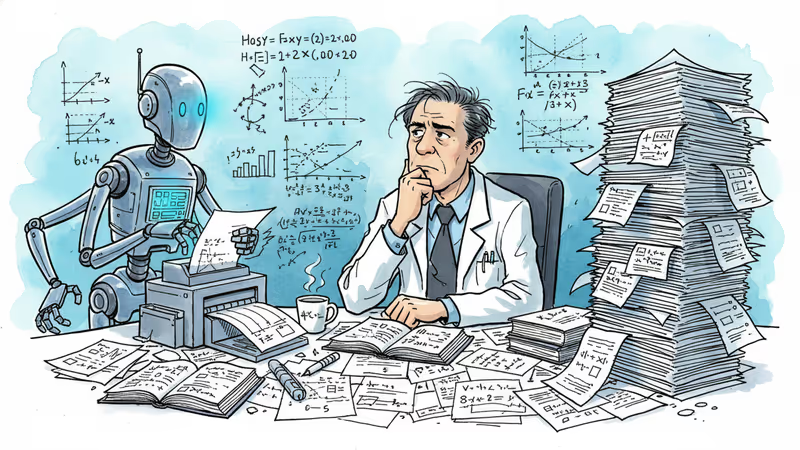
Scientists Get Their AI Assistant. But Who's Checking the Work?
OpenAI's new Prism tool promises to accelerate scientific research with GPT-5.2 integration. But as AI becomes a lab partner, questions about research integrity and human oversight loom large.
8.4 million scientific queries hit ChatGPT every week. Now OpenAI wants to give researchers their own dedicated workspace.
Launched Tuesday, Prism is an AI-enhanced word processor designed specifically for scientific papers. Deeply integrated with GPT-5.2, it can assess claims, revise prose, and search prior research. It won't do autonomous research, but it's designed to accelerate human scientists' work—much like Cursor and Windsurf transformed coding.
"I think 2026 will be for AI and science what 2025 was for AI and software engineering," said Kevin Weill, OpenAI's VP for Science, during the announcement.
The Early Evidence
The transformation is already underway. In mathematics, AI models have proven several long-standing Erdős problems by combining literature review with novel applications of existing techniques. While the significance remains hotly debated, it marks an early victory for AI-assisted formal verification.
More striking was a December statistics paper that used GPT-5.2 Pro to establish new proofs for a central axiom of statistical theory. Human researchers only prompted and verified the model's work. OpenAI celebrated this as a template for future human-AI collaboration, noting that "frontier models can help explore proofs, test hypotheses, and identify connections that might otherwise take substantial human effort to uncover."
Beyond the Hype: Practical Integration

Prism's real value lies in thoughtful product work on existing standards. It integrates with LaTeX, the open-source system used to format scientific papers, but goes significantly beyond most available LaTeX tools.
The program leverages GPT-5.2's visual capabilities to let researchers assemble diagrams from online whiteboard drawings—addressing a significant pain point with existing tools. But perhaps the most powerful feature combines AI capabilities with rigorous context management.
When users open a ChatGPT window through Prism, the model can access the full context of their research project, making responses more relevant and intelligent. As Weill explained, it's the same combination that made AI tools powerful in software engineering: "amazing models" plus "deep workflow integration."
The Bigger Questions
As AI becomes a standard research tool, fundamental questions emerge about scientific integrity and human oversight. The flood of scientific queries to consumer AI products suggests researchers are already heavily relying on these systems, often without the specialized safeguards that Prism promises.
The tool arrives as academic institutions grapple with AI's role in research. Unlike software engineering, where bugs can be caught and fixed, scientific errors can propagate through literature for years. The stakes are higher when AI assists in proving theorems or establishing statistical foundations.
OpenAI's emphasis on human verification is telling—the company clearly recognizes that autonomous AI research isn't ready for prime time. But as these tools become more sophisticated and user-friendly, the temptation to rely on them more heavily will only grow.
Authors
Related Articles

OpenAI has reorganized for the second time in a month, merging ChatGPT and Codex into a single agentic platform under president Greg Brockman's unified product leadership.

After two weeks of witnesses calling him a liar, OpenAI CEO Sam Altman testified in his own defense, claiming Elon Musk tried to kill the company twice.

Sam Nelson, 19, died after following ChatGPT's advice to mix Kratom and Xanax. His parents are suing OpenAI for wrongful death, raising urgent questions about AI trust, liability, and design.
OpenAI's new Daybreak initiative uses the Codex AI agent to find and patch security vulnerabilities before attackers do—putting it in direct competition with Anthropic's secretive Claude Mythos.
OpenAI has reorganized for the second time in a month, merging ChatGPT and Codex into a single agentic platform under president Greg Brockman's unified product leadership.
After two weeks of witnesses calling him a liar, OpenAI CEO Sam Altman testified in his own defense, claiming Elon Musk tried to kill the company twice.
Sam Nelson, 19, died after following ChatGPT's advice to mix Kratom and Xanax. His parents are suing OpenAI for wrongful death, raising urgent questions about AI trust, liability, and design.
OpenAI's new Daybreak initiative uses the Codex AI agent to find and patch security vulnerabilities before attackers do—putting it in direct competition with Anthropic's secretive Claude Mythos.
Thoughts
Share your thoughts on this article
Sign in to join the conversation