
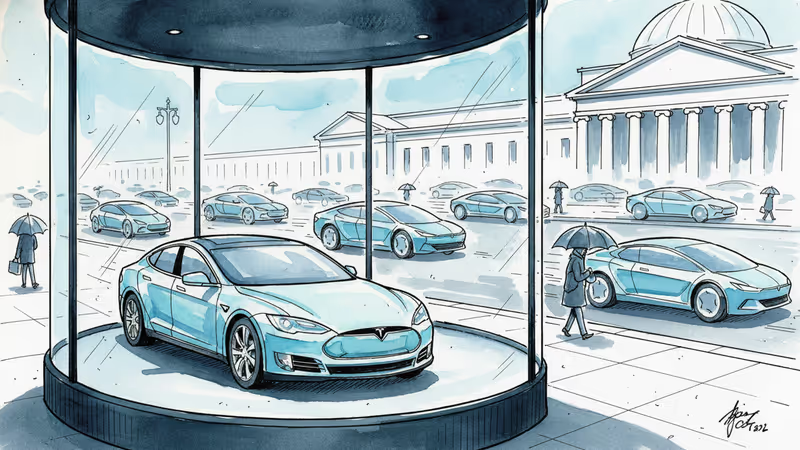
Tesla Model S Ends Its 14-Year Run: The First Chapter of the EV Revolution Closes
After 14 years, Tesla's Model S is ending production. We examine what the discontinuation of this EV pioneer means for the automotive industry and innovation cycles.
14 years. That's how long the Tesla Model S has been redefining what a car could be. Now, as its production run comes to an end, we're witnessing the close of the first chapter in the electric vehicle revolution.
When the Model S first rolled off production lines in 2012, the world looked vastly different. Facebook was acquiring Instagram. Apple launched the iPhone 5. Barack Obama cruised to his second term while Superstorm Sandy battered New York City, offering a stark reminder of climate change's growing threat. America was still recovering from the 2008 financial crisis, but cautious optimism filled the air as medium-sized tech companies seemed poised to tackle the world's biggest challenges.
Breaking the Electric Car Stereotype
Before the Model S, electric vehicles were glorified golf carts. Short range, inconvenient charging, awkward design – the whole package screamed "compromise." The Model S shattered every preconception.
With over 400 kilometers of range, sports car acceleration, and software updates that actually improved performance over time, it wasn't just an electric car – it was a computer on wheels. Traditional automakers, comfortable after a century of internal combustion dominance, suddenly found their paradigm under assault.
The ripple effects were immediate. General Motors fast-tracked the Bolt. Nissan expanded beyond the Leaf. Volkswagen launched its massive electrification program partly in response to Tesla's success. The Model S didn't just compete in the luxury sedan market; it created an entirely new category.
The Market Evolved, The Pioneer Aged
But 14 years in tech time is an eternity. The market the Model S created became crowded with formidable competitors. BMW's i7, Mercedes' EQS, and Lucid's Air Dream Edition all targeted the same affluent buyers who once had only Tesla as their electric luxury option.

More fundamentally, consumer preferences shifted. The sedan market – electric or otherwise – gave way to SUV dominance. Even Tesla recognized this, pouring resources into the Model Y and Cybertruck. The Model S remained an excellent vehicle, but it was no longer the center of Tesla's universe or the broader EV conversation.
Market data tells the story: Model S sales peaked around 2017-2018 at roughly 25,000 units annually in the US. By recent years, that number had dropped to around 10,000-15,000. Meanwhile, the Model Y became Tesla's volume seller, moving over 300,000 units annually in America alone.
What the Model S Actually Achieved
The Model S's true legacy isn't in sales figures – it's in proving the impossible possible. It demonstrated that electric vehicles could outperform gas cars, that software could be as important as hardware in automotive design, and that a startup could challenge century-old industrial giants.
This proof of concept enabled everything that followed. Elon Musk's other ventures – SpaceX, Neuralink, Starlink – gained credibility partly because the Model S showed that Musk's companies could deliver on seemingly impossible promises. The entire EV industry, now worth hundreds of billions, traces its modern roots to what Tesla proved with the Model S.
For investors, the Model S era represents a masterclass in market creation. Tesla's stock price has multiplied over 20 times since the Model S launch, driven largely by the market confidence this vehicle established.
The Innovation Lifecycle
What we're witnessing isn't just a product discontinuation – it's the natural evolution of innovation. Breakthrough products follow a predictable arc: they start as impossible dreams, become revolutionary realities, then gradually become ordinary as new innovations emerge to challenge them.
The Model S is entering the same historical category as the original iPhone, the first IBM PC, or the Ford Model T. These weren't just products; they were inflection points that redefined entire industries.
Authors
Related Articles
Waymo's new Ojai robotaxi isn't just a vehicle upgrade. It's the company's most serious attempt yet at cracking the cost problem that has kept autonomous vehicles from scaling. Here's what's really at stake.
Mercedes-AMG's new GT 4-door coupe packs three YASA axial flux motors producing 1,153 hp and 1,475 lb-ft of torque. Here's what it means for the EV performance race—and who actually wins.
Auto China 2026 set records with 1,451 vehicles and 181 world premieres. But the real story isn't the size—it's how Chinese automakers stopped competing on price and started competing on brains.
Expiring leases will flood the US used car market with over a million electric vehicles by 2028. Could this do what subsidies couldn't — make EVs genuinely affordable?
Waymo's new Ojai robotaxi isn't just a vehicle upgrade. It's the company's most serious attempt yet at cracking the cost problem that has kept autonomous vehicles from scaling. Here's what's really at stake.
Mercedes-AMG's new GT 4-door coupe packs three YASA axial flux motors producing 1,153 hp and 1,475 lb-ft of torque. Here's what it means for the EV performance race—and who actually wins.
Auto China 2026 set records with 1,451 vehicles and 181 world premieres. But the real story isn't the size—it's how Chinese automakers stopped competing on price and started competing on brains.
Expiring leases will flood the US used car market with over a million electric vehicles by 2028. Could this do what subsidies couldn't — make EVs genuinely affordable?
Thoughts
Share your thoughts on this article
Sign in to join the conversation