
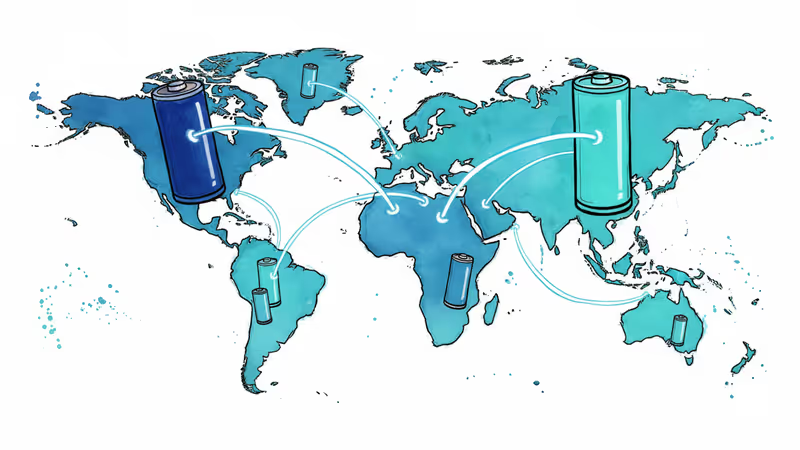
The Battery Wars Heat Up as EVs Hit Their Stride
As electric vehicles surge past 25% of global sales, new battery chemistries and geopolitical shifts are reshaping the industry landscape in unexpected ways.
25%. That's the share of global vehicle sales that went electric in 2025—a fivefold jump from just 5% in 2020. But behind these numbers lies a more complex story about the batteries powering this transformation, one that's reshaping entire industries and redrawing geopolitical maps.
The electric revolution isn't just about cars anymore. It's about who controls the technology that makes them possible, and that battle is heating up in ways few predicted.
The Sodium Surprise
While everyone's been watching lithium-ion batteries dominate the market, a quieter revolution has been brewing. Sodium-ion batteries—long dismissed as inferior—are finally getting their moment, driven by a simple economic reality: automakers are prioritizing cost over everything else.
The math is compelling. Sodium-ion batteries now cost around $59 per kilowatt-hour compared to $74 for the average lithium-ion cell. That's a significant gap, especially when you consider that lithium prices have been climbing in recent months after years of decline.
CATL, the world's largest battery manufacturer, recently began commercial production of sodium-ion cells and plans to launch its first EV using this chemistry by mid-2026. The catch? These batteries deliver shorter range, making them ideal for urban vehicles and scooters rather than long-distance cruisers.
But here's what's interesting: sodium's abundance could make it geopolitically neutral in ways lithium never will be. While lithium deposits concentrate power in specific regions, sodium is everywhere—literally extracted from seawater.
The Solid-State Gamble

Meanwhile, the industry's biggest bet remains on solid-state batteries, which promise to pack more energy into smaller packages by eliminating liquid electrolytes. Toyota has been promising these batteries since 2020, now targeting 2027-2028 for commercial launch.
Factorial Energy grabbed headlines with a Mercedes test vehicle that drove over 745 miles on a single charge. QuantumScape continues testing with automotive partners. Yet the same question persists: can anyone actually manufacture these at scale?
The answer might come through compromise. Semi-solid-state batteries—using gel electrolytes instead of fully solid ones—could bridge the gap. Chinese companies are particularly focused on this transitional technology, viewing it as a stepping stone rather than a destination.
China's Expanding Empire
The geopolitical dimension can't be ignored. CATL batteries powered more than one in three EVs made in 2025, and China just overtook Japan in global auto sales. This isn't just market share—it's infrastructure dominance.
CATL's $8.2 billion factory in Hungary will supply BMW and Mercedes-Benz, while Canada recently slashed import taxes on Chinese EVs from 100% to roughly 6%. Even as the US maintains trade barriers, Chinese battery technology is flowing into Western markets through automotive partnerships.
Emerging markets are becoming the new battlegrounds. Thailand and Vietnam each broke 100,000 annual EV sales in 2025, starting from virtually zero just years ago. Brazil could see EV sales double in 2026 as Volkswagen and BYD ramp up local production.
The American Exception
The US remains the outlier in this electric surge. 2026 marks the first full year without federal EV tax credits, creating a natural experiment in market demand. Early indicators suggest American consumers were more price-sensitive than many expected.
Yet there's a silver lining in an unexpected place: stationary storage. LG opened a massive LFP battery plant in Michigan in 2025, while SK On plans Georgia production later this year. These facilities target grid storage rather than vehicles, potentially offering a lifeline as the EV market faces headwinds.
Authors
Related Articles
Waymo's new Ojai robotaxi isn't just a vehicle upgrade. It's the company's most serious attempt yet at cracking the cost problem that has kept autonomous vehicles from scaling. Here's what's really at stake.
The Ferrari Luce is finally here — 1,000 hp, a 122 kWh battery, and an interior designed by the team behind the iPhone. But the real story is what Ferrari risked to build it.
Mercedes-AMG's new GT 4-door coupe packs three YASA axial flux motors producing 1,153 hp and 1,475 lb-ft of torque. Here's what it means for the EV performance race—and who actually wins.
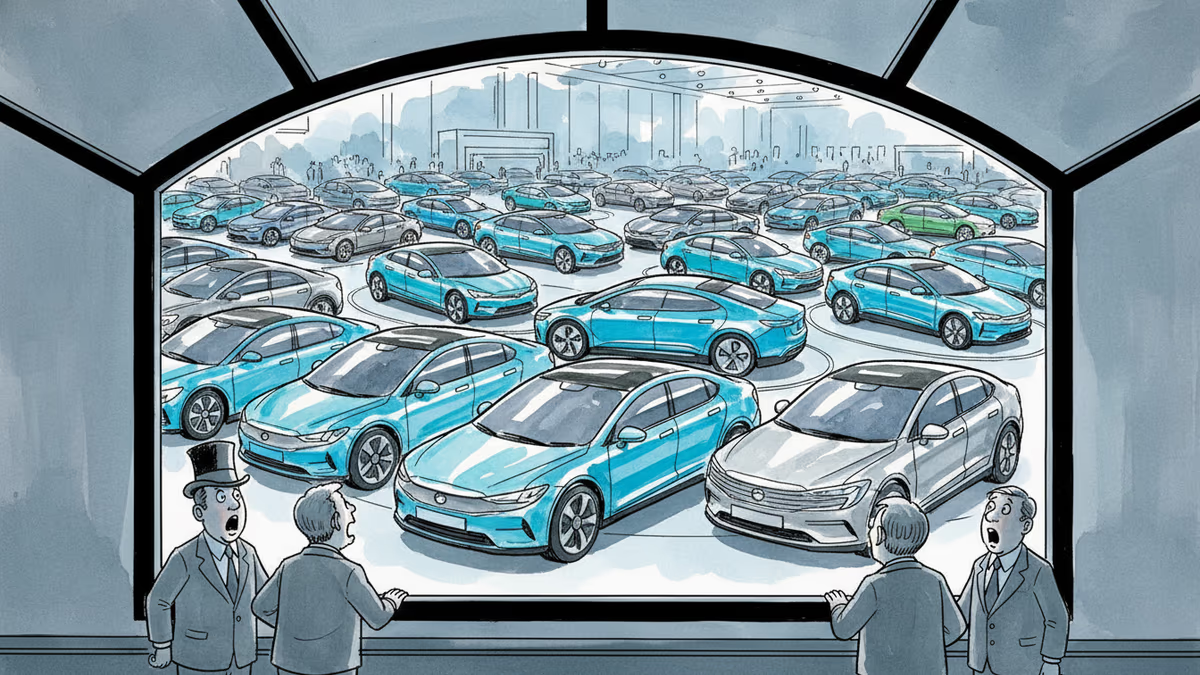
Auto China 2026 set records with 1,451 vehicles and 181 world premieres. But the real story isn't the size—it's how Chinese automakers stopped competing on price and started competing on brains.
Waymo's new Ojai robotaxi isn't just a vehicle upgrade. It's the company's most serious attempt yet at cracking the cost problem that has kept autonomous vehicles from scaling. Here's what's really at stake.
The Ferrari Luce is finally here — 1,000 hp, a 122 kWh battery, and an interior designed by the team behind the iPhone. But the real story is what Ferrari risked to build it.
Mercedes-AMG's new GT 4-door coupe packs three YASA axial flux motors producing 1,153 hp and 1,475 lb-ft of torque. Here's what it means for the EV performance race—and who actually wins.
Auto China 2026 set records with 1,451 vehicles and 181 world premieres. But the real story isn't the size—it's how Chinese automakers stopped competing on price and started competing on brains.
Thoughts
Share your thoughts on this article
Sign in to join the conversation