
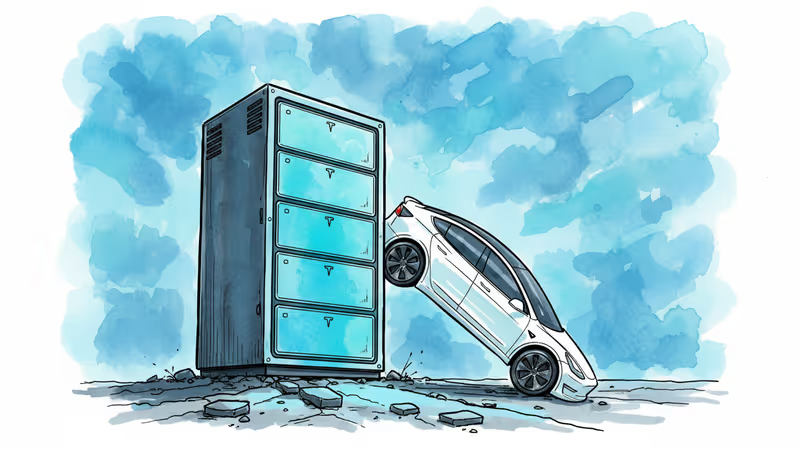
Tesla's Car Business Tanked, But Batteries Saved the Day
Tesla's 2025 profits fell 45% due to declining EV sales, but energy storage business delivered record growth with 48% increase in deployments
A car company almost killed by cars, saved by batteries. That's Tesla's 2025 story in a nutshell.
Tesla's profits plummeted 45% last year, driven largely by falling electric vehicle sales. Wall Street saw it coming, yet the company still beat earnings and revenue estimates. The secret weapon? Energy storage.
When Batteries Outshine Cars
The numbers tell the story. Tesla deployed a record 46.7 gigawatt-hours of energy storage products in 2025—a 48% jump from the previous year. Big stationary batteries like the Megapack and Powerwall, along with solar installations, now drive nearly a quarter of Tesla's gross profit.
Last quarter alone, the Megapack contributed $1.1 billion to the storage business's $3.8 billion in gross profit for the entire year. Storage and energy generation revenues climbed 26.5% to $12.8 billion.
Here's the kicker: those batteries and solar panels are far more profitable than cars. The energy business boasts a gross margin of 29.8%—nearly double what Tesla earns selling vehicles. Same company, vastly different economics.
The Pipeline Looks Even Better

Storage will likely play an even larger role going forward. Large energy storage projects operate on milestone-based revenue recognition, and Tesla expects to recognize $4.96 billion this year in deferred revenue from ongoing projects. That's more than double what the company recognized in 2025.
As AI infrastructure drives rapid load growth, Tesla sees opportunities for its energy storage products to stabilize grids, shift energy when needed most, and provide additional power capacity. While car sales stumble, data centers are booming.
Headwinds on the Horizon
It's not all smooth sailing. The One Big Beautiful Bill Act (OBBBA) phased out tax credits for residential energy storage systems like the Powerwall. Commercial tax credits for Megapack and Megablock products continue through the mid-2030s, but that's still a hit to the residential market.
Tariffs and OBBBA provisions also threaten to increase battery cell prices. Meanwhile, while sales volumes rose, the average selling price of a Megapack declined—suggesting intensifying competition in the energy storage market.
The Transformation Question
Tesla's pivot raises broader questions about how we categorize and value companies. Is Tesla still a car company? Or has it become an energy infrastructure play that happens to make vehicles?
The market seems to be figuring this out in real-time. Energy storage margins nearly double those of automotive, yet most analysts still focus primarily on vehicle delivery numbers. That disconnect might explain some of the volatility in Tesla's stock price.
The bigger question: In an era of rapid technological change, should investors focus more on a company's adaptability than its core competency?
Authors
Related Articles
Waymo's new Ojai robotaxi isn't just a vehicle upgrade. It's the company's most serious attempt yet at cracking the cost problem that has kept autonomous vehicles from scaling. Here's what's really at stake.
Mercedes-AMG's new GT 4-door coupe packs three YASA axial flux motors producing 1,153 hp and 1,475 lb-ft of torque. Here's what it means for the EV performance race—and who actually wins.
Auto China 2026 set records with 1,451 vehicles and 181 world premieres. But the real story isn't the size—it's how Chinese automakers stopped competing on price and started competing on brains.
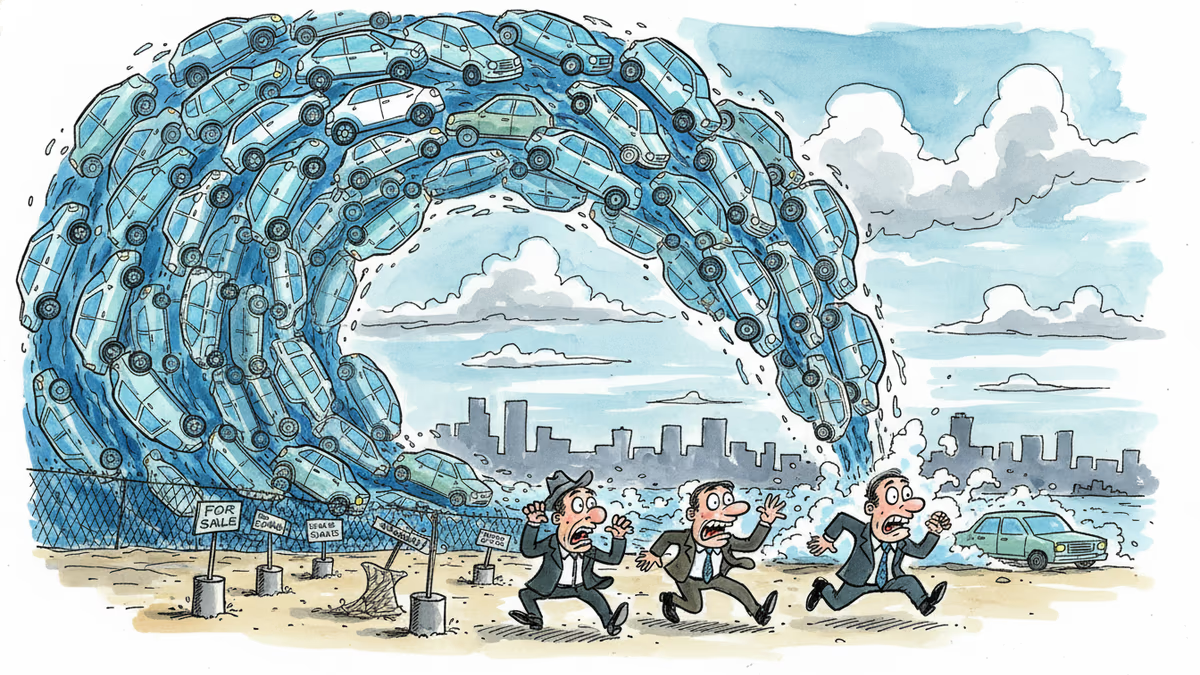
Expiring leases will flood the US used car market with over a million electric vehicles by 2028. Could this do what subsidies couldn't — make EVs genuinely affordable?
Waymo's new Ojai robotaxi isn't just a vehicle upgrade. It's the company's most serious attempt yet at cracking the cost problem that has kept autonomous vehicles from scaling. Here's what's really at stake.
Mercedes-AMG's new GT 4-door coupe packs three YASA axial flux motors producing 1,153 hp and 1,475 lb-ft of torque. Here's what it means for the EV performance race—and who actually wins.
Auto China 2026 set records with 1,451 vehicles and 181 world premieres. But the real story isn't the size—it's how Chinese automakers stopped competing on price and started competing on brains.
Expiring leases will flood the US used car market with over a million electric vehicles by 2028. Could this do what subsidies couldn't — make EVs genuinely affordable?
Thoughts
Share your thoughts on this article
Sign in to join the conversation