

The Bolt Is Back — And It's Rewriting the Budget EV Rulebook
The 2027 Chevy Bolt returns with LFP battery, 150kW charging, and Super Cruise under $30K. Here's what it means for the affordable EV market and who should care.
It was discontinued. Its fans mourned. GM brought it back anyway — and somehow made it better.
The 2027 Chevrolet Bolt starts at $28,995 all-in. That's the cheapest EV you can buy in the United States right now. But the price tag alone doesn't explain why this little hatchback matters more than it probably should.
What's Actually New
The body is borrowed from the Bolt EUV — GM's slightly larger variant — with revised front and rear styling. Nothing dramatic. The real story is under the skin.
The biggest change is the battery. The new 65 kWh pack uses lithium iron phosphate (LFP) chemistry, a first for an American automaker's mainstream EV. LFP drops the cobalt and nickel, cutting costs and eliminating the degradation problem that plagued previous Bolt owners. Those owners were told to cap daily charging at 80% to preserve battery health. With LFP, charging to 100% every single day is fine. That's not a minor quality-of-life improvement — for daily drivers, it's a fundamental change in how you live with the car.
Range actually increased despite the chemistry swap. The base LT trim is rated at 262 miles. That's 15 miles more than before, using a motor pulled from the front-wheel-drive Chevy Equinox EV — 200 horsepower, and slightly quicker to 60 mph than its predecessor.
The charging speed jump is the number that makes you do a double-take. The old Bolt maxed out at 50 kW — adding 200 miles took over an hour. The 2027 model accepts up to 150 kW, and GM claims 10% to 90% in 24 minutes. One journalist on the press drive briefly saw 157 kW at a Tesla Supercharger. The car now supports NACS, meaning Tesla's Supercharger network is open to it — plug-and-charge compatibility is coming later this year.
And then there's Super Cruise. Hands-free highway driving assistance, on a sub-$30K car. On a 14-mile test loop on the 101 outside Los Angeles, it handled afternoon traffic competently — automatic lane changes, no mirror-check required. It's not perfect (it occasionally got flustered by fast-approaching cars), but it works.
What's Missing

GM removed CarPlay and Android Auto from all its new vehicles. The Bolt is no exception. In their place: native Spotify and Apple Music apps. They function, but reviewers note they're less responsive than their CarPlay equivalents. For owners upgrading from the previous Bolt — which was one of GM's last EVs with screencasting — this will sting.
GM's defense is technically coherent: the Android Automotive-based infotainment integrates directly with the battery management system, navigation, and Super Cruise. That integration enables battery preconditioning before fast charging and seamless lane positioning before highway exits. You can't do that if Apple controls the screen. Whether that trade-off is worth it depends entirely on how much you rely on your phone's ecosystem — and how much you trust GM's maps.
The interior still has hard plastic surfaces. There's no under-seat foot room for front passengers. The trunk fits a few carry-ons, not much more. At $28,995, something had to give.
Why This Car Exists Right Now
The honest answer is: factory scheduling. GM had an 18-month production gap at its Fairfax, Kansas plant and needed something to fill it. Executives greenlit the Bolt revival. The plan is roughly two years of production, after which GM won't commit to another run.
But the timing lands in a market that's increasingly hostile to expensive EVs. Tesla has been cutting prices. Chinese automakers are circling. Federal EV incentives are politically uncertain. In that environment, a $29K electric car with 150kW charging and hands-free driving isn't just a factory filler — it's a statement about where the floor of the EV market is moving.
Three years ago, the combination of LFP chemistry, fast charging, and Level 2 driver assistance belonged to vehicles costing twice as much. The fact that it now fits in a subcompact under $30K changes the reference point for every EV buyer.
The Super Cruise version, however, requires a very specific options stack — LT + Comfort + Evotex + Tech + Super Cruise — pushing the price to $35,655. That's a $6,660 premium over the base, plus an OnStar subscription after the three-year trial ends. For long-haul commuters, the math might work. For everyone else, it's a feature to admire on spec sheets.
Who Should Actually Buy This
The people most likely to buy a 2027 Bolt already know they want one. They either owned the previous generation or have been waiting for something small, affordable, and genuinely capable. GM is essentially banking on that loyalty — and the limited production run creates a natural urgency.
For first-time EV buyers who don't need a large vehicle, the value proposition is hard to argue with. 262 miles of range, 24-minute charging, and the ability to use Tesla's Supercharger network covers most real-world use cases. The missing CarPlay is a genuine annoyance, not a dealbreaker.
For buyers cross-shopping with Tesla Model 3 (starts around $42,000) or Hyundai Ioniq 6 (starts around $39,000), the Bolt trades interior refinement and brand prestige for a $10,000–$13,000 price gap. That gap buys a lot of charging sessions.
Authors
Related Articles

Waymo's new Ojai robotaxi isn't just a vehicle upgrade. It's the company's most serious attempt yet at cracking the cost problem that has kept autonomous vehicles from scaling. Here's what's really at stake.
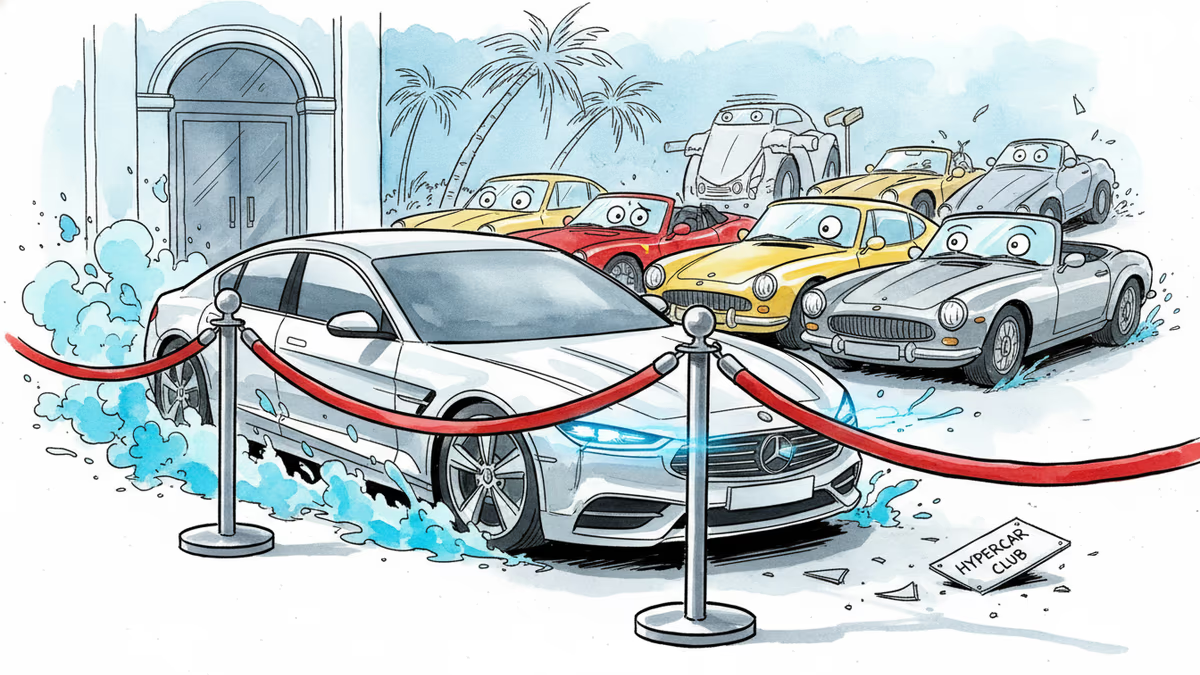
Mercedes-AMG's new GT 4-door coupe packs three YASA axial flux motors producing 1,153 hp and 1,475 lb-ft of torque. Here's what it means for the EV performance race—and who actually wins.
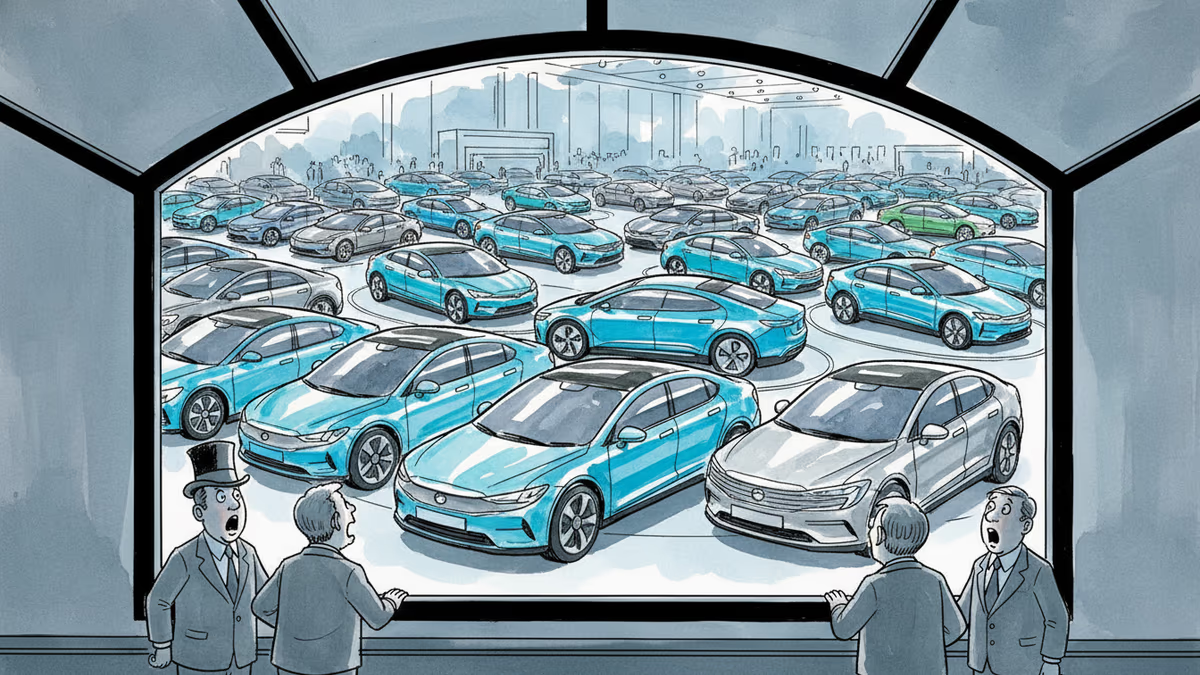
Auto China 2026 set records with 1,451 vehicles and 181 world premieres. But the real story isn't the size—it's how Chinese automakers stopped competing on price and started competing on brains.

Expiring leases will flood the US used car market with over a million electric vehicles by 2028. Could this do what subsidies couldn't — make EVs genuinely affordable?
Waymo's new Ojai robotaxi isn't just a vehicle upgrade. It's the company's most serious attempt yet at cracking the cost problem that has kept autonomous vehicles from scaling. Here's what's really at stake.
Mercedes-AMG's new GT 4-door coupe packs three YASA axial flux motors producing 1,153 hp and 1,475 lb-ft of torque. Here's what it means for the EV performance race—and who actually wins.
Auto China 2026 set records with 1,451 vehicles and 181 world premieres. But the real story isn't the size—it's how Chinese automakers stopped competing on price and started competing on brains.
Expiring leases will flood the US used car market with over a million electric vehicles by 2028. Could this do what subsidies couldn't — make EVs genuinely affordable?
Thoughts
Share your thoughts on this article
Sign in to join the conversation