
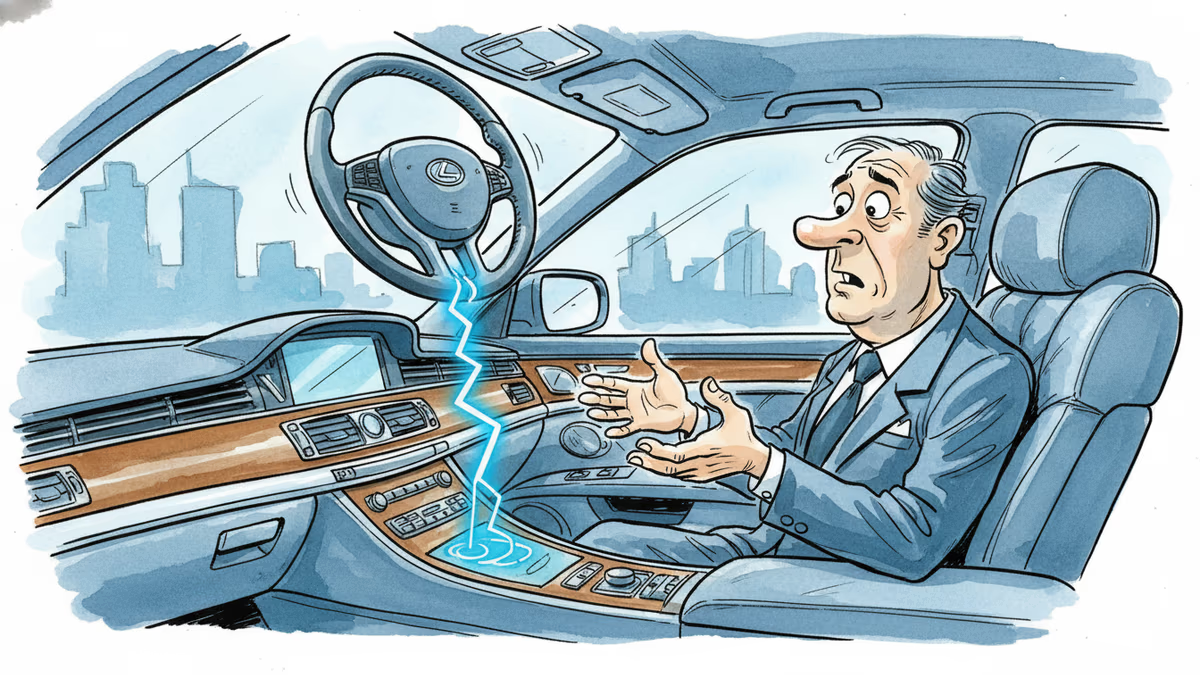
Mercedes Is Cutting the Cord Between Steering Wheel and Road
Mercedes-Benz is bringing steer-by-wire to the refreshed EQS sedan, eliminating the physical link between steering wheel and wheels. Here's what that actually means for drivers, safety, and the future of the car.
Turn the wheel, the tires follow. It's the most fundamental contract between driver and machine — and Mercedes-Benz is about to tear it up.
The German automaker has confirmed that its upcoming refreshed EQS sedan will feature steer-by-wire: a system that eliminates the physical mechanical linkage between the steering wheel and the wheels entirely. No more rack-and-pinion. No more steering column in the traditional sense. Instead, sensors read the driver's inputs and electronic actuators move the wheels in response. The whole thing runs on signals, not steel.
This Isn't New — Just New to Your Driveway
If this sounds familiar, it's because it already runs your flights. Modern commercial aircraft have used fly-by-wire systems since Airbus commercialized the technology in the 1980s. The pilot's stick inputs are converted to electrical signals; computers and actuators do the rest. It's now the industry standard in aviation, and the safety record speaks for itself.
In cars, the idea has been circling for years. Infiniti introduced a version on the Q50 back in 2013, and Lexus recently applied it to the RZ electric SUV. But those were early forays from brands looking to differentiate. When Mercedes — a company that has defined what a premium sedan should feel like for over a century — commits to the technology for its flagship EV, the signal is different in kind, not just degree.
Why the EQS, Why Now
The timing is not accidental. The auto industry is in the middle of a hard pivot toward Software Defined Vehicles — cars where software, not hardware, determines the driving experience. Steer-by-wire is one of the enabling technologies that makes that vision real.
Sever the mechanical link and suddenly the steering feel becomes a software parameter. Want a heavier, more connected feel on a mountain road? Lighter and more relaxed on the highway? Those become settings, not fixed physical properties. In a fully autonomous future, the steering wheel can retract entirely when the car is driving itself — something impossible with a physical column running through the dashboard.

The EV platform makes this cleaner too. Internal combustion cars were constrained by engine bay architecture that demanded a continuous mechanical steering axis. Electric vehicles carry no such baggage. The EQS, already built on a purpose-designed EV platform, is a natural fit.
The Questions Consumers Should Be Asking
None of this means the technology is without trade-offs.
The most immediate concern is safety redundancy. A mechanical steering system fails in ways that are slow and usually detectable — a worn tie rod, a leaking rack. An electronic system can fail fast and completely. Manufacturers address this with multiple redundant circuits and backup power systems, borrowing reliability standards from aerospace. But regulators in the US and Europe are still developing the frameworks to certify these systems at scale, and real-world edge cases remain an open question.
Then there's feel. Experienced drivers don't just steer with their hands — they read the road through them. The subtle vibration of a gravel patch, the tug of understeer approaching a limit, the feedback that tells you the front tires are working hard. Steer-by-wire systems replicate this artificially through haptic motors in the wheel. Lexus has received cautiously positive reviews for its implementation. Whether Mercedes can match or exceed that bar will be a central test of the technology's consumer viability.
Who Wins, Who Watches
For Mercedes, this is a statement about where it intends to compete. The EQS has faced pressure from Tesla, which has long operated without a traditional steering column architecture, and from a wave of Chinese EV brands that have moved aggressively into the luxury segment. Steer-by-wire is a differentiator — but more importantly, it's infrastructure for the software-defined future the company is betting on.
For suppliers, the shift reshapes the value chain. Traditional steering system manufacturers face a structural change in what they're selling. The mechanical complexity that justified premium pricing gives way to electronics and software — categories where different competitors hold the advantage.
For regulators, particularly in the US where NHTSA sets vehicle safety standards, the question is how quickly certification frameworks can keep pace with the technology. Europe faces a similar challenge. The gap between what engineers can build and what regulators have tested is not trivial.
Authors
Related Articles
Waymo's new Ojai robotaxi isn't just a vehicle upgrade. It's the company's most serious attempt yet at cracking the cost problem that has kept autonomous vehicles from scaling. Here's what's really at stake.
Mercedes-AMG's new GT 4-door coupe packs three YASA axial flux motors producing 1,153 hp and 1,475 lb-ft of torque. Here's what it means for the EV performance race—and who actually wins.
Auto China 2026 set records with 1,451 vehicles and 181 world premieres. But the real story isn't the size—it's how Chinese automakers stopped competing on price and started competing on brains.
Expiring leases will flood the US used car market with over a million electric vehicles by 2028. Could this do what subsidies couldn't — make EVs genuinely affordable?
Waymo's new Ojai robotaxi isn't just a vehicle upgrade. It's the company's most serious attempt yet at cracking the cost problem that has kept autonomous vehicles from scaling. Here's what's really at stake.
Mercedes-AMG's new GT 4-door coupe packs three YASA axial flux motors producing 1,153 hp and 1,475 lb-ft of torque. Here's what it means for the EV performance race—and who actually wins.
Auto China 2026 set records with 1,451 vehicles and 181 world premieres. But the real story isn't the size—it's how Chinese automakers stopped competing on price and started competing on brains.
Expiring leases will flood the US used car market with over a million electric vehicles by 2028. Could this do what subsidies couldn't — make EVs genuinely affordable?
Thoughts
Share your thoughts on this article
Sign in to join the conversation