
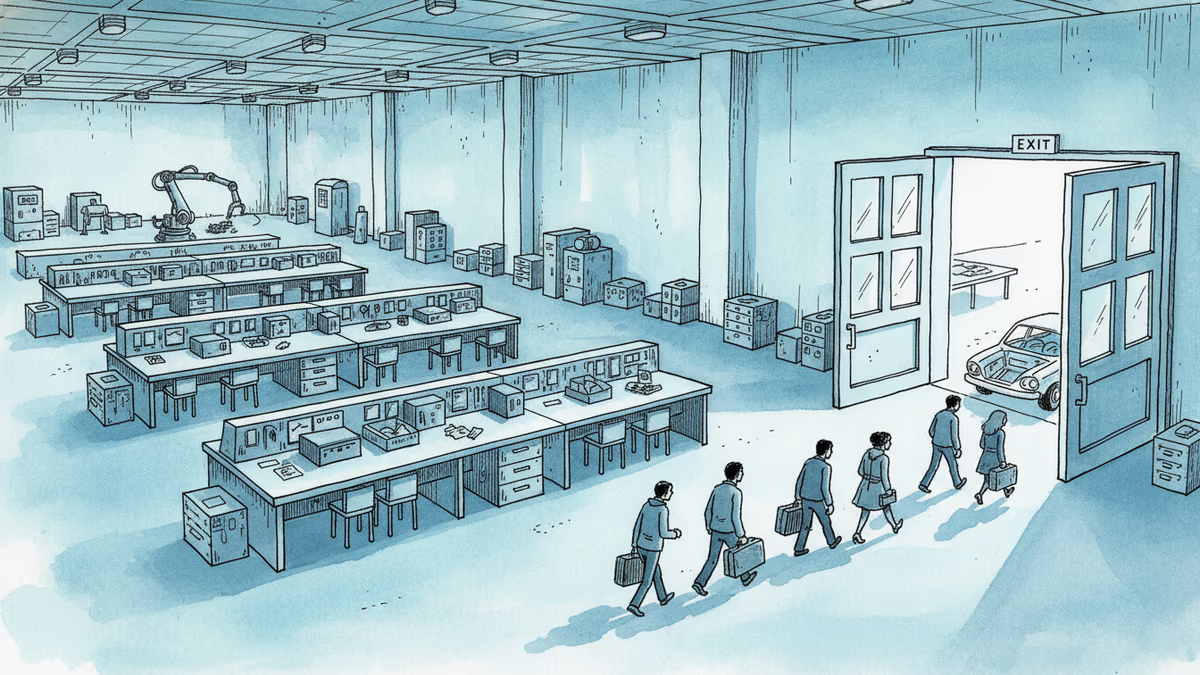
Tesla's Texas Megafactory Lost 22% of Its Workforce in a Year
Tesla's Austin gigafactory shed 4,685 workers in 2025—a 22% drop—even as its global headcount grew. What does this tell us about the future of EV manufacturing?
4,685 people. That's how many workers disappeared from Tesla's flagship Texas factory in a single year—and the company still hasn't explained exactly where they went.
The Numbers That Don't Quite Add Up
According to a compliance report obtained by the Austin American-Statesman, Tesla's gigafactory outside Austin employed 21,191 people in 2024. By 2025, that number had fallen to 16,506—a drop of 22% in twelve months.
Here's the twist: Tesla's global workforce didn't shrink. It grew. SEC filings show the company added nearly 9,000 employees worldwide over the same period, going from 125,665 to 134,785. So workers are being added somewhere—just not in Austin.
The company hasn't disclosed which teams were hit hardest or whether the reduction came from layoffs, attrition, or transfers. That silence is doing a lot of work right now.
Context: A Factory Built on Big Bets
The Austin gigafactory isn't just any plant. Elon Musk relocated Tesla's headquarters there in 2021, before the facility even opened. Since then, the company has poured more than $6.3 billion into the site. It became one of the largest employers in the Austin metro area almost overnight.
But the factory's expansion coincided with Tesla's sales peak—and the company has now posted two consecutive years of declining sales. The Model X and Model S are being phased out. The next big bet is the Cybercab, an autonomous robotaxi that represents a fundamentally different kind of vehicle and a fundamentally different kind of manufacturing challenge.
Three Ways to Read the Workforce Drop

The 22% figure is striking, but its meaning depends entirely on interpretation.
The most straightforward reading: fewer cars sold means fewer workers needed to build them. Production adjustments follow demand. That's manufacturing 101.
A more unsettling reading: Tesla has been openly testing its humanoid robot, Optimus, on actual production lines at the Austin facility. If automation is absorbing tasks previously done by humans, the workforce reduction may not be a temporary dip—it could be a structural shift that doesn't reverse when sales recover.
A third possibility: Tesla is quietly rebalancing its business mix. Its energy division has been growing faster than its automotive segment for several quarters. A company pivoting toward software, energy storage, and autonomous services needs a different workforce profile than one focused on stamping out sedans at scale.
All three explanations could be true simultaneously. That's what makes this hard to read.
Who's Watching—and Why It Matters
For Tesla investors, the divergence between factory headcount and global headcount raises a pointed question about capital allocation. Is the company getting leaner and smarter in Austin, or is it losing operational focus?
For EV competitors—GM, Ford, Rivian, Hyundai—the signal cuts both ways. If Tesla's production footprint is contracting, that's a potential opening. But if the contraction is driven by automation that competitors haven't yet matched, the gap could widen in Tesla's favor once demand returns.
For Austin's labor market, the stakes are more immediate. Tesla was supposed to be an anchor employer for the region's working class—a counterweight to the tech sector's volatility. Losing nearly 5,000 jobs at a single site in a single year is a significant local economic event, regardless of what's happening at the corporate level.
And for policymakers thinking about the future of American manufacturing, this is exactly the scenario they've been warned about: a flagship domestic factory, subsidized and celebrated, quietly shedding the kind of jobs it was supposed to create.
Authors
Related Articles
Waymo's new Ojai robotaxi isn't just a vehicle upgrade. It's the company's most serious attempt yet at cracking the cost problem that has kept autonomous vehicles from scaling. Here's what's really at stake.
SpaceX's IPO filing puts AI at the center, claiming a $26.5 trillion market opportunity. But can Grok compete with OpenAI and Anthropic for enterprise customers?
SpaceX filed a nearly 400-page S-1 with the SEC, targeting an IPO as early as June 12. Here's what the filing reveals—and what it doesn't.
SpaceX has filed its S-1 with the SEC, targeting the Nasdaq under ticker SPCX. With $18.67B in revenue but a $4.9B loss, the IPO forces investors to answer one hard question.
Waymo's new Ojai robotaxi isn't just a vehicle upgrade. It's the company's most serious attempt yet at cracking the cost problem that has kept autonomous vehicles from scaling. Here's what's really at stake.
SpaceX's IPO filing puts AI at the center, claiming a $26.5 trillion market opportunity. But can Grok compete with OpenAI and Anthropic for enterprise customers?
SpaceX filed a nearly 400-page S-1 with the SEC, targeting an IPO as early as June 12. Here's what the filing reveals—and what it doesn't.
SpaceX has filed its S-1 with the SEC, targeting the Nasdaq under ticker SPCX. With $18.67B in revenue but a $4.9B loss, the IPO forces investors to answer one hard question.
Thoughts
Share your thoughts on this article
Sign in to join the conversation