
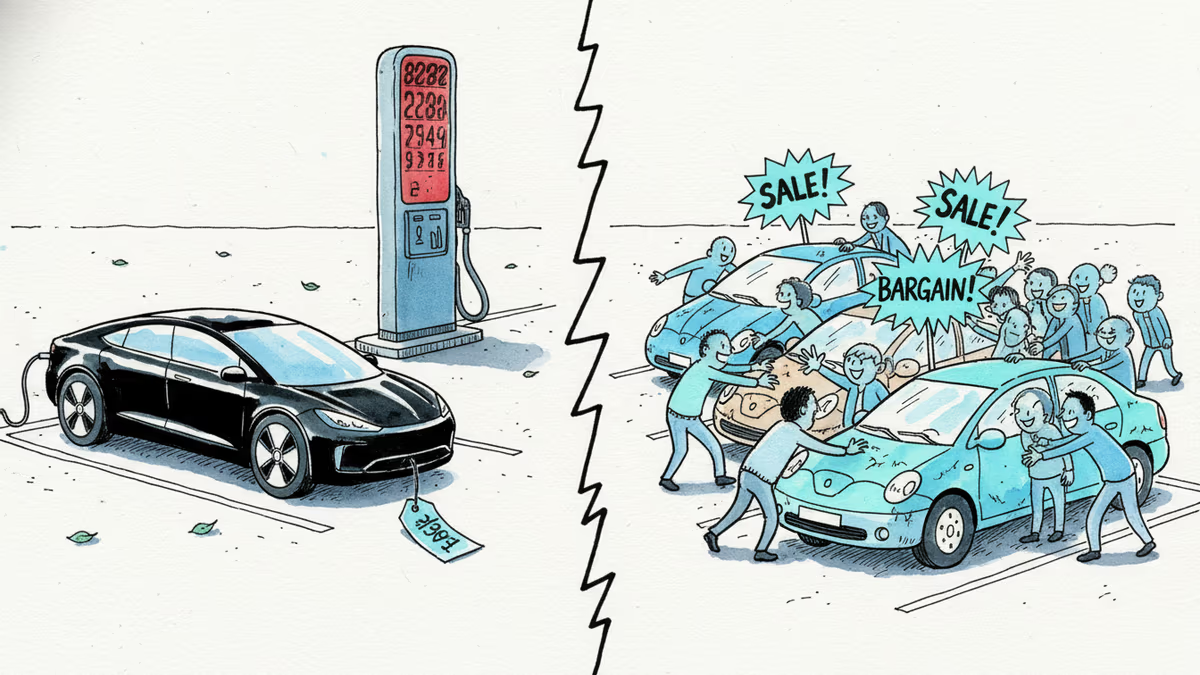
New EVs Are Tanking. Used EVs Are Booming. Here's Why Both Are True.
New EV sales dropped 28% in Q1 2026 after the $7,500 tax credit was axed. Used EV sales jumped 12%. The same market, the same quarter, two completely opposite stories.
The $7,500 is gone. And the EV market just split in two.
The Tax Credit Disappears — and the Market Fractures
When the Trump administration eliminated the federal $7,500 consumer tax credit for electric vehicles, the assumption was simple: EV sales would fall. That assumption was half right.
New EV sales in Q1 2026 dropped 28% year-over-year, according to Cox Automotive. That's not a dip — that's a collapse. Overnight, buying a new electric vehicle got $7,500 more expensive, and consumers responded the way consumers do: they walked away.
But here's what nobody quite predicted. Used EV sales went the other direction. Up 12% compared to the same quarter last year. Up 17% from Q4 2025 alone. The market didn't shrink — it shifted.
Two Accelerants, One Boom
Two forces converged to supercharge the used EV market, and neither one planned it this way.
The first is gas prices. The national average is now above $4 a gallon, a level that historically nudges cost-conscious drivers toward alternatives. Consumers still want to escape the pump — they just can't afford a new Tesla or Rivian to do it. So they're looking at used.
The second force is structural, and it's arguably more significant. EV leases were enormously popular in the early 2020s, partly because lease arrangements allowed buyers to capture federal tax credits that wouldn't have applied to outright purchases. Those leases — signed in 2022, 2023 — are now expiring. Hundreds of thousands of relatively young, well-maintained used EVs are flooding the market at once. By the end of 2026, EVs will represent 15% of all off-lease vehicles entering the used market, up from 7.7% in Q1, the Financial Times reported.

More supply pushes prices down. Average used EV price: $34,821. Average used gas equivalent: $33,487. For the first time in the EV era, price parity between used electric and used combustion vehicles is essentially here.
Who's Winning, Who's Watching Nervously
For consumers, this is a genuine opening. The used EV market now offers something that was hard to find even two years ago: a reasonably priced electric vehicle that doesn't require a leap of faith on price. The math on fuel savings starts working at these price points.
For automakers, the picture is more complicated. GM, Ford, Tesla, and the Korean giants Hyundai and Kia all took hits on new EV volume. But a used EV market that pulls in first-time EV buyers is also a pipeline. Someone who buys a used Chevy Equinox EV today might be the customer who buys a new one in five years — if the experience is good.
For dealers, the used EV surge is a double-edged opportunity. Margins on used vehicles are typically higher than new, but EVs bring new complications: battery health assessments, charging infrastructure questions, and consumer anxiety about range degradation that doesn't exist with used gas cars.
For policymakers who supported the tax credit, the data presents an uncomfortable question. If used EV sales are booming without any direct subsidy, was the $7,500 new-vehicle credit the most efficient way to accelerate adoption in the first place? Or was it primarily a subsidy for buyers who could already afford new cars?
The Structural Shift Underneath
What's happening isn't just a market blip — it reflects a maturation of the EV ecosystem. When a technology moves from "early adopter luxury" to "used car lot staple," that's a different kind of milestone than a flashy product launch.
The lease-return wave will continue through 2026 and into 2027. That means more inventory, continued price pressure, and a growing population of Americans whose first EV experience comes through the used market rather than a showroom. That changes the product expectations, the service requirements, and eventually the political constituency around EV policy.
It also raises real questions about battery longevity at scale. A used EV sold today might have 60,000 to 80,000 miles on it and a battery that's never been independently assessed. The infrastructure for used EV battery certification — the equivalent of a Carfax for kilowatt-hours — barely exists yet.
Authors
Related Articles
Waymo's new Ojai robotaxi isn't just a vehicle upgrade. It's the company's most serious attempt yet at cracking the cost problem that has kept autonomous vehicles from scaling. Here's what's really at stake.
Mercedes-AMG's new GT 4-door coupe packs three YASA axial flux motors producing 1,153 hp and 1,475 lb-ft of torque. Here's what it means for the EV performance race—and who actually wins.
Auto China 2026 set records with 1,451 vehicles and 181 world premieres. But the real story isn't the size—it's how Chinese automakers stopped competing on price and started competing on brains.
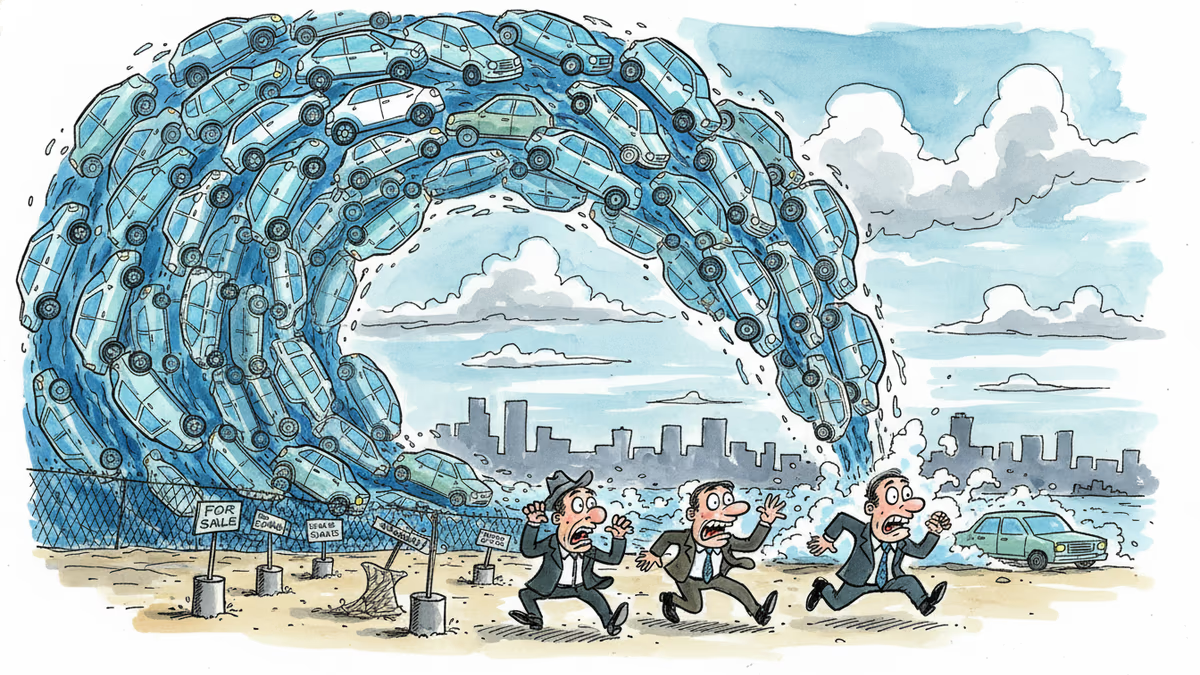
Expiring leases will flood the US used car market with over a million electric vehicles by 2028. Could this do what subsidies couldn't — make EVs genuinely affordable?
Waymo's new Ojai robotaxi isn't just a vehicle upgrade. It's the company's most serious attempt yet at cracking the cost problem that has kept autonomous vehicles from scaling. Here's what's really at stake.
Mercedes-AMG's new GT 4-door coupe packs three YASA axial flux motors producing 1,153 hp and 1,475 lb-ft of torque. Here's what it means for the EV performance race—and who actually wins.
Auto China 2026 set records with 1,451 vehicles and 181 world premieres. But the real story isn't the size—it's how Chinese automakers stopped competing on price and started competing on brains.
Expiring leases will flood the US used car market with over a million electric vehicles by 2028. Could this do what subsidies couldn't — make EVs genuinely affordable?
Thoughts
Share your thoughts on this article
Sign in to join the conversation