
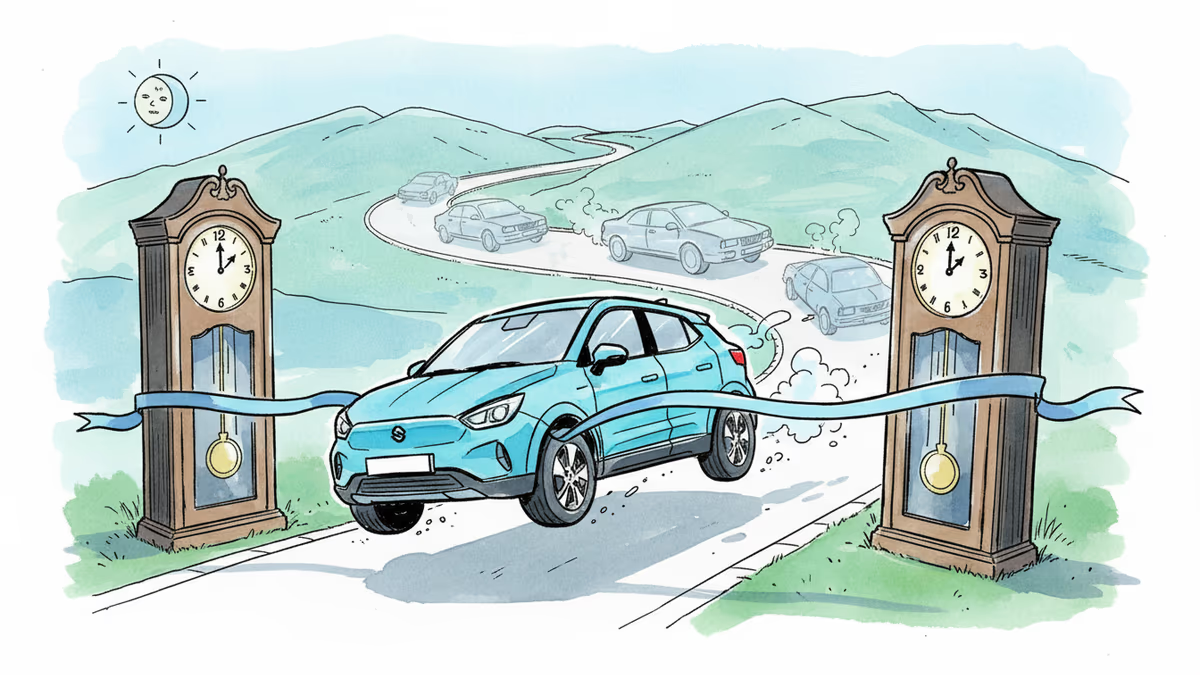
Rivian Said Spring. It Meant Spring.
Rivian's R2 Performance SUV starts deliveries this spring at $57,990 — 330 miles of range, 656 hp, and a rare thing in the EV world: an on-time launch.
In the EV industry, launching on time is its own achievement.
The Cybertruck took four years from reveal to production. Fisker filed for bankruptcy before most customers got their cars. Canoo never really got started. Against that backdrop, Rivian doing exactly what it said — unveiling the R2 in 2024, delivering it in spring 2025 — isn't just a product story. It's a credibility story.
What You Get for $57,990
Rivian is opening R2 sales with the Performance trim, following the standard industry playbook: lead with the high-margin variant, then broaden the market with more affordable versions later. The launch price is $57,990, plus a $1,495 delivery charge.
The specs hold up at that price point. An 87.9 kWh battery pack delivers up to 330 miles (531 km) of range. The dual-motor AWD powertrain puts out 656 hp (489 kW) and 609 lb-ft (825 Nm) of torque. DC fast charging takes the battery from 10 to 80 percent in 29 minutes.
The Performance trim adds semi-active suspension, a rear window that drops into the tailgate (a neat trick for loading cargo), birch wood interior accents, heated and ventilated front seats, heated rear seats, a nine-speaker audio system, and matrix LED headlights. There's also a small flashlight built into the door panel — the kind of detail that signals Rivian is still designing for people who actually go outside, not just people who want to look like they do.
Why This Launch Matters Beyond the Specs

Rivian's existing lineup — the R1T pickup and R1S SUV — targets buyers willing to spend $70,000 to $100,000+. That's a narrow slice of the market. The R2 is Rivian's first real attempt at volume. At under $60,000, it competes in the segment where most EV buyers actually shop.
The timing is pointed. Tesla's brand has taken hits from Elon Musk's political visibility, and a segment of buyers who were once default-Tesla shoppers are now actively looking elsewhere. Rivian — with its outdoor-lifestyle identity and reputation for build quality — is well-positioned to absorb some of that drift.
But Rivian is also still burning cash. The Amazon delivery van contract and a major joint venture with Volkswagen have helped stabilize the balance sheet, but the company needs R2 to sell in real numbers. Getting the car out the door on schedule was step one. Selling enough of them is the harder part.
Who's Watching Nervously
Ford's Mustang Mach-E and Hyundai's Ioniq 5 both occupy similar territory — mid-$50,000 electric SUVs with strong range and brand recognition. The R2 Performance matches or beats both on power output, and Rivian's over-the-air software updates and charging network have matured considerably since the R1 launch.
General Motors and Stellantis are watching too. Both have struggled to find an EV identity that resonates with buyers in the way Rivian's outdoor-adventure positioning has. If R2 finds its audience, it validates a branding approach that neither legacy automaker has convincingly replicated.
For consumers, the competitive pressure is straightforwardly good news. More credible options at this price point mean better deals, faster iteration, and less tolerance for vaporware launches.
Authors
Related Articles
Waymo's new Ojai robotaxi isn't just a vehicle upgrade. It's the company's most serious attempt yet at cracking the cost problem that has kept autonomous vehicles from scaling. Here's what's really at stake.
Mercedes-AMG's new GT 4-door coupe packs three YASA axial flux motors producing 1,153 hp and 1,475 lb-ft of torque. Here's what it means for the EV performance race—and who actually wins.
Auto China 2026 set records with 1,451 vehicles and 181 world premieres. But the real story isn't the size—it's how Chinese automakers stopped competing on price and started competing on brains.
Expiring leases will flood the US used car market with over a million electric vehicles by 2028. Could this do what subsidies couldn't — make EVs genuinely affordable?
Waymo's new Ojai robotaxi isn't just a vehicle upgrade. It's the company's most serious attempt yet at cracking the cost problem that has kept autonomous vehicles from scaling. Here's what's really at stake.
Mercedes-AMG's new GT 4-door coupe packs three YASA axial flux motors producing 1,153 hp and 1,475 lb-ft of torque. Here's what it means for the EV performance race—and who actually wins.
Auto China 2026 set records with 1,451 vehicles and 181 world premieres. But the real story isn't the size—it's how Chinese automakers stopped competing on price and started competing on brains.
Expiring leases will flood the US used car market with over a million electric vehicles by 2028. Could this do what subsidies couldn't — make EVs genuinely affordable?
Thoughts
Share your thoughts on this article
Sign in to join the conversation