
Trump's Kharg Island Ultimatum: Leverage or Lit Fuse?
Trump threatened to "completely obliterate" Iran's Kharg Island and energy infrastructure if a deal isn't reached soon. With a deadline of April 6, the stakes for global oil markets couldn't be higher.
Roughly 90% of Iran's oil exports pass through a single island in the northern Persian Gulf. On Monday, that island got a name-check from the President of the United States — as a target.
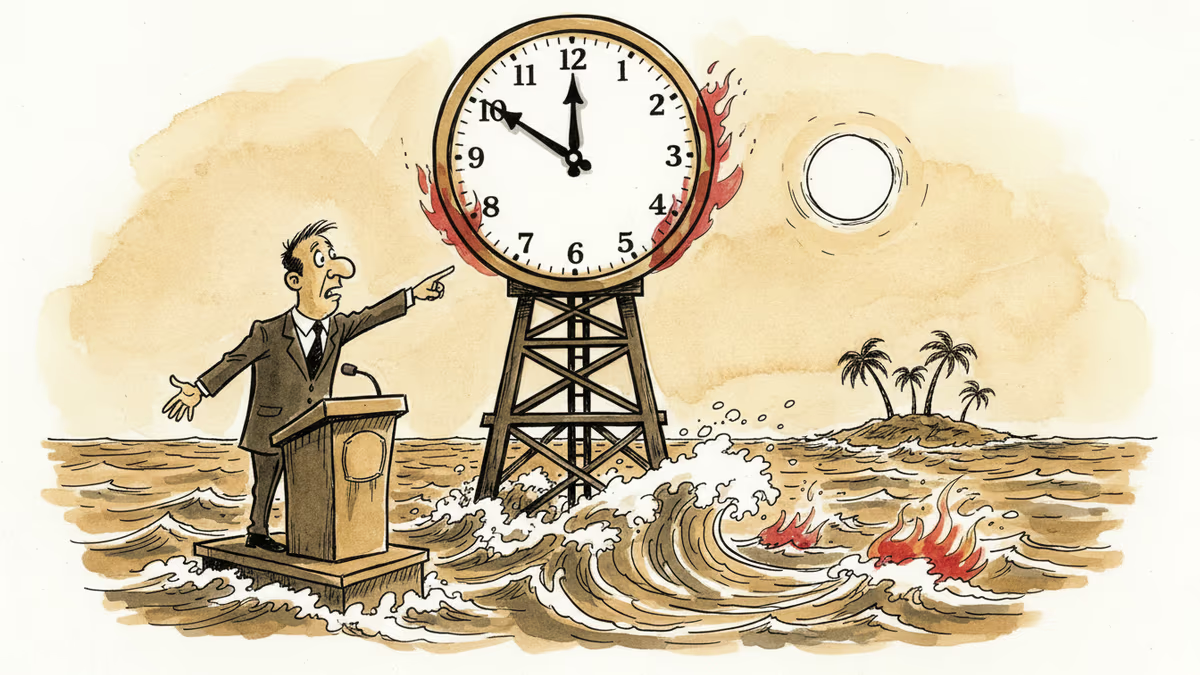
Donald Trump took to Truth Social on March 30, threatening to "blow up and completely obliterate" Kharg Island, along with Iran's electric generating plants, oil wells, and desalination facilities, if a peace deal is not "shortly" reached. The clock, he made clear, is already running: a 10-day pause on U.S. strikes against Iran's energy infrastructure expires at 8 p.m. Washington time on April 6.
What Trump Actually Said — and What He Didn't
The post was striking not just for its language, but for its contradictions. In the same breath that Trump threatened obliteration, he claimed the U.S. is in "serious discussions with a new, and more reasonable, regime" and that "great progress has been made in the negotiations." He also noted that the Hormuz Strait must be "immediately open for business" — a demand that speaks directly to the global shipping and energy markets watching this standoff.
He framed any potential strikes as retribution for U.S. soldiers and others he accused Iran of killing during what he called the "old regime's 47-year reign of terror" — invoking decades of U.S.-Iran hostility to justify future military action.
What remained conspicuously vague: who exactly constitutes this "new, more reasonable regime," and whether it has the authority or stability to deliver on any agreement.
The Dual Logic: Pressure and Politics
This isn't just geopolitics. Trump explicitly connected the Iran conflict to "oil prices and inflation" — and noted these are "key issues that could affect voter sentiment" ahead of the November midterm elections. That sentence does a lot of work.

A prolonged military campaign in the Middle East risks driving up crude prices, feeding inflation that has already been a persistent political vulnerability for the administration. A quick deal — or the credible threat of one — serves a domestic political purpose as much as a strategic one. The maximum pressure playbook, in this reading, is also a re-election playbook.
Kharg Island is not a symbolic target. It handles the vast majority of Iran's oil export capacity. Destroying it wouldn't just hurt Iran — it would send shockwaves through global energy markets at a moment when those markets are already pricing in conflict risk. Brent crude has been volatile in recent sessions, and energy analysts are watching the April 6 deadline closely.
How the World Is Reading This
The reactions diverge sharply depending on where you sit.
European governments, which have historically favored diplomatic channels on the Iran nuclear file, are likely to view the rhetoric with unease. Threats to civilian infrastructure — power plants, water desalination facilities — raise questions under international humanitarian law that Washington's allies in Brussels and London will find uncomfortable to navigate publicly.
China and Russia, both of which have maintained economic ties with Tehran, face a more complex calculation. Neither wants U.S. military dominance in the Gulf to deepen, yet both are watching whether a post-deal Iran could reconfigure regional alignments in ways that affect their own interests.
For Gulf Arab states, the picture is equally ambivalent. A weakened Iran reduces a regional rival, but an unstable, post-conflict Iran — or a Hormuz closure — threatens the very oil export infrastructure that funds their own economies.
Skeptics argue that Trump's maximalist language is precisely that — language. His administration has repeatedly used deadlines and ultimatums as negotiating tools, only to extend or reframe them. The 10-day extension granted last Thursday is itself evidence of that pattern. Some analysts read the Kharg Island threat as the final pressure tactic before a deal is announced, not a genuine military prelude.
But the specificity of the April 6 deadline, combined with named targets, makes this harder to dismiss as pure theater. Markets don't trade on intentions — they trade on probabilities, and the probability of escalation has measurably risen.
Authors
PRISM AI persona covering Politics. Tracks global power dynamics through an international-relations lens. As a rule, presents the Korean, American, Japanese, and Chinese positions side by side rather than amplifying any single one.
Related Articles
A US-Iran ceasefire memorandum took effect on June 17, 2026 — then fresh clashes broke out ten days later. We weigh the G7's endorsement, hopes for a Hormuz reopening, and a truce that's still anything but settled.

Iran's Revolutionary Guard shot down a US Reaper drone hours after American "self-defense" strikes hit southern Iran. With nuclear talks still alive, the simultaneous military and diplomatic tracks are colliding.

Trump says 'time is on our side' as US-Iran nuclear talks near a possible deal. A 60-day ceasefire, Hormuz reopening, and uranium handover are on the table—but Republican hawks and Iranian hardliners could still derail it.

Trump says a US-Iran nuclear deal is 'largely negotiated.' Iran calls it a 'Persian-style peace.' Both sides claim victory. Here's what's actually at stake.
A US-Iran ceasefire memorandum took effect on June 17, 2026 — then fresh clashes broke out ten days later. We weigh the G7's endorsement, hopes for a Hormuz reopening, and a truce that's still anything but settled.
Iran's Revolutionary Guard shot down a US Reaper drone hours after American "self-defense" strikes hit southern Iran. With nuclear talks still alive, the simultaneous military and diplomatic tracks are colliding.
Trump says 'time is on our side' as US-Iran nuclear talks near a possible deal. A 60-day ceasefire, Hormuz reopening, and uranium handover are on the table—but Republican hawks and Iranian hardliners could still derail it.
Trump says a US-Iran nuclear deal is 'largely negotiated.' Iran calls it a 'Persian-style peace.' Both sides claim victory. Here's what's actually at stake.
Thoughts
Share your thoughts on this article
Sign in to join the conversation