
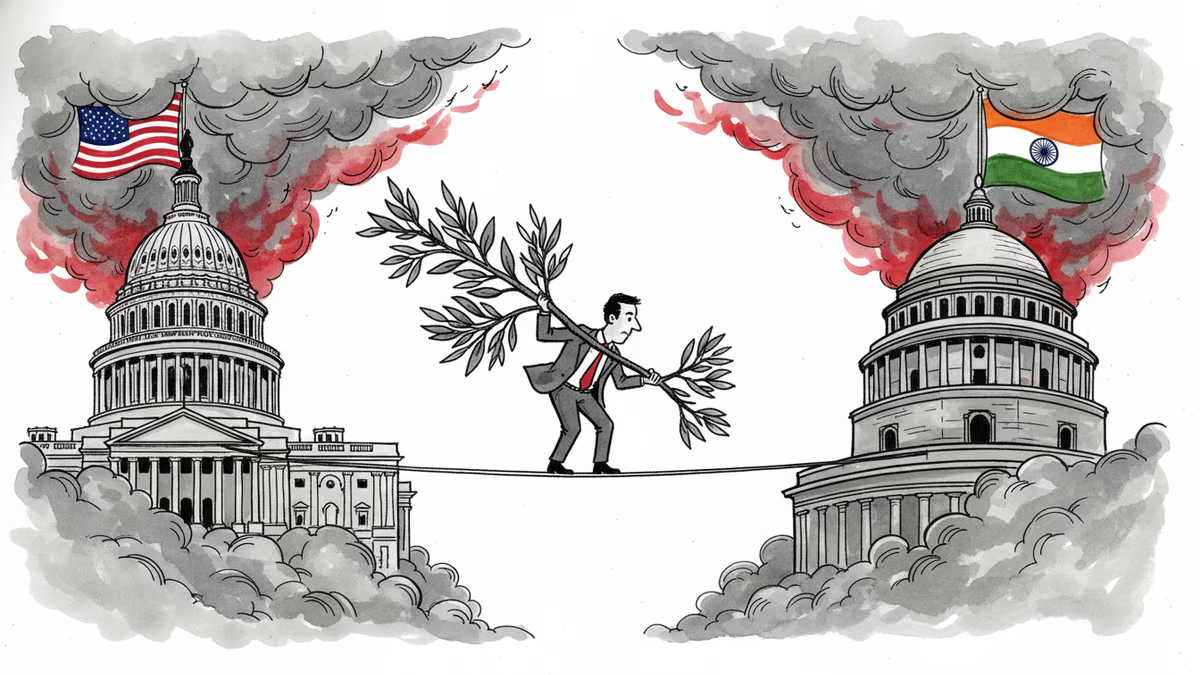
Rubio Lands in India, But the Welcome Mat Has Wrinkles
Marco Rubio visits India for four days amid trade friction, Pakistan tensions, and strategic drift. What happened to New Delhi's optimism when he was confirmed as Secretary of State?
When Marco Rubio was confirmed as Secretary of State, New Delhi quietly celebrated. Here, finally, was a man who had spent years in the Senate championing India and hammering China. Surely the relationship was about to enter a new chapter.
That was the theory. The practice, as Rubio touches down for a four-day sweep through Kolkata, Agra, Jaipur, and New Delhi, looks considerably messier.
The Gap Between Expectation and Reality
The friction isn't about Rubio personally. It's about the broader logic of Trump's second-term foreign policy — one that mixes strategic rhetoric with transactional pressure, often in the same breath.
Washington has been quietly rehabilitating its relationship with Pakistan, a move that sets off alarm bells in New Delhi every time it happens. On Afghanistan, US signals have diverged from Indian preferences. And on trade, the Trump administration's tariff regime spared few countries — India included. Telling a partner that they're strategically indispensable while simultaneously squeezing them on market access creates a credibility problem that no amount of goodwill visits can easily fix.
Then there's the structural deadlock that has quietly calcified over the past year. The US wants India to reduce its dependence on Russian oil and phase down its reliance on Russian weapons systems — a legacy of decades of Soviet-era procurement. India's answer, consistent and firm, is that strategic autonomy isn't negotiable. As the war in Ukraine grinds on, this gap hasn't narrowed. If anything, it has widened.
Why This Visit, Why Now
The timing carries weight. India and Pakistan have seen renewed tensions over Kashmir in recent weeks — a fault line that never fully goes dormant. Rubio's itinerary almost certainly includes messaging aimed at de-escalation, with Washington once again positioning itself as a stabilizing force in South Asia.

But the deeper purpose is structural. The Quad — the security grouping of the US, Japan, Australia, and India — remains Washington's primary architecture for managing China's rise in the Indo-Pacific. India is the non-negotiable anchor of that framework. A country of 1.4 billion people, the world's fifth-largest economy, and sharing 3,488 kilometers of contested border with China isn't a partner you can afford to let drift.
New Delhi knows this, and that knowledge shapes how India negotiates. Prime Minister Modi's foreign policy doctrine of strategic autonomy — maintaining workable relationships with Washington, Moscow, and Beijing simultaneously — isn't naive fence-sitting. It's a calculated approach that gives India leverage precisely because it refuses to be fully captured by any single pole.
A Visit Seen Through Different Eyes
For Indian security analysts, Rubio's presence is itself a signal — proof that Washington still treats India as a priority rather than an afterthought. For India's economic ministries, the more pressing question is whether anything concrete emerges on the tariff front. Symbolic visits without trade relief have a short shelf life in domestic politics.
Pakistan reads the visit through a different lens entirely. Every step Washington takes toward New Delhi pushes Islamabad closer to Beijing. The US has long tried to play both sides in South Asia — deepening ties with India while preserving enough influence in Pakistan to matter — and this balancing act is precisely what makes India suspicious of American intentions.
China is watching carefully. Rubio has been one of Beijing's most consistent critics in American public life. What matters to Chinese analysts is not the optics of the visit but the substance: will India sign onto language on the South China Sea or Taiwan that goes further than it has before? Any joint statement will be parsed closely in Beijing.
The Bigger Picture
Rubio's India visit sits inside a larger story about how the US manages its partnerships in an era of great-power competition. The old model — build alliances through shared values and long-term institutional commitment — has given way to something more episodic and transactional. Partners are expected to deliver specific outcomes in exchange for specific benefits, with less patience for strategic ambiguity.
For India, that model is uncomfortable. India has built its entire foreign policy identity around the right to be ambiguous. For the US, the frustration is equally real: you can't run a coherent Indo-Pacific strategy if your most important regional partner keeps one foot in the Russian camp.
Neither side is wrong, exactly. They're just operating from different assumptions about what an alliance is supposed to be.
This content is AI-generated based on source articles. While we strive for accuracy, errors may occur. We recommend verifying with the original source.
Related Articles

Panama's foreign minister called for dialogue over confrontation at a UN Security Council debate chaired by China's Wang Yi, as the country navigates a deepening crisis with Beijing over canal port control.

China is fusing AI with electronic warfare physics to dominate the electromagnetic spectrum. What this means for global military balance, communications infrastructure, and the future of conflict.
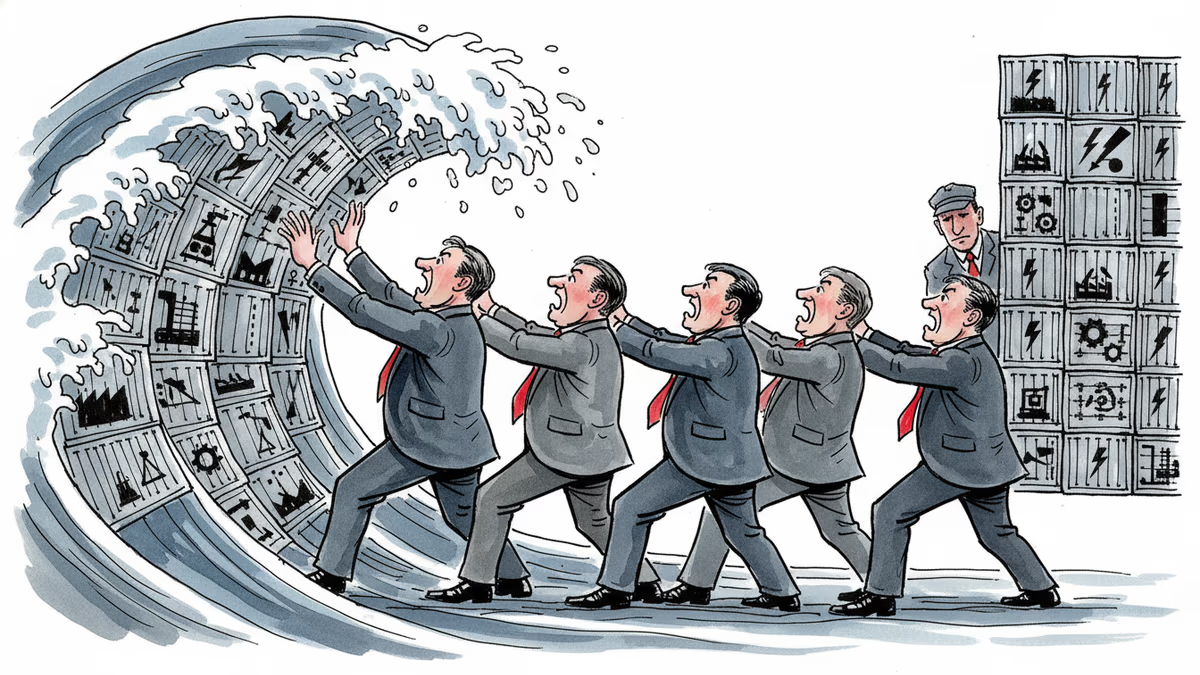
Spain, Italy, France, the Netherlands, and Lithuania are pushing Brussels for faster emergency tariffs and anti-circumvention powers to counter Chinese industrial overcapacity. Here's what's at stake.

Trump says a US-Iran nuclear deal is 'largely negotiated.' Iran calls it a 'Persian-style peace.' Both sides claim victory. Here's what's actually at stake.
Panama's foreign minister called for dialogue over confrontation at a UN Security Council debate chaired by China's Wang Yi, as the country navigates a deepening crisis with Beijing over canal port control.
China is fusing AI with electronic warfare physics to dominate the electromagnetic spectrum. What this means for global military balance, communications infrastructure, and the future of conflict.
Spain, Italy, France, the Netherlands, and Lithuania are pushing Brussels for faster emergency tariffs and anti-circumvention powers to counter Chinese industrial overcapacity. Here's what's at stake.
Trump says a US-Iran nuclear deal is 'largely negotiated.' Iran calls it a 'Persian-style peace.' Both sides claim victory. Here's what's actually at stake.
Thoughts
Share your thoughts on this article
Sign in to join the conversation