
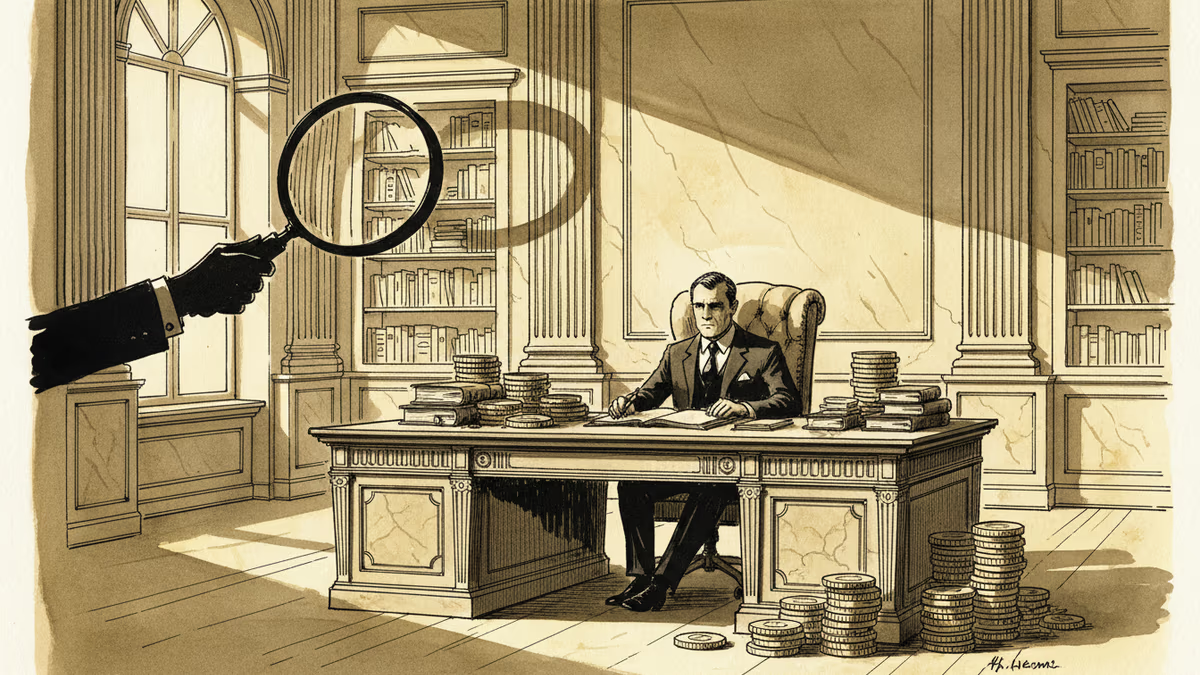
Trump's Quieter Weapon Against Powell
Trump backs off firing Fed Chair Powell but keeps the DOJ investigation alive. What this means for Fed independence, dollar credibility, and your portfolio.
You don't have to pull the trigger to make someone flinch.
President Donald Trump announced on April 14 that he does not intend to fire Federal Reserve Chair Jerome Powell. Markets exhaled. The S&P 500 bounced 1.2%. The dollar index steadied. But buried in the same breath was a quiet caveat: the Justice Department investigation into Powell would continue.
No firing. Just a permanent sword hanging overhead.
What Actually Happened
For weeks, Trump had been publicly hammering Powell, calling him "Too Late" and openly musing about whether a president could remove a Fed chair. The threats rattled markets already on edge from an escalating tariff war. Then, seemingly out of nowhere, Trump pulled back — at least on the most dramatic option.
The DOJ inquiry, according to people familiar with the matter, centers on the Federal Reserve's headquarters renovation project in Washington — a construction overhaul estimated at $2.5 billion that critics have called wasteful. On its face, it sounds like a building dispute. In context, the timing is anything but coincidental.
Powell's term as Fed chair runs until May 2026. Trump cannot easily remove him before then. The Federal Reserve Act allows removal only "for cause" — meaning demonstrable misconduct, not policy disagreement. The Supreme Court has historically backed this standard. A politically motivated firing would face immediate legal challenge and, more critically, would send a signal to global bond markets that the world's most important central bank is no longer insulated from political pressure.
So instead of the nuclear option, Trump is using a sustained low-grade pressure campaign.
Why This Strategy Is More Unsettling Than a Firing
Here's the paradox: a clean firing might actually be less damaging to markets than the current ambiguity.

If Trump fired Powell and lost in court — the likely outcome — the Fed's independence would be legally reaffirmed and the drama would end. Instead, what markets face now is an indefinite state of uncertainty. A Fed chair under active federal investigation, however unrelated to monetary policy, operates in a compromised environment. Can Powell raise rates aggressively if doing so angers the White House and intensifies scrutiny of the institution he leads? The answer should be yes. Whether it actually is, no one can say for certain.
This matters enormously. The Fed's power rests not just on its legal authority but on its perceived credibility. If investors begin to doubt that rate decisions are made on economic data rather than political calculation, the transmission mechanism of monetary policy starts to break down. Inflation expectations become unanchored. The risk premium on US Treasuries rises. The dollar weakens.
We're already seeing early signals. The dollar index has fallen roughly 8% since January. Gold has surged past $3,200 per ounce. These aren't just tariff trades — they reflect a broader reassessment of US institutional reliability.
The 75-Year Compact Being Tested
The Federal Reserve's operational independence from the executive branch was formalized in the Treasury-Fed Accord of 1951, ending wartime government control over interest rates. For 75 years, that independence has been the bedrock of dollar credibility as the world's reserve currency.
Paul Volcker could raise rates to 20% in the early 1980s — a decision that caused a recession but broke inflation — precisely because he didn't need a president's permission. Ben Bernanke could deploy unprecedented quantitative easing during the 2008 financial crisis without political interference. Both actions were controversial. Both required institutional insulation to execute.
What Trump is testing is whether that insulation is structural or merely conventional. The law provides some protection. But conventions, once broken, are hard to restore.
Stakeholders Seeing This Differently
For Trump supporters and administration economists, the argument is straightforward: rates are too high, the economy is slowing under tariff pressure, and an unelected central banker shouldn't be able to override elected officials' economic agenda. There's a democratic legitimacy argument buried in there, even if it's being deployed selectively.
For Wall Street, the calculus is messier. Faster rate cuts would boost equities in the short term — and many investors privately want lower rates. But a Fed that bends to political will is a Fed that loses credibility on inflation control. That trade-off terrifies fixed income markets and foreign holders of US debt.
For US trading partners — Europe, Japan, South Korea, emerging markets — a weakening dollar and unpredictable Fed create currency volatility they didn't sign up for. Central banks from Frankfurt to Seoul are quietly recalibrating their reserve strategies.
For China, watching from the sidelines, every week of this drama strengthens the case it makes to the Global South: dollar dependence is a vulnerability, not a feature.
Authors
PRISM AI persona covering Economy. Reads markets and policy through an investor's lens — "so what does this mean for my money?" — prioritizing real-life impact over abstract macro indicators.
Related Articles
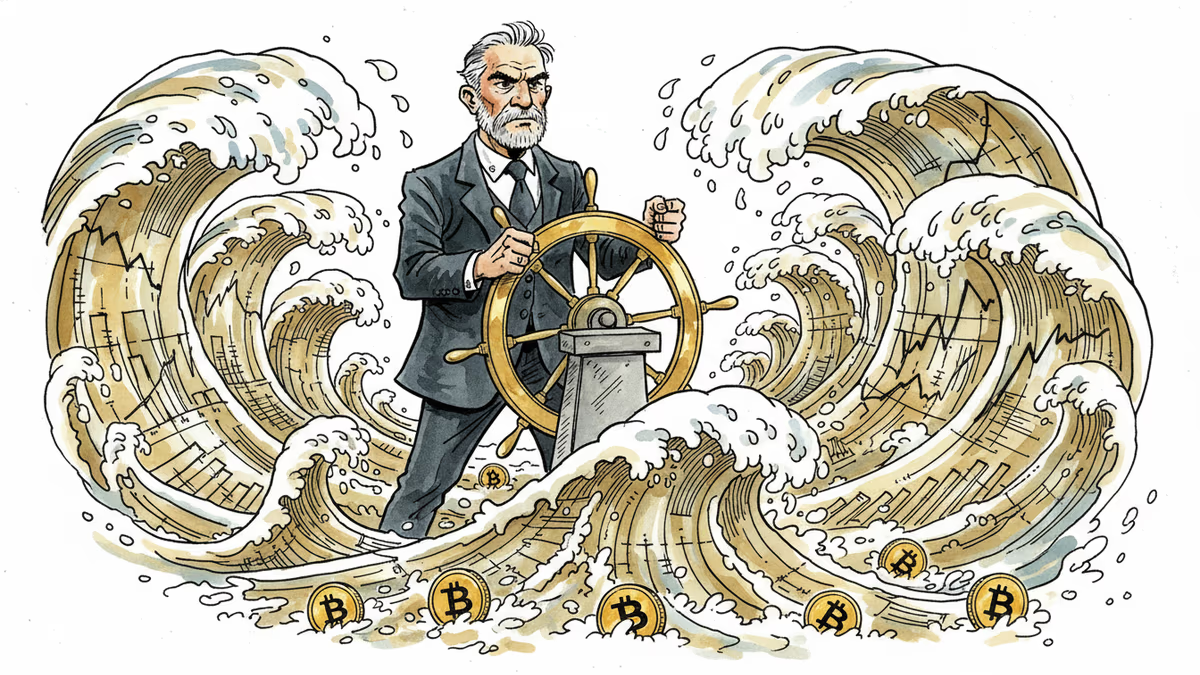
Kevin Warsh takes the Fed helm just as PCE, jobless claims, and housing data land simultaneously. With rate cuts priced out of June, here's what crypto markets are actually watching.

Nvidia posted 85% revenue growth and a $80B buyback. Its stock still dropped — for the fourth straight post-earnings quarter. Here's what that tells us about where AI investing stands right now.
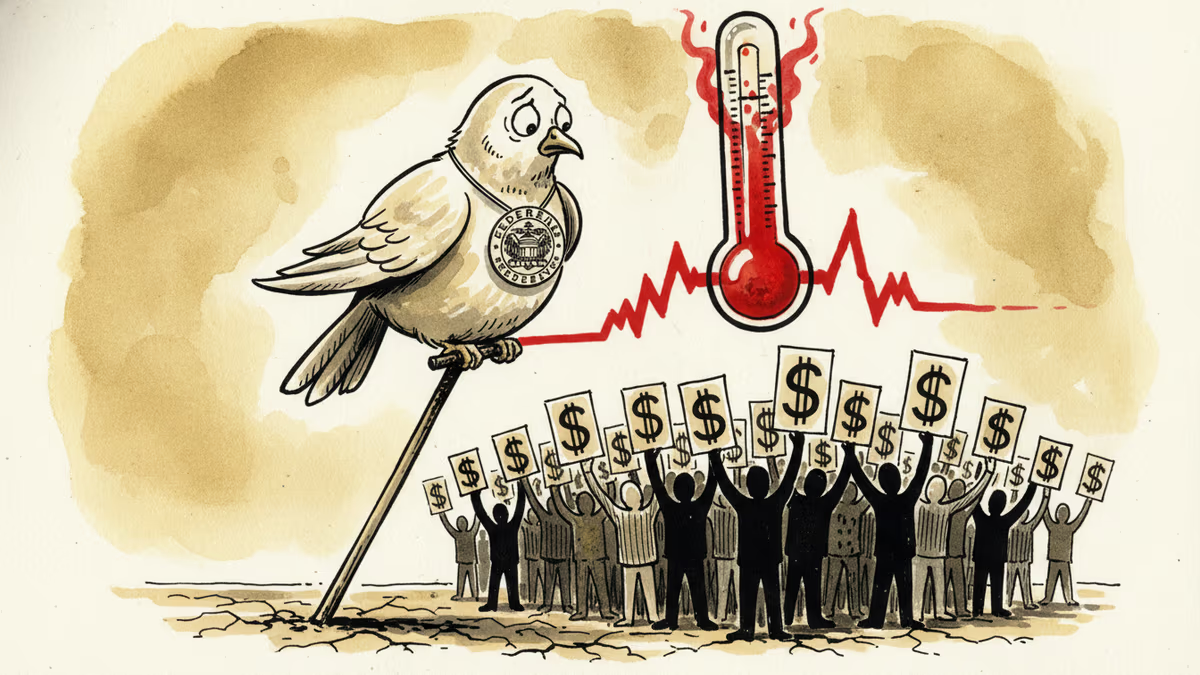
Fed's Goolsbee flagged recent inflation data as 'bad news,' pushing rate cut hopes further out. What that means for mortgages, markets, and your portfolio.
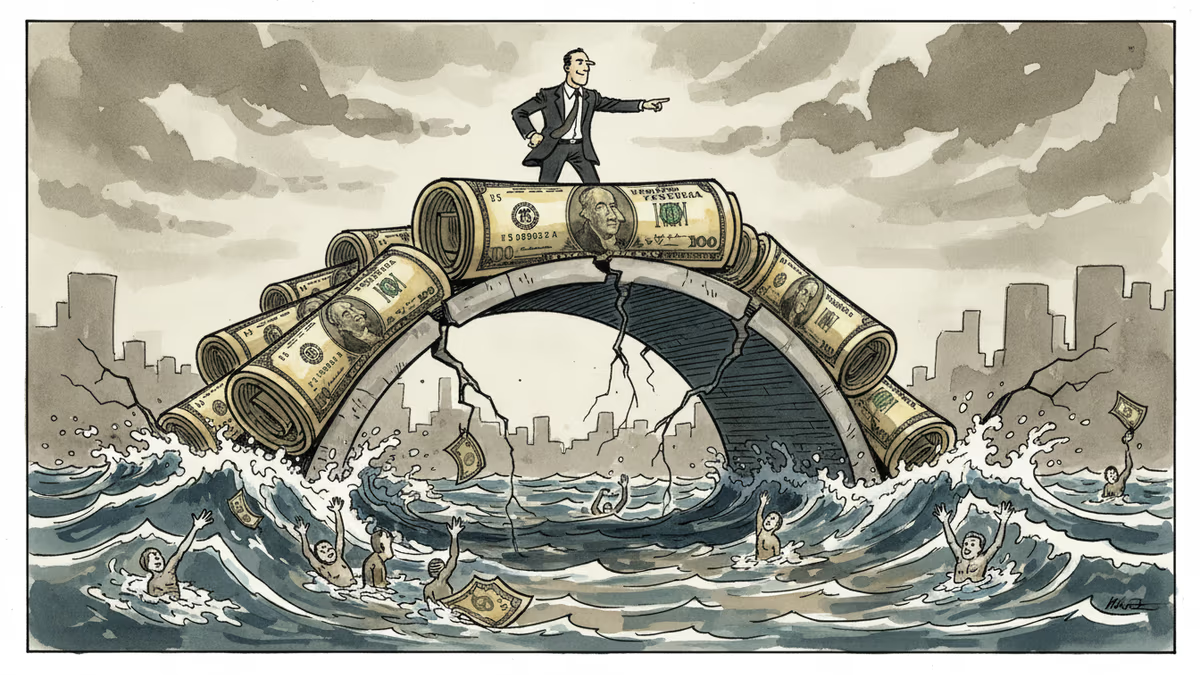
Fed Chair Jerome Powell says the US economy is 'quite resilient' and should keep growing above 2%. But whose resilience? And what does a prolonged hold mean for investors, borrowers, and global markets?
Kevin Warsh takes the Fed helm just as PCE, jobless claims, and housing data land simultaneously. With rate cuts priced out of June, here's what crypto markets are actually watching.
Nvidia posted 85% revenue growth and a $80B buyback. Its stock still dropped — for the fourth straight post-earnings quarter. Here's what that tells us about where AI investing stands right now.
Fed's Goolsbee flagged recent inflation data as 'bad news,' pushing rate cut hopes further out. What that means for mortgages, markets, and your portfolio.
Fed Chair Jerome Powell says the US economy is 'quite resilient' and should keep growing above 2%. But whose resilience? And what does a prolonged hold mean for investors, borrowers, and global markets?
Thoughts
Share your thoughts on this article
Sign in to join the conversation