
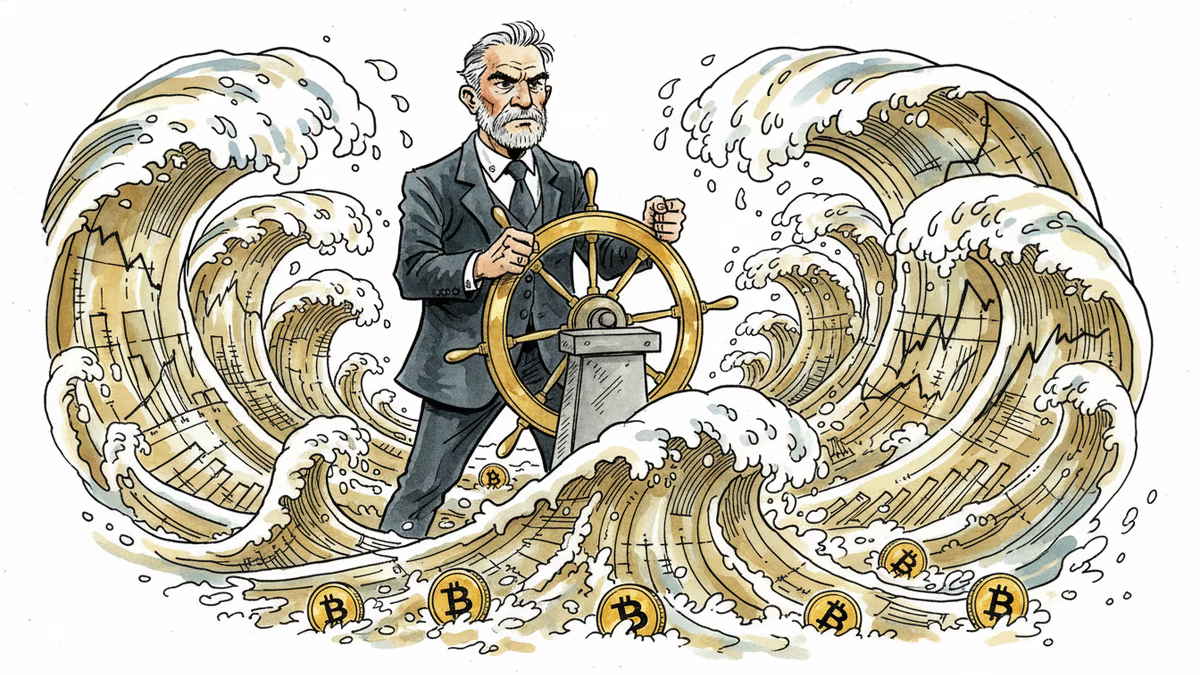
New Fed Chair, Old Inflation Problem: What's at Stake for Crypto
Kevin Warsh takes the Fed helm just as PCE, jobless claims, and housing data land simultaneously. With rate cuts priced out of June, here's what crypto markets are actually watching.
The week Kevin Warsh officially takes the Fed's wheel is the same week the economy hands him its most uncomfortable reading.
On May 26, Warsh begins his first full week as Federal Reserve Chair. Two days later, on May 28, three of the most market-sensitive data releases in the U.S. economic calendar drop at the same time: the PCE price index, weekly jobless claims, and new home sales. For crypto markets — already navigating a quiet but meaningful rotation away from large-cap assets — the timing couldn't be more loaded.
What the Numbers Actually Say
The PCE print is the one to watch. The Fed's preferred inflation gauge came in at 3.5% year-over-year in March, with core PCE at 3.2%. Both sit well above the Fed's 2% target. A softer April reading would keep rate-cut hopes on life support; a hotter one would effectively close the door on June.
Right now, both the CME FedWatch tool and prediction markets are pricing in no change at the June meeting. That's not a surprise — but it does mean any upside inflation surprise would hit markets that have already absorbed the bad news, while a downside surprise could trigger an outsized rally in risk assets, crypto included.
Jobless claims are expected to tick up slightly to 212,000 from the prior 209,000. That's not enough to signal labor market stress, but it's the direction that matters. A labor market that starts to crack gives the Fed cover to cut; one that holds firm keeps the "higher for longer" narrative intact.
Layered on top of all this: the ongoing Middle East conflict keeps energy prices volatile. Oil spikes feed directly into inflation data, which means the PCE number isn't just a function of domestic demand — it's partly a geopolitical hostage.
The Crypto Rotation Nobody's Talking About Loudly Enough

While macro traders stare at spreadsheets, something quieter is happening inside crypto markets. Last week, bitcoin ETFs bled over $1 billion in outflows. Ether funds lost another $215 million. The two assets that were supposed to be the "safe" crypto bets are losing institutional appetite — at least for now.
The money isn't leaving crypto. It's moving. HYPE spot products pulled in roughly $72 million. XRP and SOL ETFs absorbed meaningful inflows. This isn't a story about crypto losing favor; it's a story about investors no longer treating the entire asset class as a monolith.
That shift matters for how you read the macro data. If PCE comes in hot and risk assets sell off broadly, the question isn't just "will bitcoin fall?" — it's "which parts of crypto are actually correlated to macro, and which have decoupled?" The rotation data suggests the answer is increasingly: it depends on which token you're holding.
Token Unlocks: Scheduled Pressure
Beyond the macro calendar, several token unlock events this week add their own supply-side pressure. On May 26, Huma Finance (HUMA) unlocks 20.04% of its circulating supply — worth approximately $11.76 million. Plasma (XPL) unlocks 3.38%, worth $7.39 million, the same day. By June 1, EigenCloud (EIGEN) adds another $8.48 million to circulating supply.
None of these are large enough individually to move the broader market. But in a week where macro sentiment is already fragile, incremental sell pressure from unlocks can amplify moves that might otherwise be contained. Timing, as always, is everything.
What Warsh Actually Changes
Warsh served as a Fed governor from 2006 to 2011 and has historically leaned hawkish on inflation. But "historically hawkish" is a label, not a policy. What the market doesn't yet know is how he'll communicate — what language he'll use, how he'll frame uncertainty, and whether he'll signal any departure from the Yellen-Powell era's relatively transparent forward guidance.
Every Fed Chair transition comes with a re-learning period. Markets spent months decoding Ben Bernanke's academic framing, then recalibrated for Janet Yellen's labor-market focus, then again for Jerome Powell's press-conference-driven style. Warsh's first real test isn't just the PCE number itself — it's how he responds to it publicly. A single phrase can move markets more than the data point underneath it.
For crypto specifically, Fed Chair transitions have historically increased volatility in the short term, not because the underlying policy changes immediately, but because the market's confidence in its own interpretation drops. That interpretive uncertainty is priced as risk.
This content is AI-generated based on source articles. While we strive for accuracy, errors may occur. We recommend verifying with the original source.
Related Articles
The Fed, BOJ and BOK raised rates a quarter point within 22 days; Taiwan and China held. What each said, plus the impact on Korean borrowers and the won.
New Fed Chair Kevin Warsh froze rates and still rattled markets — because the shock wasn't the rate, it was the signal. Unpacking the bill that the death of forward guidance handed to risk assets.
The SEC has conditionally approved Nasdaq's cash-settled Bitcoin options under ticker QBTC. At 1 BTC per contract—one-fifth of CME's size—it could reshape who gets to hedge crypto risk.
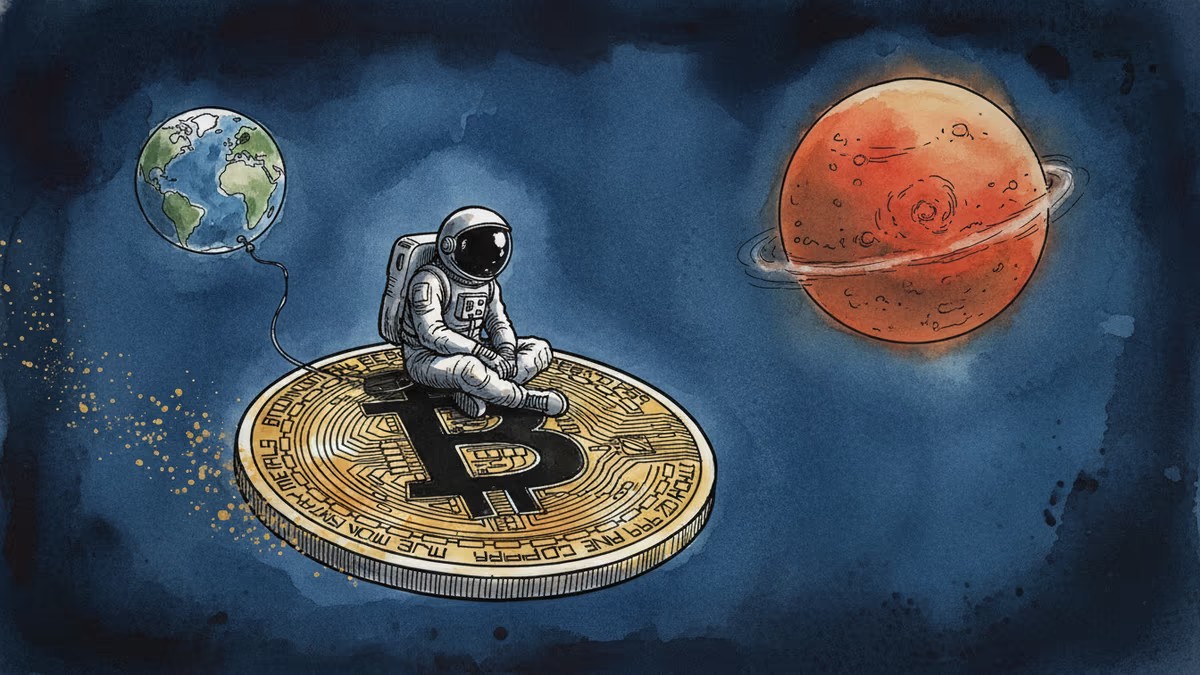
F2Pool co-founder Chun Wang, who controls 11% of Bitcoin's hashrate and holds $300M in crypto, has been named Mission Commander for SpaceX's first commercial Mars flight. What does it mean when crypto capital funds humanity's next frontier?
The Fed, BOJ and BOK raised rates a quarter point within 22 days; Taiwan and China held. What each said, plus the impact on Korean borrowers and the won.
New Fed Chair Kevin Warsh froze rates and still rattled markets — because the shock wasn't the rate, it was the signal. Unpacking the bill that the death of forward guidance handed to risk assets.
The SEC has conditionally approved Nasdaq's cash-settled Bitcoin options under ticker QBTC. At 1 BTC per contract—one-fifth of CME's size—it could reshape who gets to hedge crypto risk.
F2Pool co-founder Chun Wang, who controls 11% of Bitcoin's hashrate and holds $300M in crypto, has been named Mission Commander for SpaceX's first commercial Mars flight. What does it mean when crypto capital funds humanity's next frontier?
Thoughts
Share your thoughts on this article
Sign in to join the conversation