

Bitcoin Options Are Coming to Your Stock Account
The SEC has conditionally approved Nasdaq's cash-settled Bitcoin options under ticker QBTC. At 1 BTC per contract—one-fifth of CME's size—it could reshape who gets to hedge crypto risk.
You've been able to buy a Bitcoin ETF in your brokerage account since January 2024. Soon, you may be able to hedge it there too—without opening a single new account.
What Just Happened
The SEC last week granted Nasdaq PHLX conditional approval to list cash-settled, European-style Bitcoin index options under the ticker QBTC. Final clearance from the CFTC is still pending, but the regulatory architecture is largely in place.
Three details define this product. First, no actual bitcoin changes hands. At expiration, the exchange simply credits or debits the dollar difference between the strike price and the final index value. Second, QBTC tracks the CME CF Bitcoin Real Time Index (BRTT)—a spot index, not a futures price. Third, and most consequentially: each contract represents exposure to exactly 1 BTC.
Why Contract Size Is the Real Story
One number can redraw a market. CME's standard Bitcoin option is sized at 5 BTC per contract. At current prices, that's a notional value running into hundreds of thousands of dollars per contract—fine for a large fund, impractical for most everyone else.
QBTC cuts that to one-fifth the size. A smaller institution running a $10 million crypto sleeve can now hedge with surgical precision rather than blunt force. A retail investor sitting on a few bitcoin in a spot ETF can buy downside protection without needing to round up to the nearest five.

But the more underrated shift is operational. CME Bitcoin options require a dedicated derivatives account—separate margin rules, separate platform, separate onboarding. QBTC trades on the same Nasdaq infrastructure as Apple or Nvidia stock. Existing brokerage account. Same login. Done.
Winners, Losers, and the Unanswered Question
The beneficiaries are reasonably clear: smaller hedge funds, family offices, and the growing cohort of retail investors who bought into Bitcoin spot ETFs but had no practical way to hedge their position. Put options become a real tool, not a theoretical one.
CME faces competitive pressure. It has dominated Bitcoin derivatives since launching options in 2020, but QBTC beats it on three dimensions simultaneously—spot index tracking, smaller contract size, and zero additional account friction. Whether CME responds with a competing product or leans into its institutional depth will be worth watching.
For the broader market, the timing matters. Bitcoin spot ETFs crossed $100 billion in combined AUM earlier this year. A maturing options market layered on top of that means more sophisticated hedging, more yield-generation strategies, and—critically—a more efficient price discovery mechanism. Institutional money doesn't just buy and hold; it manages risk dynamically. QBTC gives it the tools to do that without leaving the familiar world of regulated securities.
The Bigger Trend: Crypto's Infrastructure Moment
The arc is consistent. Spot ETF approval in early 2024 brought bitcoin into mainstream portfolios. Options expansion is the next layer. After that, likely comes more structured products—yield notes, defined-outcome ETFs, volatility indices—all built on the same foundation.
This is how asset classes mature. It happened with gold, with equity index products, with currencies. Each new instrument doesn't just add a trading option; it brings in a new category of participant who previously couldn't or wouldn't engage. The crypto options market has already grown sharply as institutionalization accelerated. QBTC is designed to extend that curve further down the capital stack.
This content is AI-generated based on source articles. While we strive for accuracy, errors may occur. We recommend verifying with the original source.
Related Articles
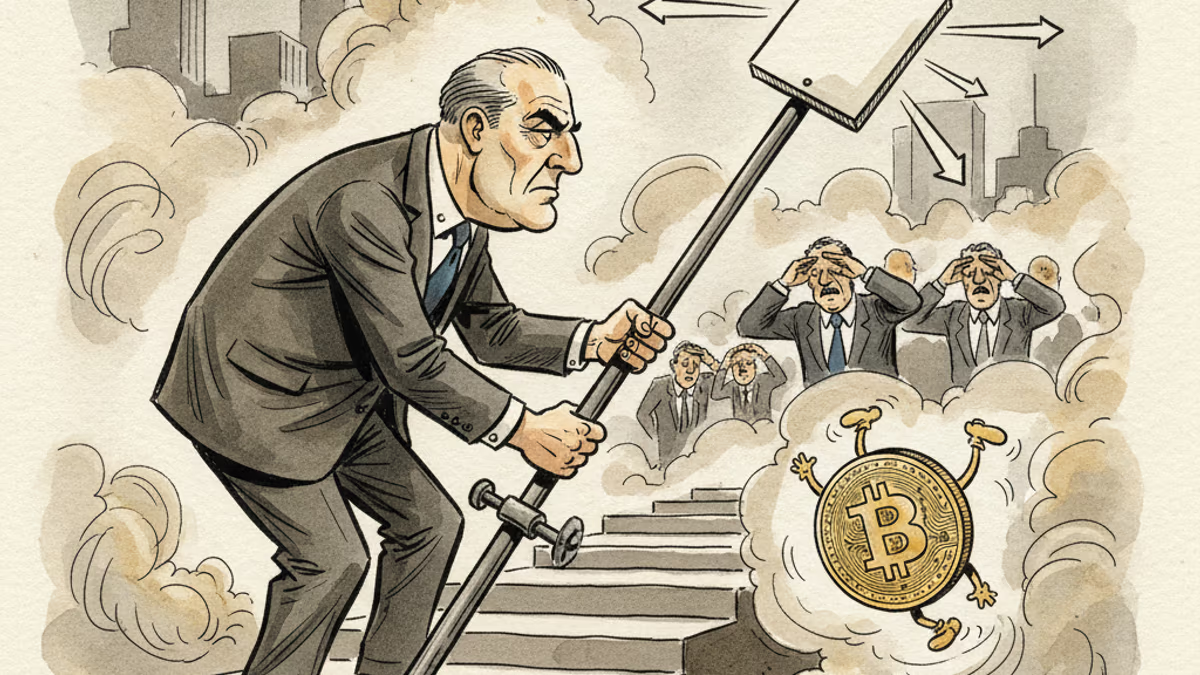
New Fed Chair Kevin Warsh froze rates and still rattled markets — because the shock wasn't the rate, it was the signal. Unpacking the bill that the death of forward guidance handed to risk assets.

Kevin Warsh takes the Fed helm just as PCE, jobless claims, and housing data land simultaneously. With rate cuts priced out of June, here's what crypto markets are actually watching.

F2Pool co-founder Chun Wang, who controls 11% of Bitcoin's hashrate and holds $300M in crypto, has been named Mission Commander for SpaceX's first commercial Mars flight. What does it mean when crypto capital funds humanity's next frontier?

Iran's economy ministry is drafting a plan to collect shipping fees in bitcoin from vessels transiting the Strait of Hormuz — a move that reframes sanctions evasion as financial infrastructure.
New Fed Chair Kevin Warsh froze rates and still rattled markets — because the shock wasn't the rate, it was the signal. Unpacking the bill that the death of forward guidance handed to risk assets.
Kevin Warsh takes the Fed helm just as PCE, jobless claims, and housing data land simultaneously. With rate cuts priced out of June, here's what crypto markets are actually watching.
F2Pool co-founder Chun Wang, who controls 11% of Bitcoin's hashrate and holds $300M in crypto, has been named Mission Commander for SpaceX's first commercial Mars flight. What does it mean when crypto capital funds humanity's next frontier?
Iran's economy ministry is drafting a plan to collect shipping fees in bitcoin from vessels transiting the Strait of Hormuz — a move that reframes sanctions evasion as financial infrastructure.
Thoughts
Share your thoughts on this article
Sign in to join the conversation