

The Bitcoin Miner Heading to Mars
F2Pool co-founder Chun Wang, who controls 11% of Bitcoin's hashrate and holds $300M in crypto, has been named Mission Commander for SpaceX's first commercial Mars flight. What does it mean when crypto capital funds humanity's next frontier?
The man who secures 11.3% of the Bitcoin network is leaving the planet. For two years.
Chun Wang, co-founder of F2Pool and one of the most powerful figures in Bitcoin mining, has been named Mission Commander for SpaceX's first commercial interplanetary human spaceflight to Mars. His personal Bitcoin holdings are estimated above $300 million. His mining pool processes more than a tenth of every Bitcoin transaction confirmed on Earth. And starting in 2026, he'll be roughly 140 million miles away from all of it.
What the Mission Actually Involves
This isn't a joyride. The itinerary runs for 24 consecutive months and breaks into three distinct phases. First, Wang joins Dennis and Akiko Tito for a circumlunar flyby—passing within approximately 125 miles of the Moon's surface. Then comes the main event: a high-altitude Mars flyby. Finally, a complex return trajectory back to Earth.
The technical stakes are steep. SpaceX is debuting its next-generation Starship V3 architecture on this mission—a vehicle equipped with vacuum-jacketed cryogenic fuel lines, high-voltage recirculation systems, and 60 integrated avionics units capable of handling up to 9MW of peak power. Managing cryogenic propellant for two years in deep space has never been done before. If the hardware holds, SpaceX gets the data it needs to validate rapid vehicle reuse. If it doesn't, Elon Musk's timeline for putting one million people on Mars takes a significant hit.
Wang's crew will also attempt something genuinely novel: capturing the first-ever human X-ray images in microgravity. The goal is to measure how 24 months of deep-space radiation and zero gravity degrade the human body—data that no simulation on Earth can replicate.
Why This Moment, Why This Person

The timing is loaded. SpaceX is quietly preparing for what could be the largest IPO in history, targeting a valuation north of $1.75 trillion. In the lead-up, the company made an unusual disclosure: it holds 8,285 BTC on its balance sheet. A Mars mission announcement, a record IPO filing, and a Bitcoin reveal—all landing in the same window. That's not accidental sequencing.
Wang's selection is equally deliberate. He's not a career astronaut or a Silicon Valley billionaire buying a seat. He's an operator—someone who has run critical infrastructure at scale under adversarial conditions. Bitcoin mining pools are targets for attacks, regulatory pressure, and hardware failure. Managing 11.3% of global hashrate requires the kind of systems thinking that deep-space operations demand. Whether that translates to actual mission competence, only 24 months in space will tell.
But the symbolism is hard to miss. Crypto capital—specifically, wealth generated by processing Bitcoin transactions—is now being deployed to fund the operational data collection for humanity's first attempt at multi-planetary civilization. That's a new sentence in the history of space exploration.
The Tensions Worth Watching
Not everyone reads this story the same way. For SpaceX investors and IPO watchers, Wang's mission is a narrative asset: proof that commercial deep-space operations are real, not theoretical. For Bitcoin maximalists, it's validation that crypto wealth can fund something beyond speculation. For critics of both industries, it raises harder questions about who controls the infrastructure of the future—and who gets left behind.
There's also the operational gap Wang leaves behind. F2Pool doesn't pause while its co-founder is in deep space. A pool controlling 11% of Bitcoin's hashrate running without its founder for two years is an untested scenario. Competitors will notice.
And then there's the bigger number: one million people on Mars. Wang's mission is explicitly framed as the data-collection phase that makes that goal physically possible. The biomedical telemetry, the hardware stress tests, the propellant transfer data—all of it feeds into the logistical baseline SpaceX needs before it can scale. The mission isn't the destination. It's the proof of concept.
This content is AI-generated based on source articles. While we strive for accuracy, errors may occur. We recommend verifying with the original source.
Related Articles
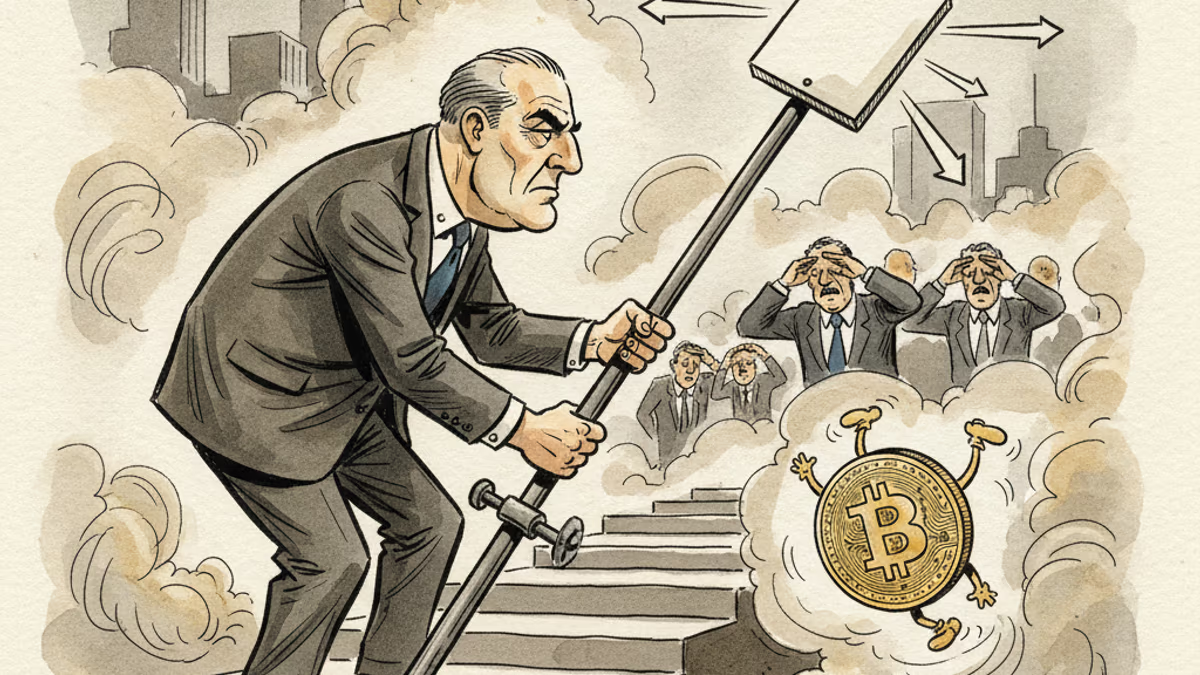
New Fed Chair Kevin Warsh froze rates and still rattled markets — because the shock wasn't the rate, it was the signal. Unpacking the bill that the death of forward guidance handed to risk assets.

Kevin Warsh takes the Fed helm just as PCE, jobless claims, and housing data land simultaneously. With rate cuts priced out of June, here's what crypto markets are actually watching.

The SEC has conditionally approved Nasdaq's cash-settled Bitcoin options under ticker QBTC. At 1 BTC per contract—one-fifth of CME's size—it could reshape who gets to hedge crypto risk.

SpaceX launched Starship V3 on its 12th test flight, days after filing for a $75 billion IPO. Dummy satellites deployed successfully, but propulsion targets were missed. What does that mean for investors?
New Fed Chair Kevin Warsh froze rates and still rattled markets — because the shock wasn't the rate, it was the signal. Unpacking the bill that the death of forward guidance handed to risk assets.
Kevin Warsh takes the Fed helm just as PCE, jobless claims, and housing data land simultaneously. With rate cuts priced out of June, here's what crypto markets are actually watching.
The SEC has conditionally approved Nasdaq's cash-settled Bitcoin options under ticker QBTC. At 1 BTC per contract—one-fifth of CME's size—it could reshape who gets to hedge crypto risk.
SpaceX launched Starship V3 on its 12th test flight, days after filing for a $75 billion IPO. Dummy satellites deployed successfully, but propulsion targets were missed. What does that mean for investors?
Thoughts
Share your thoughts on this article
Sign in to join the conversation