
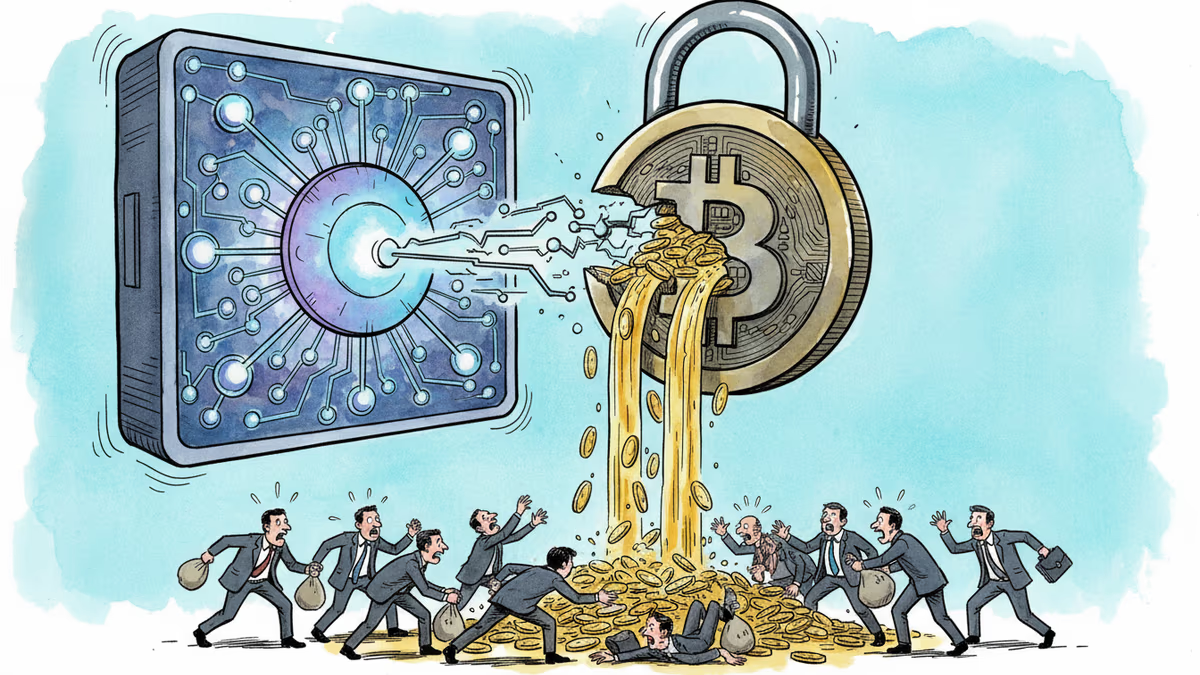
The Clock to Crack Bitcoin Is Already Ticking
Project Eleven's 110-page report warns that quantum computers could break today's crypto security by 2030—and migrating Bitcoin could take longer than that window allows.
The lock protecting your crypto wallet was designed for a world before quantum computers existed. That world has an expiration date: somewhere between 2030 and 2033.
That's the central warning in a 110-page report released May 9 by Project Eleven, a firm specializing in post-quantum security for digital assets. The document doesn't traffic in vague future-threat language. It names a timeline, quantifies the exposure, and identifies exactly why the fix is harder than the problem.
What's Actually at Risk—and How Much
Nearly every digital asset in existence—bitcoin, ether, stablecoins—is secured by elliptic curve digital signatures (ECDSA). So is your bank's authentication system, the cloud infrastructure behind most enterprise software, and classified military communications networks. They all rely on the same foundational assumption: that deriving a private key from a public key is computationally impossible.
Quantum computers running Shor's Algorithm would make that assumption false.
Once a sufficiently powerful quantum machine exists, an attacker could take any exposed public key—the kind visible on a blockchain every time you transact—and reverse-engineer the private key that controls the wallet. From there, forging signatures and draining funds becomes straightforward.
Project Eleven estimates that more than $3 trillion in digital assets are currently secured by cryptography vulnerable to this attack. The firm places "Q-Day"—the arrival of a cryptographically relevant quantum computer—as early as 2030, and no later than 2033.
"Our analysis suggests that, based on current trends, Q-Day is more likely to occur than not by 2033," the report states. "The window for the world to migrate to post-quantum cryptography is narrowing."
The Migration Math Doesn't Add Up
Here's the uncomfortable arithmetic: large-scale systems typically take five to more than ten years to migrate. If Q-Day arrives in 2030, the window opened yesterday—and most of the industry hasn't started moving.
The technical solution already exists. The U.S. National Institute of Standards and Technology (NIST) finalized its post-quantum cryptography standards in 2024. The bottleneck isn't engineering. It's coordination.

For centralized systems—banks, cloud providers, government networks—regulators can mandate a transition timeline. Painful, expensive, but achievable. For Bitcoin, the problem is structurally different.
Every network upgrade requires simultaneous buy-in from users, exchanges, custodians, wallet providers, and miners. The SegWit upgrade in 2015–2017, a comparatively minor technical change, took over two years to activate and still triggered a contentious chain split. A full post-quantum cryptography migration would be orders of magnitude more complex.
"The distributed nature of blockchain networks means that migration to post-quantum cryptography may take the better part of a decade," the report notes—potentially longer than the time remaining before Q-Day.
The $500 Billion Sitting Duck
Project Eleven CEO Alex Pruden, who co-authored the report with CTO Conor Deegan, flagged a specific subset of bitcoin that faces outsized risk: wallets where the public key is already exposed on-chain. This includes coins associated with early adopters—possibly including Satoshi Nakamoto himself.
The estimate: 5.6 to 6.9 million BTC, worth roughly $500 billion at current prices, sitting in addresses where a quantum attacker would have everything they need to act on day one of Q-Day.
Pruden said he personally favors "recycling" those coins back into Bitcoin's supply curve rather than allowing a quantum attacker to sweep them. The logic is pragmatic: if the coins will be stolen anyway, better to have the network reclaim them.
But that position runs directly into Bitcoin's foundational commitments. Fixed supply is a feature, not a bug. Property rights are inviolable. Forcing a redistribution of dormant coins—even to prevent theft—looks a lot like the kind of centralized intervention Bitcoin was built to resist. Adam Back, a prominent Bitcoin developer, has already pushed back, advocating for optional upgrades rather than forced freezes or recycling.
The tension is real, and the report acknowledges it openly.
Who Moves First—and Who Pays
For institutional investors and financial firms, the report's implications are more immediate than they might appear. Banks and custodians operating in regulated markets will likely face mandatory PQC migration timelines within the next few years. The compliance cost will be significant. Those who start now will have an advantage; those who wait for regulatory deadlines will be scrambling.
For individual crypto holders, the calculus is different. If you hold bitcoin in a wallet where your public key has been exposed through prior transactions, your exposure is higher than someone using fresh addresses. Hardware wallet providers and exchanges will need to communicate clearly about what migration actually means for user funds—and when.
For quantum computing companies themselves—IBM, Google, IonQ, and others racing toward cryptographically relevant machines—the report is, in a sense, a business development document. The closer Q-Day gets, the more urgent the migration market becomes.
This content is AI-generated based on source articles. While we strive for accuracy, errors may occur. We recommend verifying with the original source.
Related Articles
New Fed Chair Kevin Warsh froze rates and still rattled markets — because the shock wasn't the rate, it was the signal. Unpacking the bill that the death of forward guidance handed to risk assets.
Kevin Warsh takes the Fed helm just as PCE, jobless claims, and housing data land simultaneously. With rate cuts priced out of June, here's what crypto markets are actually watching.

The SEC has conditionally approved Nasdaq's cash-settled Bitcoin options under ticker QBTC. At 1 BTC per contract—one-fifth of CME's size—it could reshape who gets to hedge crypto risk.
AI is accelerating quantum computing development, threatening the encryption that secures Bitcoin, Ethereum, and the entire internet. Security experts warn the arms race has already begun.
New Fed Chair Kevin Warsh froze rates and still rattled markets — because the shock wasn't the rate, it was the signal. Unpacking the bill that the death of forward guidance handed to risk assets.
Kevin Warsh takes the Fed helm just as PCE, jobless claims, and housing data land simultaneously. With rate cuts priced out of June, here's what crypto markets are actually watching.
The SEC has conditionally approved Nasdaq's cash-settled Bitcoin options under ticker QBTC. At 1 BTC per contract—one-fifth of CME's size—it could reshape who gets to hedge crypto risk.
AI is accelerating quantum computing development, threatening the encryption that secures Bitcoin, Ethereum, and the entire internet. Security experts warn the arms race has already begun.
Thoughts
Share your thoughts on this article
Sign in to join the conversation