

Saylor's Next Move: Erasing the Debt
Strategy is retiring half its outstanding 0% 2029 convertible notes. What does this liability restructuring tell us about the maturity of the Bitcoin treasury playbook?
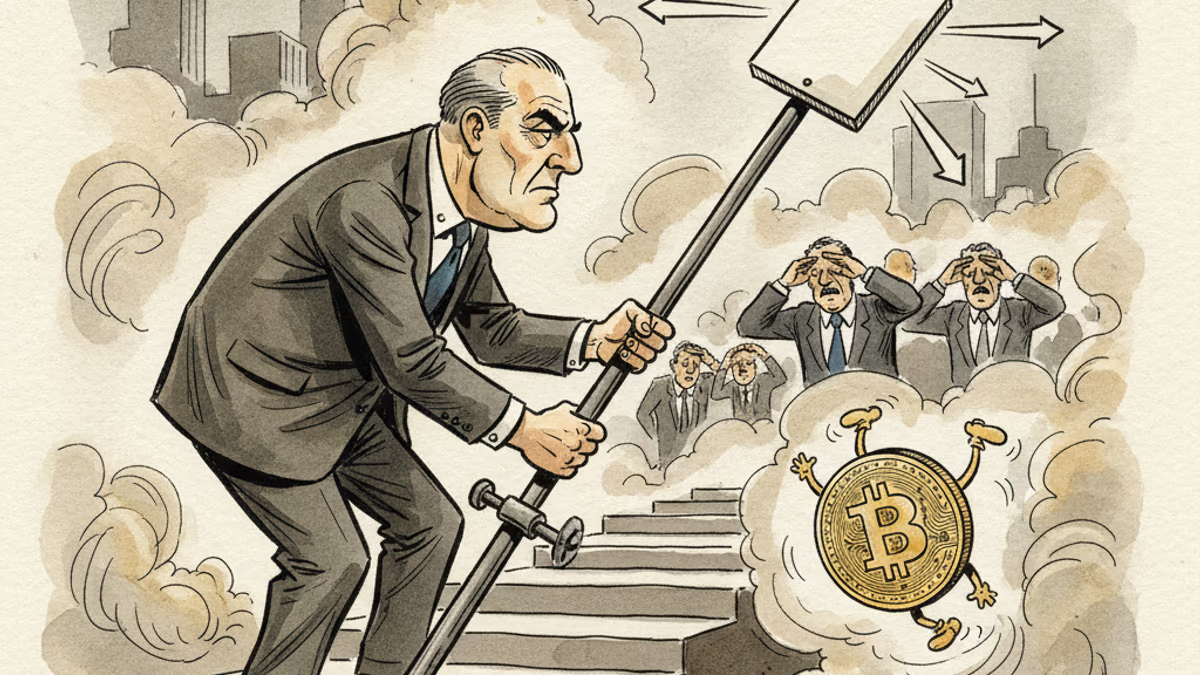
Buying bitcoin was the easy part. Now Michael Saylor is doing something harder: unwinding the debt that paid for it.
What Happened
Strategy has announced it intends to retire approximately half of its outstanding 0% convertible notes due 2029 as part of a broader restructuring of liabilities tied to its bitcoin treasury strategy. The move is framed not as a retreat but as a refinement — a deliberate reshaping of the capital structure that has funded the company's ascent to the world's largest corporate bitcoin holder.
The numbers behind this are significant. Strategy currently holds roughly 214,000 BTC, accumulated over several years through a mix of equity raises, conventional debt, and — most notably — convertible notes that carry no coupon but offer investors the right to convert into shares at a premium. The 2029 converts represent one tranche of that layered liability stack. Retiring half of them now signals a shift in how Saylor thinks the balance sheet should look going forward.
Why Converts, and Why Now
Zero-coupon convertible notes are a clever instrument in a rising-asset environment. The company pays no interest. Investors accept that trade-off because they hold an option: if the stock price climbs above the conversion price, they can flip the notes into equity and pocket the difference. For Strategy, whose stock price has historically tracked bitcoin's trajectory, this created a self-reinforcing loop — bitcoin goes up, stock goes up, converts get exercised, dilution follows.
That dilution is the pressure Saylor is now moving to contain. By retiring a substantial portion of the 2029 notes early, Strategy reduces the overhang of potential share issuance. For long-term equity holders, fewer converts outstanding means less future dilution risk, particularly during bitcoin bull runs when conversion incentives peak.

The timing is deliberate. After bitcoin crossed $100,000 in late 2025, institutional appetite for bitcoin-linked exposure expanded sharply. Strategy stock functions as a leveraged proxy for bitcoin — but leverage cuts both ways, and a cleaner liability structure makes the instrument more palatable to institutional allocators with strict risk mandates.
Winners, Losers, and the Unanswered Question
For equity investors, this is a constructive signal. Reduced convert overhang translates to a tighter share count and less dilution pressure in the scenarios that matter most — namely, continued bitcoin appreciation.
For convertible note holders, the calculus is less straightforward. Early redemption terms will determine whether they're made whole or left short of the conversion upside they originally priced in. Investors who bought the notes betting on bitcoin's continued rise may find themselves cashed out at par precisely when the trade was about to pay off.
For the broader market, Strategy's restructuring is a data point in an emerging field: corporate bitcoin treasury management as a discipline. The company has moved well beyond simply accumulating BTC. It is now actively managing the liability side of a balance sheet built around a single volatile asset — something no corporate finance textbook has a clean chapter on yet.
The Risk That Doesn't Go Away
None of this eliminates the fundamental vulnerability. Strategy's entire financial architecture rests on bitcoin's price staying above its blended acquisition cost — estimated at roughly $35,000 per BTC. At current prices that margin looks comfortable, but the history of bitcoin includes drawdowns of 70–80% from peak. A sustained bear market wouldn't just compress the asset side; it would expose whatever liabilities remain as disproportionately heavy.
There's also the question of how the early retirement is being funded. If Strategy issues new equity to raise the cash, it reduces debt-driven dilution while creating equity-driven dilution — a structural irony that sophisticated investors will price in.
This content is AI-generated based on source articles. While we strive for accuracy, errors may occur. We recommend verifying with the original source.
Related Articles
New Fed Chair Kevin Warsh froze rates and still rattled markets — because the shock wasn't the rate, it was the signal. Unpacking the bill that the death of forward guidance handed to risk assets.

Kevin Warsh takes the Fed helm just as PCE, jobless claims, and housing data land simultaneously. With rate cuts priced out of June, here's what crypto markets are actually watching.

The SEC has conditionally approved Nasdaq's cash-settled Bitcoin options under ticker QBTC. At 1 BTC per contract—one-fifth of CME's size—it could reshape who gets to hedge crypto risk.

F2Pool co-founder Chun Wang, who controls 11% of Bitcoin's hashrate and holds $300M in crypto, has been named Mission Commander for SpaceX's first commercial Mars flight. What does it mean when crypto capital funds humanity's next frontier?
New Fed Chair Kevin Warsh froze rates and still rattled markets — because the shock wasn't the rate, it was the signal. Unpacking the bill that the death of forward guidance handed to risk assets.
Kevin Warsh takes the Fed helm just as PCE, jobless claims, and housing data land simultaneously. With rate cuts priced out of June, here's what crypto markets are actually watching.
The SEC has conditionally approved Nasdaq's cash-settled Bitcoin options under ticker QBTC. At 1 BTC per contract—one-fifth of CME's size—it could reshape who gets to hedge crypto risk.
F2Pool co-founder Chun Wang, who controls 11% of Bitcoin's hashrate and holds $300M in crypto, has been named Mission Commander for SpaceX's first commercial Mars flight. What does it mean when crypto capital funds humanity's next frontier?
Thoughts
Share your thoughts on this article
Sign in to join the conversation