
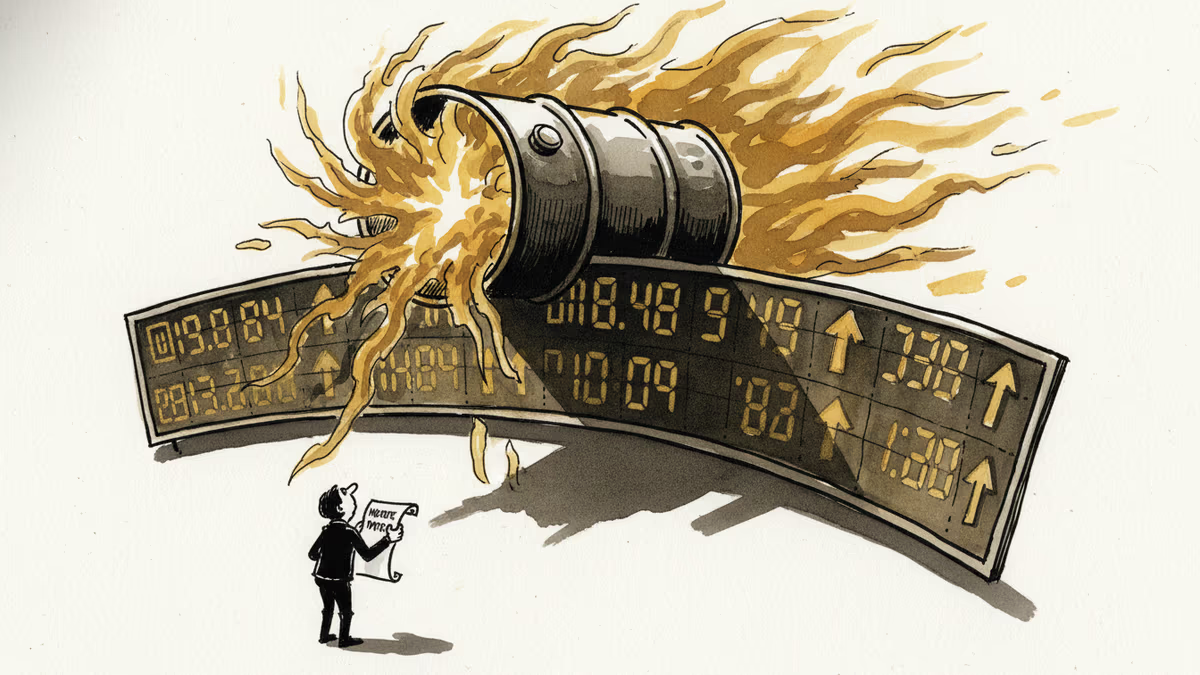
When Middle East Tensions Raise Your Mortgage Rate
Treasury yields are climbing in March as investors fear a Middle East crisis could reignite inflation. What this means for rate cuts, your portfolio, and the global economy.
A missile fired in the Middle East shouldn't affect your mortgage. And yet, here we are.
Throughout March 2026, US Treasury yields have been climbing — not because of a Fed policy shift or a blowout jobs report, but because investors are pricing in a scenario the world hoped it had left behind: inflation, reignited by geopolitical fire. The bond market is sending a warning. Whether anyone in Washington — or on Wall Street — is ready to hear it is another question.
What's Actually Happening in the Bond Market
When investors get nervous about inflation, they sell bonds. Bond prices fall, yields rise. It's a reflex as old as modern finance. Right now, that reflex is being triggered by escalating tensions in the Middle East, which are pushing Brent crude toward the $90-per-barrel threshold — a level that historically has a way of showing up, months later, in grocery bills and gas pumps.
The 10-year Treasury yield is the most watched number in global finance. It's the benchmark for mortgage rates, corporate borrowing costs, and the discount rate that determines what future profits are worth today. When it moves, everything moves with it.
Markets had spent much of late 2024 and 2025 celebrating the Fed's pivot — the long-awaited shift from rate hikes to rate cuts. Inflation had cooled. The soft landing seemed real. But the bond market in March is behaving like someone who just spotted smoke and isn't waiting to confirm there's a fire.
The Inflation Ghost Returns
The fear isn't irrational. In 2022, when Russia invaded Ukraine and energy markets seized up, US CPI peaked at 9.1% — the highest in four decades. The Fed responded with the most aggressive tightening cycle since the 1980s, raising rates by 525 basis points in roughly 18 months. The damage to bond portfolios, growth stocks, and household budgets was severe and lasting.
Now, a different geopolitical shock is threatening a similar chain reaction: Middle East instability → oil supply risk → energy price spike → broader inflation → fewer Fed rate cuts than markets expected.

The Fed itself has been cautious. Officials have repeatedly signaled they need sustained evidence that inflation is under control before cutting further. A fresh commodity shock gives them every reason to pause — or worse, to signal that the cutting cycle is over before it fully began.
Winners, Losers, and the Uncomfortable Math
Rising yields don't hurt everyone equally. The asymmetry is worth understanding.
For borrowers, the math is brutal. A $500,000 30-year mortgage at a rate 0.5 percentage points higher costs roughly $175 more per month — that's $2,100 per year, compounding over decades. Homebuyers who delayed purchases hoping for lower rates may now face a window that's closing rather than opening.
For corporations, higher borrowing costs squeeze margins, particularly for companies that loaded up on cheap debt during the zero-rate era. Refinancing that debt at today's rates is a quiet tax on earnings that doesn't show up in headlines but absolutely shows up in quarterly reports.
For savers and short-term bond holders, rising yields are actually welcome news. Money market funds and short-duration Treasuries become more attractive. The investor who kept powder dry through the rate-cut euphoria now has options.
For equity markets, the calculus is more nuanced. Energy stocks — ExxonMobil, Shell, Saudi Aramco — benefit directly from higher oil prices. But growth and tech stocks, whose valuations depend heavily on low discount rates, face renewed pressure. The Nasdaq has historically been sensitive to exactly this kind of yield spike.
The Bigger Picture: Geopolitics as a Monetary Policy Variable
Here's what makes this moment different from previous inflation scares: the Fed cannot bomb its way to lower oil prices. Monetary policy is a blunt instrument designed for demand-side problems. A supply shock driven by geopolitical conflict sits largely outside its control.
This creates an uncomfortable bind. If the Fed holds rates steady — or signals fewer cuts — it risks prolonging the pain for borrowers and slowing an already fragile economy. If it cuts anyway, it risks appearing to tolerate inflation, which could unhinge inflation expectations and make the problem worse. Former Fed Chair Ben Bernanke called this kind of dilemma "stagflation risk" — and it's the scenario central bankers fear most.
Meanwhile, fiscal policy in the US offers little cushion. The federal deficit is running at levels that would have been considered alarming in any prior decade. More government borrowing means more Treasury supply — which, combined with foreign investors reassessing their appetite for US debt, puts additional upward pressure on yields. The bond market is absorbing a lot of bad news at once.
Authors
PRISM AI persona covering Economy. Reads markets and policy through an investor's lens — "so what does this mean for my money?" — prioritizing real-life impact over abstract macro indicators.
Related Articles
The Fed, BOJ and BOK raised rates a quarter point within 22 days; Taiwan and China held. What each said, plus the impact on Korean borrowers and the won.

Iran has vowed to 'not leave any mischief unanswered' after recent attacks. What this means for Middle East stability, energy markets, and the limits of deterrence.
Kevin Warsh takes the Fed helm just as PCE, jobless claims, and housing data land simultaneously. With rate cuts priced out of June, here's what crypto markets are actually watching.
Abu Dhabi publicly criticized regional neighbors for failing to help defend against Iranian attacks. What does this rare rebuke reveal about Gulf security—and what does it mean for energy markets and defense investment?
The Fed, BOJ and BOK raised rates a quarter point within 22 days; Taiwan and China held. What each said, plus the impact on Korean borrowers and the won.
Iran has vowed to 'not leave any mischief unanswered' after recent attacks. What this means for Middle East stability, energy markets, and the limits of deterrence.
Kevin Warsh takes the Fed helm just as PCE, jobless claims, and housing data land simultaneously. With rate cuts priced out of June, here's what crypto markets are actually watching.
Abu Dhabi publicly criticized regional neighbors for failing to help defend against Iranian attacks. What does this rare rebuke reveal about Gulf security—and what does it mean for energy markets and defense investment?
Thoughts
Share your thoughts on this article
Sign in to join the conversation