
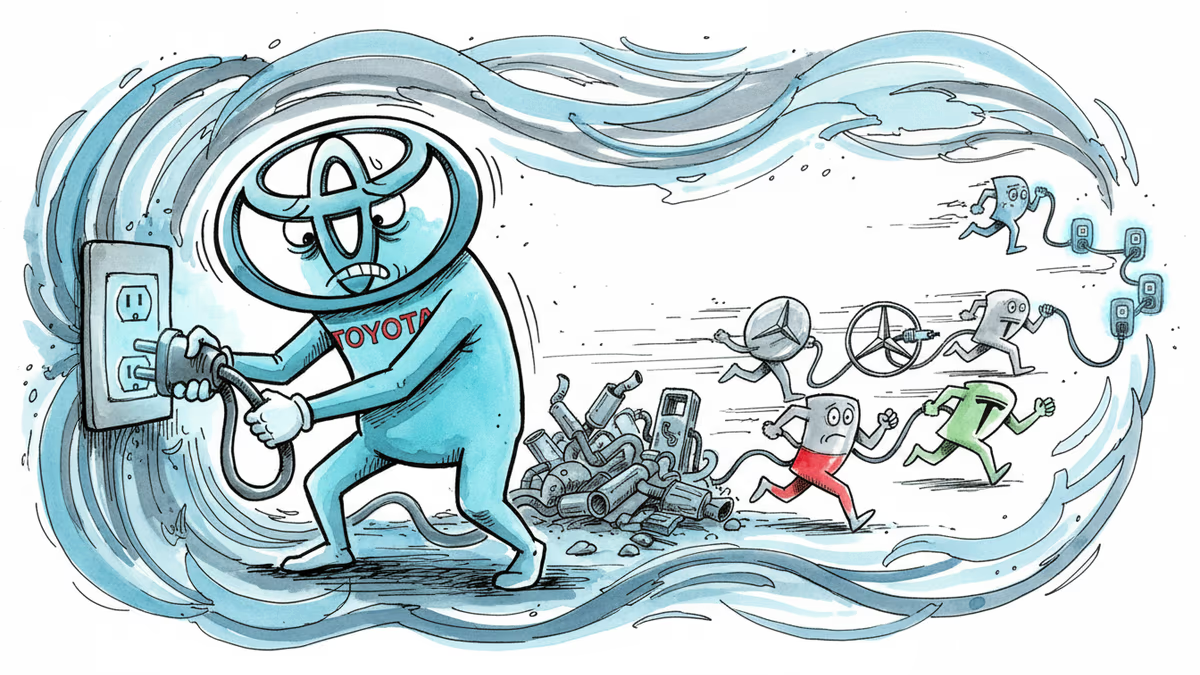
Why Toyota Finally Got Serious About Electric Cars
The world's largest automaker just boosted EV range by 25% and adopted Tesla's charging standard. What changed Toyota's mind about electric vehicles?
The world's biggest car company was the electric vehicle skeptic's biggest cheerleader. While competitors rushed into EVs, Toyota insisted hybrids made more sense given "limited battery supply." Their first serious EV attempt, the awkwardly named bZ4x, stumbled out of the gate with wheels literally falling off and lukewarm reviews.
Then something changed. The 2024 bZ delivers 314 miles of range—a 25% jump from its predecessor—and sports a Tesla-style charging port in North America. What finally convinced the hybrid king to go all-in on electrons?
The Numbers Tell a Different Story
Toyota's EV transformation isn't just marketing spin. The new bZ packs a 74.7 kWh battery that delivers 314 miles of EPA-rated range, compared to the previous model's 252 miles from 71.4 kWh. That's not just bigger batteries—it's smarter engineering.
The secret sauce? Silicon carbide power electronics that slash energy waste. While competitors focused on cramming in more battery cells, Toyota squeezed more efficiency from every electron. At $37,900 for the longest-range model, it's finally price-competitive with rivals like the Tesla Model Y and Hyundai Ioniq 5.
Tesla's Charging Gambit Pays Off
Perhaps the biggest shift isn't the car itself, but what plugs into it. By adopting Tesla's NACS charging standard in North America, Toyota just handed Elon Musk a massive validation. Tesla controls over 60% of US fast-charging infrastructure, and every major automaker—Ford, GM, Volkswagen, now Toyota—is bowing to that reality.

This isn't just about convenience. It's about eliminating the biggest barrier to EV adoption: charging anxiety. When Toyota customers can pull up to any Supercharger, the "where will I charge?" question largely disappears.
The Late-Mover Advantage?
Toyota's timing might be shrewder than it appears. While early EV adopters like Nissan and Chevrolet stumbled through battery degradation issues and software bugs, Toyota watched and learned. The bZ benefits from years of competitor mistakes—better thermal management, more reliable software, proven manufacturing at scale.
But there's a flip side. Tesla now owns 20% of the US EV market, while traditional luxury brands like BMW and Mercedes have established electric credibility. Toyota's hybrid reputation, once an asset, now feels like baggage in showrooms where buyers want to go fully electric.
What This Means for Everyone Else
Toyota's EV commitment sends ripples beyond automotive. Suppliers who bet on hybrid technology now need dual strategies. Charging networks must prepare for millions more EVs. Even oil companies are watching—when the world's largest automaker goes electric, demand projections change.
For consumers, it's validation that EVs have crossed the reliability threshold that Toyota demands. If the company that perfected the 20-year Camry is betting on electric, the technology has matured.
Authors
Related Articles
Waymo's new Ojai robotaxi isn't just a vehicle upgrade. It's the company's most serious attempt yet at cracking the cost problem that has kept autonomous vehicles from scaling. Here's what's really at stake.
The Ferrari Luce is finally here — 1,000 hp, a 122 kWh battery, and an interior designed by the team behind the iPhone. But the real story is what Ferrari risked to build it.
Mercedes-AMG's new GT 4-door coupe packs three YASA axial flux motors producing 1,153 hp and 1,475 lb-ft of torque. Here's what it means for the EV performance race—and who actually wins.
Auto China 2026 set records with 1,451 vehicles and 181 world premieres. But the real story isn't the size—it's how Chinese automakers stopped competing on price and started competing on brains.
Waymo's new Ojai robotaxi isn't just a vehicle upgrade. It's the company's most serious attempt yet at cracking the cost problem that has kept autonomous vehicles from scaling. Here's what's really at stake.
The Ferrari Luce is finally here — 1,000 hp, a 122 kWh battery, and an interior designed by the team behind the iPhone. But the real story is what Ferrari risked to build it.
Mercedes-AMG's new GT 4-door coupe packs three YASA axial flux motors producing 1,153 hp and 1,475 lb-ft of torque. Here's what it means for the EV performance race—and who actually wins.
Auto China 2026 set records with 1,451 vehicles and 181 world premieres. But the real story isn't the size—it's how Chinese automakers stopped competing on price and started competing on brains.
Thoughts
Share your thoughts on this article
Sign in to join the conversation