
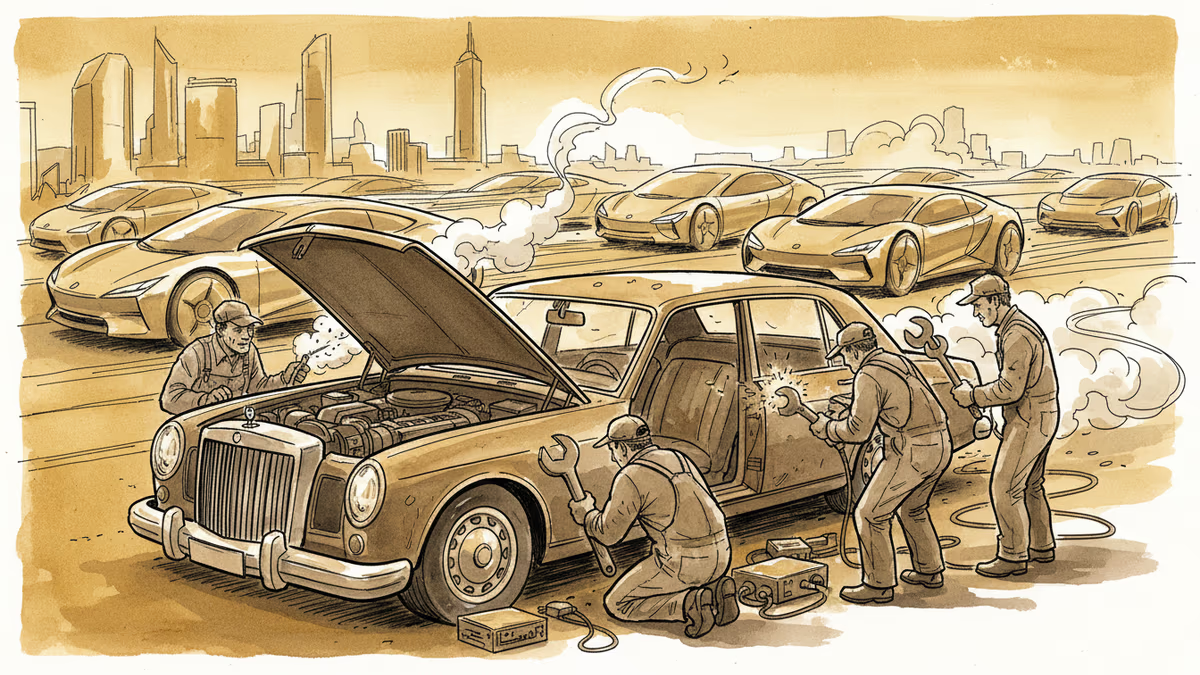
Why Lexus Is Taking Another Shot at Electric Luxury
The 2023 Lexus RZ was widely panned. Now the 2026 model comes with new motors, battery, and NACS charging. What this redesign reveals about luxury brands' electric vehicle strategy.
From Failure to Second Chance
When Lexus launched its first battery EV in 2023, automotive journalists weren't kind. One reviewer compared the RZ unfavorably to the "extremely not-good Vinfast VF8" – a brutal assessment for a luxury brand. But sometimes harsh feedback is exactly what's needed.
Fast-forward to 2026, and Lexus has essentially rebuilt the RZ from the ground up. New motors, new battery, NACS charging for North America, and a complete rethink of what an electric Lexus should be. The front-wheel-drive RZ 350e starts at $47,295, while the all-wheel-drive RZ 550e F Sport tops out at $58,295.
The Luxury EV Dilemma
This dramatic overhaul reveals a deeper struggle facing traditional luxury brands in the electric era. While Tesla carved out the premium EV space with tech-forward minimalism, established luxury marques are caught between heritage and innovation.
Mercedes-Benz doubled down on traditional luxury with the EQS. BMW went futuristic with the iX. Audi emphasized sportiness with the e-tron GT. Each brand is essentially asking: What does luxury mean when the engine disappears?
The challenge isn't just philosophical – it's practical. Luxury buyers expect perfection, but the EV market moves at startup speed. Traditional automakers, used to 5-7 year development cycles, are struggling to match the 2-3 year iteration pace of EV specialists.
Infrastructure as Brand Differentiator

The RZ's adoption of NACS charging is more significant than it appears. By embracing Tesla's charging standard, Lexus is essentially admitting that access trumps exclusivity in the EV world.
This marks a fundamental shift. Luxury car ownership used to be about exclusive dealerships and specialized service. Now it's about whether you can charge at the grocery store. The 50,000+ Tesla Supercharger network suddenly becomes more valuable than any luxury badge.
For luxury brands, this creates an uncomfortable reality: your customer experience is now partially dependent on your biggest competitor's infrastructure.
Performance vs. Pedigree
The RZ 550e F Sport's positioning is telling. Instead of emphasizing Lexus's traditional strengths – whisper-quiet cabins and cloud-like ride quality – it highlights immediate torque and sporty handling. This isn't just marketing; it's a strategic pivot.
Electric motors deliver instant performance that internal combustion engines can't match. But they also eliminate many of the engineering challenges that luxury brands used to excel at – engine refinement, transmission smoothness, noise isolation. In the EV era, what exactly are you paying $58,295 for?
The Speed of Forgiveness
Perhaps most interesting is how quickly Lexus moved to address the RZ's shortcomings. In the past, automakers might have waited for the next generation – typically 6-8 years – to make major improvements. Now, meaningful updates arrive in 2-3 years.
This compressed timeline has implications beyond product development. It suggests that modern consumers, especially in the luxury segment, are more forgiving of initial missteps if brands demonstrate rapid learning and improvement.
Authors
Related Articles
Waymo's new Ojai robotaxi isn't just a vehicle upgrade. It's the company's most serious attempt yet at cracking the cost problem that has kept autonomous vehicles from scaling. Here's what's really at stake.
Mercedes-AMG's new GT 4-door coupe packs three YASA axial flux motors producing 1,153 hp and 1,475 lb-ft of torque. Here's what it means for the EV performance race—and who actually wins.
Auto China 2026 set records with 1,451 vehicles and 181 world premieres. But the real story isn't the size—it's how Chinese automakers stopped competing on price and started competing on brains.

Expiring leases will flood the US used car market with over a million electric vehicles by 2028. Could this do what subsidies couldn't — make EVs genuinely affordable?
Waymo's new Ojai robotaxi isn't just a vehicle upgrade. It's the company's most serious attempt yet at cracking the cost problem that has kept autonomous vehicles from scaling. Here's what's really at stake.
Mercedes-AMG's new GT 4-door coupe packs three YASA axial flux motors producing 1,153 hp and 1,475 lb-ft of torque. Here's what it means for the EV performance race—and who actually wins.
Auto China 2026 set records with 1,451 vehicles and 181 world premieres. But the real story isn't the size—it's how Chinese automakers stopped competing on price and started competing on brains.
Expiring leases will flood the US used car market with over a million electric vehicles by 2028. Could this do what subsidies couldn't — make EVs genuinely affordable?
Thoughts
Share your thoughts on this article
Sign in to join the conversation