
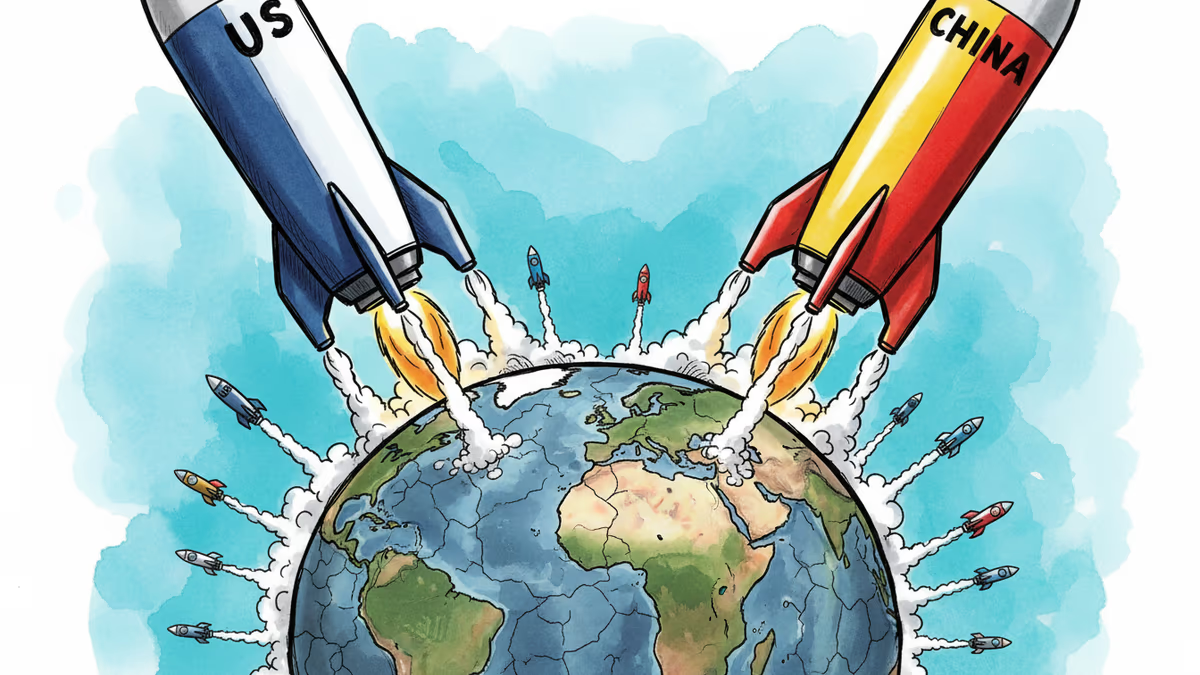
The Space Launch Duopoly Is Cracking
US allies like Australia, Canada, Germany, and Spain are investing billions to build domestic launch capabilities, challenging American and Chinese dominance in space access
90% of global satellite launches currently happen from American or Chinese launch pads. But that monopoly is showing its first cracks. A handful of middle powers—longtime US allies—are now betting billions that sovereign space access isn't just nice to have. It's national security.
The money tells the story. Australia just committed $50 million to Gilmour Space Technologies. Germany's backing Rocket Factory Augsburg with €80 million. Canada promised $120 million CAD to MDA Space for small launch vehicle development. Spain's throwing €40 million at PLD Space and their Miura rocket.
What these countries share isn't just ambition—it's vulnerability. None can independently put their own satellites into orbit today.
The Trump Factor Changes Everything
This isn't happening in a vacuum. The return of Donald Trump has fundamentally altered how allies think about dependence on American systems. Tariffs, trade wars, and threats to invade NATO territory have European capitals asking uncomfortable questions about every aspect of their security architecture.
Space access is no exception. During Trump's first term, SpaceX faced restrictions on launching certain foreign payloads. What happens when geopolitical tensions spike and launch services become another bargaining chip?
Dr. Sarah Mitchell, a space policy analyst at the Atlantic Council, puts it bluntly: "These countries watched what happened to European energy security when they became too dependent on Russian gas. They're not making the same mistake with space."
The numbers back up her concern. Europe's dependence on American launch services has only grown. 85% of European government satellites launched on US rockets in 2025, up from 60% in 2020.
More Than Just Rockets

But this isn't simply about launch vehicles. It's about the entire space supply chain. Australia's investment in Gilmour Space includes funding for satellite manufacturing and mission control systems. Germany's backing Rocket Factory Augsburg while simultaneously investing in domestic satellite production through OHB SE.
Spain's strategy is particularly clever. PLD Space's planned launch site in Andalusia could serve the entire Mediterranean region, offering polar orbit access that even SpaceX can't easily provide from Florida. The company's already signed preliminary agreements with Italian and French satellite operators.
Canada's taking a different approach. Rather than building everything from scratch, MDA Space is developing modular launch systems that can be rapidly deployed from multiple sites. Think of it as space launch's answer to distributed manufacturing.
The Economics Don't Add Up—Yet
Here's the uncomfortable truth: none of these ventures make economic sense today. SpaceX's Falcon 9 launches cost roughly $3,000 per kilogram to low Earth orbit. The new European entrants are targeting $8,000-12,000 per kilogram for their first commercial flights.
But that misses the point entirely. These aren't purely commercial ventures—they're strategic investments. Just as countries maintain domestic steel production or semiconductor fabs for national security reasons, space launch is becoming another "critical capability" that can't be outsourced.
Jean-Marc Astorg, former head of launch systems at the European Space Agency, explains: "The question isn't whether we can compete with SpaceX on price tomorrow. It's whether we can guarantee access to space when we need it, regardless of what's happening in Washington or Beijing."
The Ripple Effects
This trend is reshaping more than just the launch market. Defense contractors like Northrop Grumman and Lockheed Martin are suddenly facing competition from European and Australian firms for satellite contracts. Small satellite manufacturers from Germany's Berlin Space Technologies to Canada's Kepler Communications are finding new funding sources.
Even the insurance market is adapting. Lloyd's of London recently created new coverage categories for "sovereign launch risk"—essentially betting on whether countries can deliver on their space independence promises.
The venture capital world is taking notice too. European space startups raised €2.3 billion in 2025, triple the amount from 2023. Much of that money is flowing to companies that promise to reduce dependence on American or Chinese space services.
Authors
Related Articles

A US special forces soldier involved in the operation that captured Venezuela's Maduro allegedly used classified intel to bet on Polymarket, pocketing over $400,000. The case exposes a gaping hole in how prediction markets are regulated.

SpaceX wants to launch a million orbital data centers to power AI without draining Earth. The vision is compelling. The physics, economics, and debris math are not.

FBI's wiretapping and surveillance systems have been hacked. We analyze the strategic pattern behind China's cascade of cyberattacks and what it means for national security.
Senator Ted Cruz pressures NASA with legislation after the agency delays competition for ISS replacement. The political battle reveals deeper tensions in space commercialization.
A US special forces soldier involved in the operation that captured Venezuela's Maduro allegedly used classified intel to bet on Polymarket, pocketing over $400,000. The case exposes a gaping hole in how prediction markets are regulated.
SpaceX wants to launch a million orbital data centers to power AI without draining Earth. The vision is compelling. The physics, economics, and debris math are not.
FBI's wiretapping and surveillance systems have been hacked. We analyze the strategic pattern behind China's cascade of cyberattacks and what it means for national security.
Senator Ted Cruz pressures NASA with legislation after the agency delays competition for ISS replacement. The political battle reveals deeper tensions in space commercialization.
Thoughts
Share your thoughts on this article
Sign in to join the conversation