
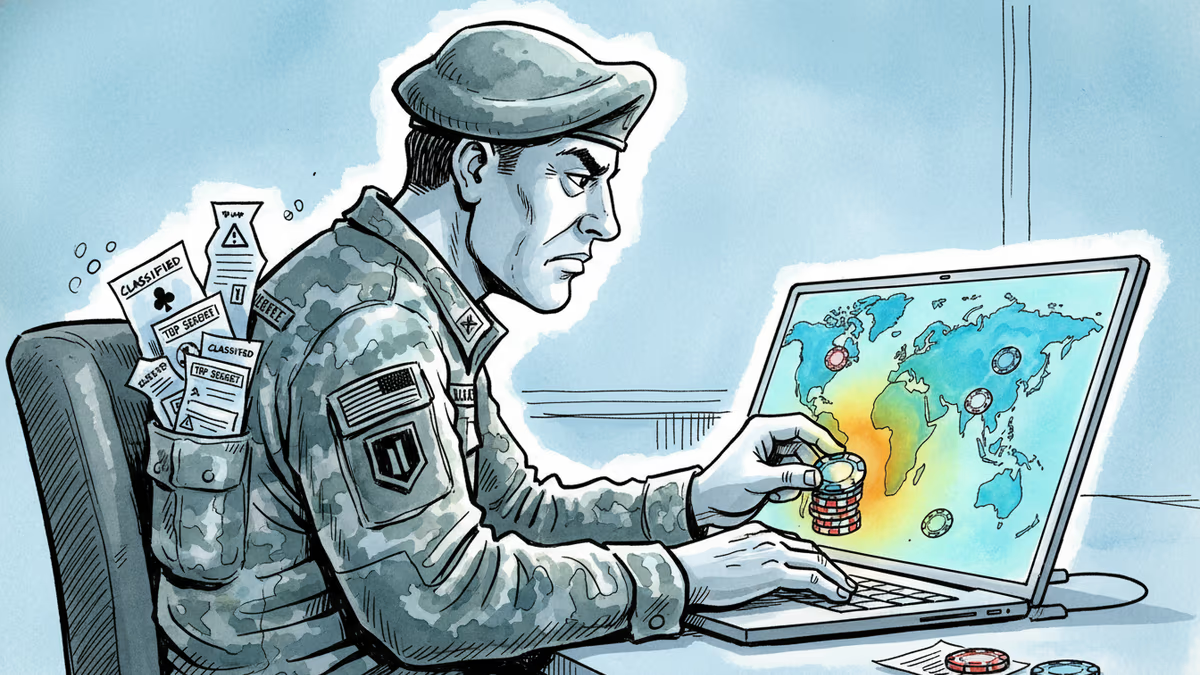
He Planned the Op. Then He Bet on It.
A US special forces soldier involved in the operation that captured Venezuela's Maduro allegedly used classified intel to bet on Polymarket, pocketing over $400,000. The case exposes a gaping hole in how prediction markets are regulated.
$400,000. That's roughly what a US special forces soldier allegedly made betting on the outcome of a covert operation he personally helped plan and execute.
The Justice Department indicted Gannon Ken Van Dyke on April 24, accusing him of using classified military intelligence to place bets on Polymarket — a prediction market platform where users wager on real-world events. The operation in question: Operation Absolute Resolve, the stratagem that toppled Venezuelan President Nicolás Maduro. Van Dyke was reportedly involved in its "planning and execution." Then, allegedly, he opened a Polymarket account and started betting on whether it would succeed.
What He Did, Step by Step
According to federal officials, Van Dyke created his Polymarket account in December 2025. Between December 27, 2025 and January 26, 2026, he placed 13 bets totaling $33,034 on markets like "U.S. Forces in Venezuela by January 31, 2026" and "Maduro out by January 31, 2026." When Maduro was removed from power, Van Dyke collected his winnings — over $400,000 in total profits, authorities allege.
He didn't stop there. After cashing out, officials say he took steps to obscure his connection to the account. He now faces charges including violations of the Commodity Exchange Act, wire fraud, and unlawful monetary transactions.
Acting Attorney General Todd Blanche didn't mince words: "Our men and women in uniform are trusted with classified information in order to accomplish their mission as safely and effectively as possible, and are prohibited from using this highly sensitive information for personal financial gain. Widespread access to prediction markets is a relatively new phenomenon, but federal laws protecting national security information fully apply."
Why Prediction Markets Make This Complicated
Polymarket operates on a deceptively simple premise: crowds, betting real money, are better at forecasting events than individual experts. Users stake crypto on yes/no questions about geopolitics, economics, elections — anything with a verifiable outcome. Over the past year, the platform has grown from a niche crypto curiosity into a mainstream fixture, striking deals with media organizations and sports bodies, and attracting attention from policymakers and investors alike.

But that growth has outpaced regulation. Traditional stock markets have decades of case law and statute governing insider trading — the idea that trading on material non-public information is fraud. Prediction markets occupy a murkier legal space. Legislation is currently being considered in the US that would ban public officials from using non-public information to bet on prediction platforms, but it hasn't passed yet.
Van Dyke's case is the first high-profile criminal indictment that tests exactly where that line sits.
Three Ways to Read This Story
From the military's perspective, this is a breach of trust that strikes at the core of how classified operations function. Van Dyke signed nondisclosure agreements explicitly prohibiting him from revealing sensitive information "by writing, words, conduct, or otherwise." The government is arguing that placing an informed financial bet constitutes a form of "conduct" that exploits classified knowledge — a novel interpretation that courts will now have to weigh in on.
From Polymarket's perspective, the case is an existential credibility problem. The platform's entire value proposition rests on the idea that its markets aggregate genuine public uncertainty into accurate forecasts. If insiders with asymmetric knowledge are quietly draining liquidity from uninformed bettors, that's not a wisdom-of-crowds mechanism — it's a rigged game. The platform hasn't publicly commented on the case.
From a retail user's perspective, the question is more uncomfortable: how many other Van Dykes are out there? Prediction markets currently have limited tools to identify whether a winning bettor had access to information the rest of the market didn't. Unlike public equities, there's no mandatory disclosure regime, no short-selling reporting threshold, no equivalent of a Form 4 filing.
What Comes Next
The legislative push to regulate prediction markets is gaining momentum precisely because cases like this make the stakes concrete. But regulation cuts both ways. Overly restrictive rules could stifle what many researchers argue is a genuinely useful forecasting tool. Too little oversight, and prediction markets become a quiet extraction mechanism for anyone with privileged access to information — government officials, corporate insiders, intelligence contractors.
The Van Dyke case also raises a subtler question about the nature of classified information itself. He didn't leak documents. He didn't brief a journalist. He placed bets. Is that a disclosure? The DOJ says yes. The courts will decide.
Authors
Related Articles
A US official involved in the operation to capture Venezuelan president Nicolás Maduro made over $400,000 on Polymarket bets days before it happened. Now he has a name.
Despite fierce competition, the CEOs of Polymarket and Kalshi have co-invested in 5(c) Capital, a $35M VC fund targeting prediction market infrastructure. What this signals for the industry.
The Golden Globes partnered with Polymarket. From war timelines to Nobel Prizes, prediction markets now price every uncertainty. What does that do to the way we experience the world?
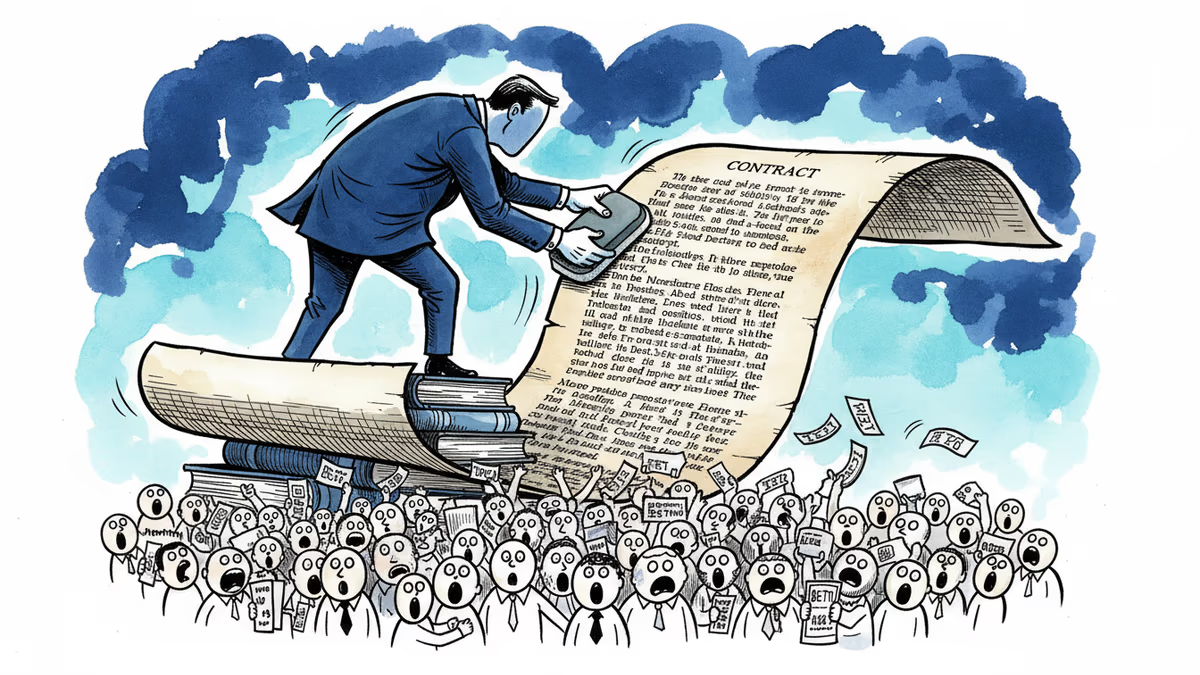
A class action lawsuit accuses Kalshi of changing payout rules after Iran's Supreme Leader Khamenei was killed. The case cuts to the heart of prediction market credibility.
A US official involved in the operation to capture Venezuelan president Nicolás Maduro made over $400,000 on Polymarket bets days before it happened. Now he has a name.
Despite fierce competition, the CEOs of Polymarket and Kalshi have co-invested in 5(c) Capital, a $35M VC fund targeting prediction market infrastructure. What this signals for the industry.
The Golden Globes partnered with Polymarket. From war timelines to Nobel Prizes, prediction markets now price every uncertainty. What does that do to the way we experience the world?
A class action lawsuit accuses Kalshi of changing payout rules after Iran's Supreme Leader Khamenei was killed. The case cuts to the heart of prediction market credibility.
Thoughts
Share your thoughts on this article
Sign in to join the conversation