

Rivals Kalshi and Polymarket Just Backed the Same VC Fund
Despite fierce competition, the CEOs of Polymarket and Kalshi have co-invested in 5(c) Capital, a $35M VC fund targeting prediction market infrastructure. What this signals for the industry.
They compete for the same users, the same liquidity, and arguably the same future. So why are their CEOs writing checks to the same fund?
The CEOs of Polymarket and Kalshi—two platforms locked in one of fintech's most aggressive rivalries—have both invested in 5(c) Capital, a new $35 million VC fund targeting prediction market infrastructure. Reported by Fortune and Bloomberg, the move isn't a détente. It's a tell: the prediction market space has grown large enough that even the fiercest competitors are betting on the ecosystem, not just their own slice of it.
What Happened
5(c) Capital takes its name from the regulatory clause that governs prediction markets in the US—a deliberately insider signal about who this fund is for. It was founded by two Kalshi alumni: Adhi Rajaprabhakaran, a former Kalshi trader, and Noah Zingler-Sternig, Kalshi's ex-head of operations.
The investor list is what turned heads. Kalshi CEO Tarek Mansour and Polymarket CEO Shayne Coplan both appear as backers. Marc Andreessen joined via Moneta Luna, one of his investment vehicles. Ribbit Capital founder Micky Malka also participated. Kalshi confirmed Mansour's involvement; Polymarket did not respond to requests for comment.
The fund's mandate is deliberate: it won't bet on prediction market platforms themselves. Instead, it targets founders building for the second-, third-, and fourth-order effects of the category's growth—roughly 20 companies focused on infrastructure like market makers and index designers.
Why This Matters Now

The timing isn't coincidental. Both platforms are in the middle of fundraising rounds that would have seemed implausible a year ago.
Kalshi is raising $1 billion at a $22 billion valuation—double the $11 billion it was valued at less than four months ago, per The Wall Street Journal. Polymarket is reportedly in talks for a new round at a $20 billion valuation. Combined, that's a $42 billion prediction market ecosystem taking shape in real time.
When two competing platforms are each worth more than $20 billion, the infrastructure they depend on becomes its own investable category. That's the thesis 5(c) Capital is running.
Think of it like the early internet: Amazon and eBay competed fiercely for e-commerce dominance, but both needed payment rails, logistics networks, and cloud infrastructure. The companies that built those layers—Stripe, Shopify, AWS—often outlasted the platform wars themselves.
Three Ways to Read This
For founders and investors: The prediction market stack is underdeveloped. Market makers, data feeds, risk management tools, compliance infrastructure—these layers don't exist at scale yet. 5(c) Capital is essentially saying: whoever wins the platform battle, the picks-and-shovels plays survive. It's a lower-variance bet on a high-conviction trend.
For regulators: The co-investment is notable beyond its financial logic. A bipartisan bill is already moving through Congress to ban sports betting on both Kalshi and Polymarket. When industry rivals align their capital around shared infrastructure, they also tend to align their lobbying. A joint ecosystem fund is, quietly, also a joint political interest.
For skeptics: Prediction market valuations are moving fast—perhaps too fast. Kalshi's valuation doubled in under four months, driven in part by the 2024 US election cycle, which brought unprecedented volume to these platforms. The question is whether that demand is structural or event-driven. If the next major political cycle underperforms expectations, $22 billion starts to look like a number that needs explaining.
Authors
Related Articles
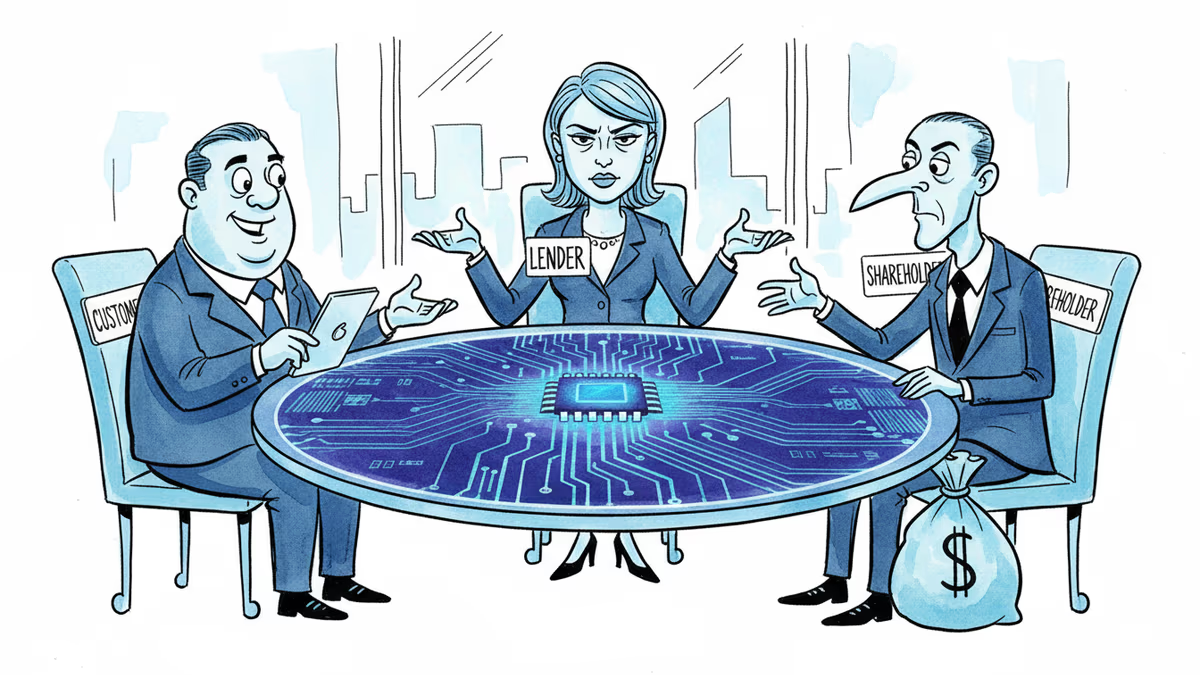
Cerebras Systems is targeting a $26.6B valuation in what could be 2026's largest tech IPO. But the real story is how deeply OpenAI is embedded in its capital structure—as customer, lender, and potential shareholder.

A US official involved in the operation to capture Venezuelan president Nicolás Maduro made over $400,000 on Polymarket bets days before it happened. Now he has a name.

A US special forces soldier involved in the operation that captured Venezuela's Maduro allegedly used classified intel to bet on Polymarket, pocketing over $400,000. The case exposes a gaping hole in how prediction markets are regulated.
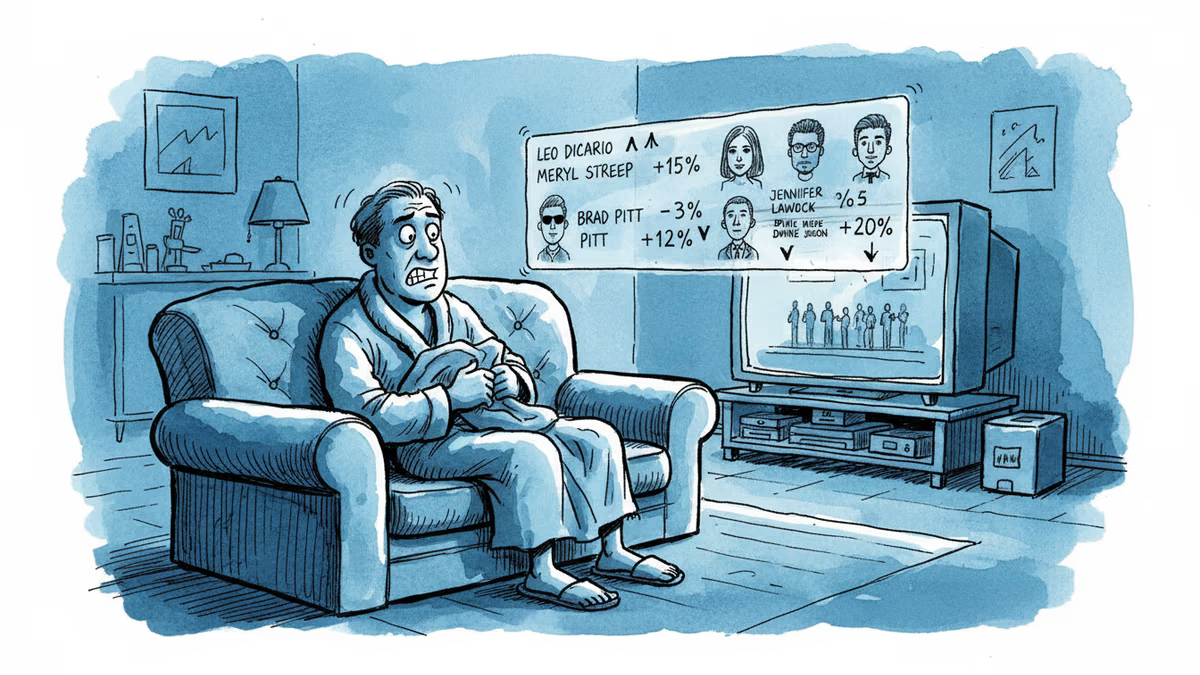
The Golden Globes partnered with Polymarket. From war timelines to Nobel Prizes, prediction markets now price every uncertainty. What does that do to the way we experience the world?
Cerebras Systems is targeting a $26.6B valuation in what could be 2026's largest tech IPO. But the real story is how deeply OpenAI is embedded in its capital structure—as customer, lender, and potential shareholder.
A US official involved in the operation to capture Venezuelan president Nicolás Maduro made over $400,000 on Polymarket bets days before it happened. Now he has a name.
A US special forces soldier involved in the operation that captured Venezuela's Maduro allegedly used classified intel to bet on Polymarket, pocketing over $400,000. The case exposes a gaping hole in how prediction markets are regulated.
The Golden Globes partnered with Polymarket. From war timelines to Nobel Prizes, prediction markets now price every uncertainty. What does that do to the way we experience the world?
Thoughts
Share your thoughts on this article
Sign in to join the conversation