
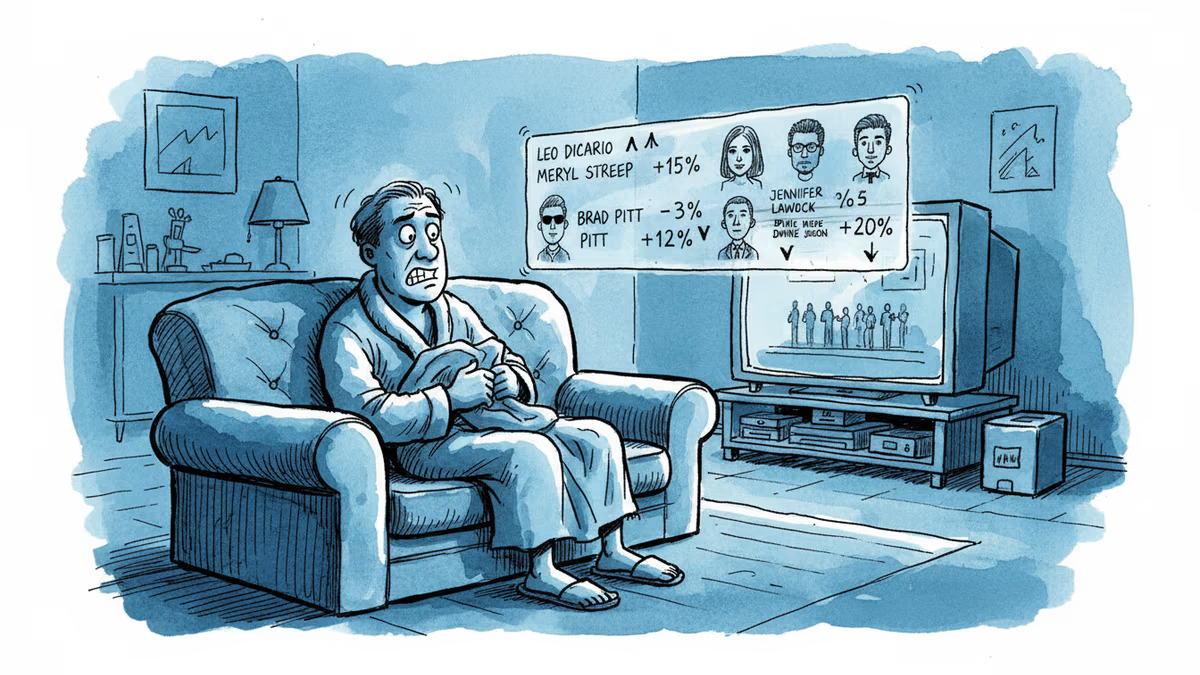
When Everything Becomes a Bet
The Golden Globes partnered with Polymarket. From war timelines to Nobel Prizes, prediction markets now price every uncertainty. What does that do to the way we experience the world?
What if the moment you started betting on whether your favorite film wins Best Picture, you stopped actually watching the film?
The Golden Globes Just Told You Something About Where Culture Is Heading
The Golden Globes recently partnered with Polymarket, the blockchain-based prediction market platform, for its awards ceremony. The reaction from most observers wasn't outrage—it was a shrug. And that shrug might be the most telling part of this story.
Polymarket lets users place real money on the outcome of future events using smart contracts. The range of available markets is staggering: the timing of geopolitical conflicts, Federal Reserve rate decisions, Nobel Prize winners, election results. Betting on which actor takes home a trophy is, by that standard, practically wholesome. The platform saw daily trading volumes exceeding hundreds of millions of dollars during the 2024 U.S. presidential election cycle, and mainstream outlets began citing its odds alongside—or instead of—traditional polling data.
The partnership with the Golden Globes is less a pivot than a logical next step.
How Prediction Markets Went Mainstream
Prediction markets aren't new. The Iowa Electronic Markets have been forecasting U.S. election outcomes since 1988, often outperforming professional pollsters. What changed recently is access and scale.
Platforms like Polymarket and Kalshi stripped away the institutional gatekeeping. Anyone with a crypto wallet can now participate. Kalshi spent years in legal battles with the CFTC before winning the right to operate election prediction markets in 2024—a ruling that effectively legitimized the broader concept in the United States. The regulatory dam didn't break all at once, but it cracked visibly.

For the Golden Globes, the calculus is straightforward. Broadcast viewership for major awards shows has been declining for over a decade. Turning a passive viewing experience into an interactive wagering event creates a new kind of engagement—the kind measured not in Nielsen ratings but in open positions and trading volume.
Three Stakeholders, Three Very Different Problems
For platforms like Polymarket, entertainment events are a user acquisition strategy wrapped in a press release. Low-stakes, high-visibility, morally uncomplicated. Nobody feels queasy betting on whether a film wins an award the way they might feel betting on when a ceasefire collapses.
For consumers, the line is blurrier. Sports betting has already normalized wagering on live events in much of the U.S., with 38 states having legalized it since the Supreme Court's 2018 ruling. Prediction markets feel like the next iteration of the same impulse. But critics argue there's a meaningful difference between betting on a football game and betting on cultural events—that financializing the latter changes the nature of the experience itself.
For regulators, the challenge is definitional. Is a prediction market a financial instrument, a gambling product, or something else entirely? The answer varies by jurisdiction, and the global patchwork of rules creates obvious arbitrage opportunities for platforms operating across borders.
The Bigger Pattern Worth Watching
This isn't really about the Golden Globes. It's about a broader architecture being quietly assembled: one where every uncertain outcome—artistic, political, scientific, social—has a real-time price attached to it.
Proponents argue this is epistemically useful. Markets aggregate dispersed information efficiently; prediction market prices can be more accurate signals than expert opinion. There's genuine academic support for this view.
But there's a counterargument that doesn't get enough attention: when you put a price on an outcome, you change how people relate to it. A film you've bet on is not the same experience as a film you haven't. An election you've got money riding on is not the same civic act as one you haven't. The question isn't just whether prediction markets are accurate—it's what they do to the texture of participation in public life.
Authors
Related Articles
A US official involved in the operation to capture Venezuelan president Nicolás Maduro made over $400,000 on Polymarket bets days before it happened. Now he has a name.

A US special forces soldier involved in the operation that captured Venezuela's Maduro allegedly used classified intel to bet on Polymarket, pocketing over $400,000. The case exposes a gaping hole in how prediction markets are regulated.
Despite fierce competition, the CEOs of Polymarket and Kalshi have co-invested in 5(c) Capital, a $35M VC fund targeting prediction market infrastructure. What this signals for the industry.
Generative AI tools dominated GDC 2026 — but most developers aren't shipping them in real games. What's holding the industry back, and what does that gap reveal?
A US official involved in the operation to capture Venezuelan president Nicolás Maduro made over $400,000 on Polymarket bets days before it happened. Now he has a name.
A US special forces soldier involved in the operation that captured Venezuela's Maduro allegedly used classified intel to bet on Polymarket, pocketing over $400,000. The case exposes a gaping hole in how prediction markets are regulated.
Despite fierce competition, the CEOs of Polymarket and Kalshi have co-invested in 5(c) Capital, a $35M VC fund targeting prediction market infrastructure. What this signals for the industry.
Generative AI tools dominated GDC 2026 — but most developers aren't shipping them in real games. What's holding the industry back, and what does that gap reveal?
Thoughts
Share your thoughts on this article
Sign in to join the conversation