
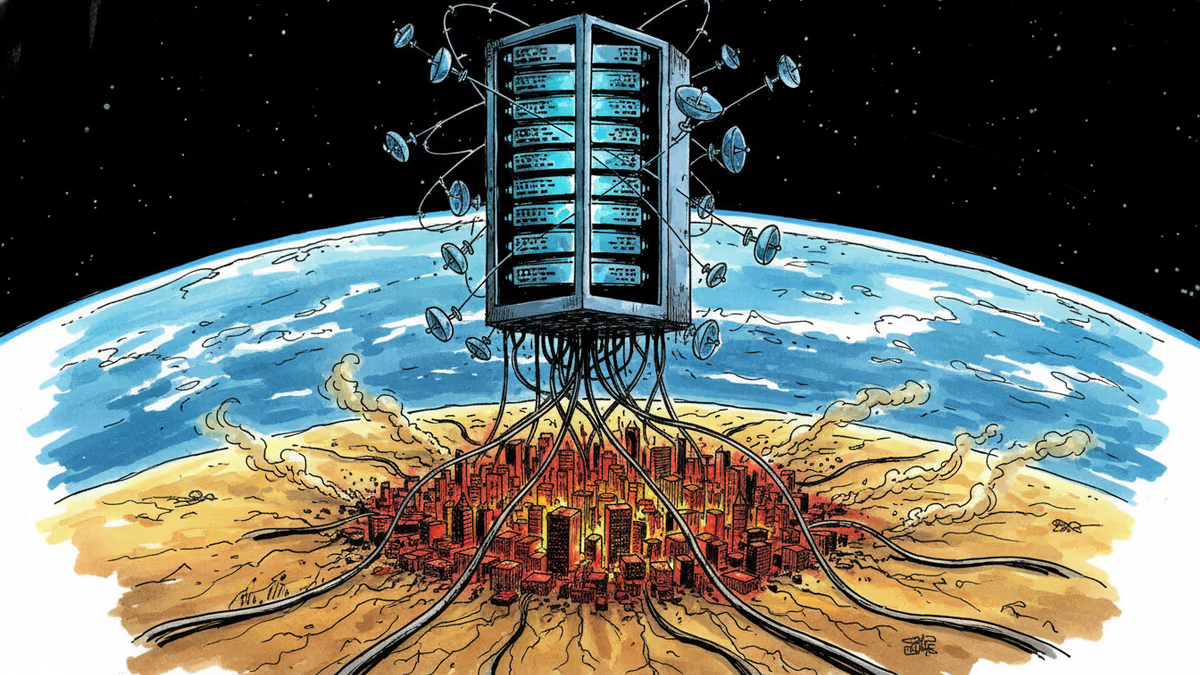
A Million Data Centers in Orbit — Genius or Hubris?
SpaceX wants to launch a million orbital data centers to power AI without draining Earth. The vision is compelling. The physics, economics, and debris math are not.
What if the cloud literally became the cloud?
One million. That's how many orbital data centers SpaceX proposed to the US Federal Communications Commission this past January. Not satellites for communication. Not weather monitors. Data centers — the kind that crunch the numbers behind every AI model you've ever used — floating in low Earth orbit.
The pitch is seductive. AI's energy appetite is straining power grids from Virginia to Singapore. Cooling the computers that train and run these models consumes staggering amounts of water. Communities near large data center clusters are already fighting back over rising utility costs and strained local infrastructure. So why not take the whole operation off-planet? Unlimited solar power. No water needed. Heat dissipated into the cold vacuum of space. Problem solved.
Except it isn't. Not yet, and maybe not ever at the scale being promised.
The physics don't care about the pitch deck
SpaceX isn't alone in this bet. Jeff Bezos has publicly predicted a future of large-scale computing in space. Google is planning a test constellation of 80 data-crunching satellites, potentially launching as early as next year. In November 2024, Washington-based startup Starcloud put a satellite equipped with an Nvidia H100 GPU into orbit — the first real-world test of an advanced AI chip in space. Starcloud envisions orbital facilities matching the scale of Earth's largest data centers by 2030.
But four hard engineering problems stand between the vision and reality.

Heat is the first paradox. Space seems like a perfect radiator — it's cold, after all. But in a sun-synchronous orbit (the kind needed for uninterrupted solar power), equipment temperatures never drop below 80°C. That's well above safe operating range for electronics. On Earth, heat dissipates through convection — air and water moving it away naturally. In vacuum, only radiation works, and radiation is far less efficient. Larger radiative surfaces help, but bulkier satellites are harder to cool. Lilly Eichinger, CEO of Austrian space tech firm Satellives, puts it plainly: "Thermal management and cooling in space is generally a huge problem." Yves Durand, former technology director at Thales Alenia Space, counters that refrigerant-loop systems already used in large telecom satellites could be adapted. His 2024 feasibility study concluded gigawatt-scale orbital data centers are achievable by 2050 — but they'd need solar arrays hundreds of meters across, larger than the International Space Station.
Radiation is the second wall. Earth's atmosphere and magnetosphere shield us from the constant barrage of cosmic particles and solar radiation. In orbit, there's no such protection. High-energy particles cause bit flips that corrupt data, degrade chip performance over time, and can physically displace atoms inside processors — permanent damage. Traditionally, space-hardened chips were built to survive this, but they're expensive and run years behind commercial performance. Nvidia announced in mid-March that it's developing GPU hardware specifically for orbital data centers, claiming radiation resilience at the system level through shielding, error-detection software, and hybrid architectures. Ken Mai, a principal systems scientist at Carnegie Mellon University, is measured in his enthusiasm: "You not only need to throw up a data center to space that meets your current needs; you need redundancy, extra parts, and reconfigurability, so when stuff breaks, you can just change your configuration and continue working."
Space debris is the third problem — and arguably the most politically charged. Low Earth orbit is already crowded. Starlink satellites alone perform hundreds of thousands of collision avoidance maneuvers every year. The estimated maximum safe capacity of low Earth orbit is around 240,000 satellites across all orbital shells. One million is not a number that fits. Greg Vialle, founder of orbital recycling startup Lunexus Space, is direct: "You can't have one million satellites around Earth unless it's a monopoly." And if SpaceX refreshes its orbital fleet every five years — which technology cycles would demand — a group of astronomers who filed objections to the FCC application calculates that debris reentry would jump from roughly 3-4 pieces per day to one every three minutes. Some scientists flag potential ozone layer damage and disruption to Earth's thermal balance as consequences no one has fully modeled.
Launch economics and assembly round out the quartet. Even SpaceX's forthcoming Starship — promising 6x the payload of Falcon 9 — can't loft a full-scale data center in one trip. Assembly in orbit requires advanced robotics that don't yet exist outside of Earth-based prototypes. The economics only pencil out if hardware survives long enough in orbit to justify the launch cost, which loops back to the radiation and debris problems.
So who actually benefits — and when?
The most credible near-term use case isn't replacing Earth's data centers. It's processing satellite imagery in orbit before transmitting it down. Earth observation satellites generate enormous datasets; competition for ground station downlink bandwidth is growing. Processing on-board — using something like Starcloud's H100-equipped satellite — cuts transmission costs and latency dramatically. For companies selling agricultural analytics, maritime tracking, or climate monitoring, that's a real and immediate value proposition.
Durand frames the trajectory well: "You can start with small servers and gradually increase and build up larger data centers. You can use modularity. You can learn little by little." That's a different story than a million satellites solving AI's energy crisis by 2030.
For investors, the distinction matters. Companies building orbital edge-computing infrastructure for specific data-processing applications are solving a defined problem with near-term revenue. Companies pitching orbital data centers as a wholesale replacement for terrestrial AI infrastructure are, at best, a decade-plus bet — and at worst, a narrative that runs ahead of physics.
For policymakers, the FCC's response to SpaceX's application will set a precedent. Approving a million-satellite constellation without enforceable debris mitigation and deorbit requirements could lock in orbital congestion for generations. The regulatory frameworks governing Earth's orbit were not designed for this scale, and they're not keeping up.
Authors
Related Articles

American Airlines just signed Starlink for 500+ aircraft. It's not just about faster inflight internet — it's a calculated move in the run-up to what could be the largest IPO in history.
SpaceX's upgraded Starship V3 completed its first test flight, deploying 20 Starlink simulators but losing the Super Heavy booster. With an IPO weeks away, the stakes just got higher.
SpaceX's IPO filing puts AI at the center, claiming a $26.5 trillion market opportunity. But can Grok compete with OpenAI and Anthropic for enterprise customers?
SpaceX filed a nearly 400-page S-1 with the SEC, targeting an IPO as early as June 12. Here's what the filing reveals—and what it doesn't.
American Airlines just signed Starlink for 500+ aircraft. It's not just about faster inflight internet — it's a calculated move in the run-up to what could be the largest IPO in history.
SpaceX's upgraded Starship V3 completed its first test flight, deploying 20 Starlink simulators but losing the Super Heavy booster. With an IPO weeks away, the stakes just got higher.
SpaceX's IPO filing puts AI at the center, claiming a $26.5 trillion market opportunity. But can Grok compete with OpenAI and Anthropic for enterprise customers?
SpaceX filed a nearly 400-page S-1 with the SEC, targeting an IPO as early as June 12. Here's what the filing reveals—and what it doesn't.
Thoughts
Share your thoughts on this article
Sign in to join the conversation