

Tesla Unleashes Empty Cars in Austin: A High-Stakes Gamble to Justify its AI Fantasy
Tesla is testing fully driverless cars in Austin. PRISM analyzes why this is a high-stakes gamble to catch Waymo, testing its camera-only AI in a key regulatory gray area.
The Lede
Tesla has begun testing its vehicles on public roads in Austin, Texas with no one inside—a milestone that is less a technology victory lap and more a high-stakes bet to catch up in a race it's already losing. While Elon Musk's supporters celebrate this as the dawn of the Robotaxi era, for investors and industry strategists, this move is a calculated gamble in a favorable regulatory environment, designed to prove a controversial technology thesis and justify a valuation built on future promises, not current reality.
Why It Matters
This isn't just about a few cars driving themselves. This is the first real-world, public test of Tesla's core autonomous strategy against established leaders like Waymo. For years, Musk has promised that millions of Teslas would become appreciating assets via an autonomous ride-hailing network. By removing the human safety driver, Tesla is forcing the issue. This move shifts the narrative from a perpetually-in-beta consumer feature (FSD) to a potential commercial service. The second-order effect is a direct challenge to the industry's multi-sensor orthodoxy (LiDAR, radar, cameras) with Tesla's camera-only approach. If it succeeds, it could upend the cost structure of autonomous vehicles; if it fails, it could trigger a regulatory crackdown and shatter the AI-centric valuation propping up Tesla's stock.
The Analysis
A Regulatory Proving Ground by Design

Tesla's choice of Austin is no accident. Texas currently operates under a permissive legal framework, allowing AV testing as long as vehicles obey traffic laws. This regulatory 'light touch' is a stark contrast to California, where Waymo underwent years of rigorous permitting and where Tesla has not yet even applied for driverless testing permits. Tesla is engaging in regulatory arbitrage, seeking the path of least resistance to gather data and prove its concept. However, this window is closing. A new Texas law taking effect in May 2026 will require formal DMV authorization for commercial AVs, meaning Tesla has a roughly 18-month runway to demonstrate its system's safety before facing stricter oversight. This is a race against the clock as much as a technology trial.
The Data Paradox: Miles Driven vs. Proven Safety
Tesla's greatest asset is the billions of miles of data collected from its consumer fleet. The company's argument is that this massive dataset gives its neural network an unparalleled understanding of real-world driving. Yet, this is a different class of data. It's largely 'shadow mode' data or from consumer-supervised FSD, not from a dedicated, fully autonomous commercial operation. The competition, while having fewer total miles, has more relevant miles. Waymo has operated fully driverless commercial services for years, meticulously validating its geofenced approach.
The early data from Austin is concerning. As Carnegie Mellon's Philip Koopman noted, seven collisions in a small fleet of under 30 vehicles—even with safety supervisors present—is a statistical red flag. Tesla’s refusal to release narrative details about these incidents further obscures the true safety profile of its system, a move that contrasts with the greater transparency of rivals in the AV space.
A High-Stakes Bet on Vision-Only
This Austin test is the ultimate referendum on Tesla's 'vision-only' strategy. By eschewing LiDAR and radar, Tesla significantly lowers hardware costs but bets everything on its AI's ability to interpret the world through cameras alone. Competitors like Waymo and Cruise (before its own setbacks) use a 'belt and suspenders' approach with multiple, redundant sensor types. They argue LiDAR is essential for reliability in adverse weather and for detecting object distances with infallible precision. Tesla's deployment of empty vehicles is a defiant statement that its software can overcome the physical limitations of cameras. The industry is watching closely: a single failure caused by an edge case a LiDAR system might have caught could be catastrophic for Tesla's entire AV program.
PRISM's Take
Tesla's deployment of driverless cars in Austin is an act of aggressive, almost desperate, innovation. It's a necessary move to close the vast operational gap with Waymo and to finally begin delivering on a decade of audacious promises. However, by leveraging a temporary regulatory loophole to test a controversial technology stack on public streets, Tesla is not just testing its cars; it's testing public trust. The 'move fast and break things' ethos of software development is profoundly dangerous when applied to two-ton vehicles in urban environments. While this is a significant engineering milestone, it's premature to call it a success. The real verdict will be written in the safety data and regulatory responses that emerge from the streets of Austin over the coming months.
Authors
Related Articles
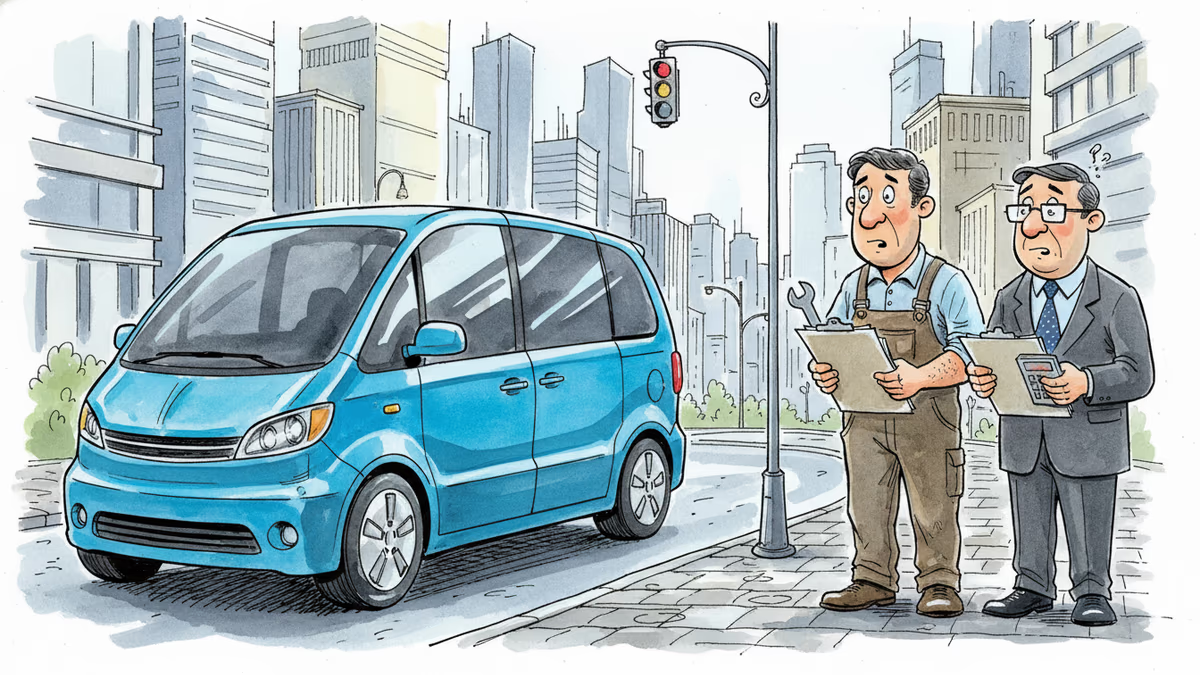
Waymo's new Ojai robotaxi isn't just a vehicle upgrade. It's the company's most serious attempt yet at cracking the cost problem that has kept autonomous vehicles from scaling. Here's what's really at stake.
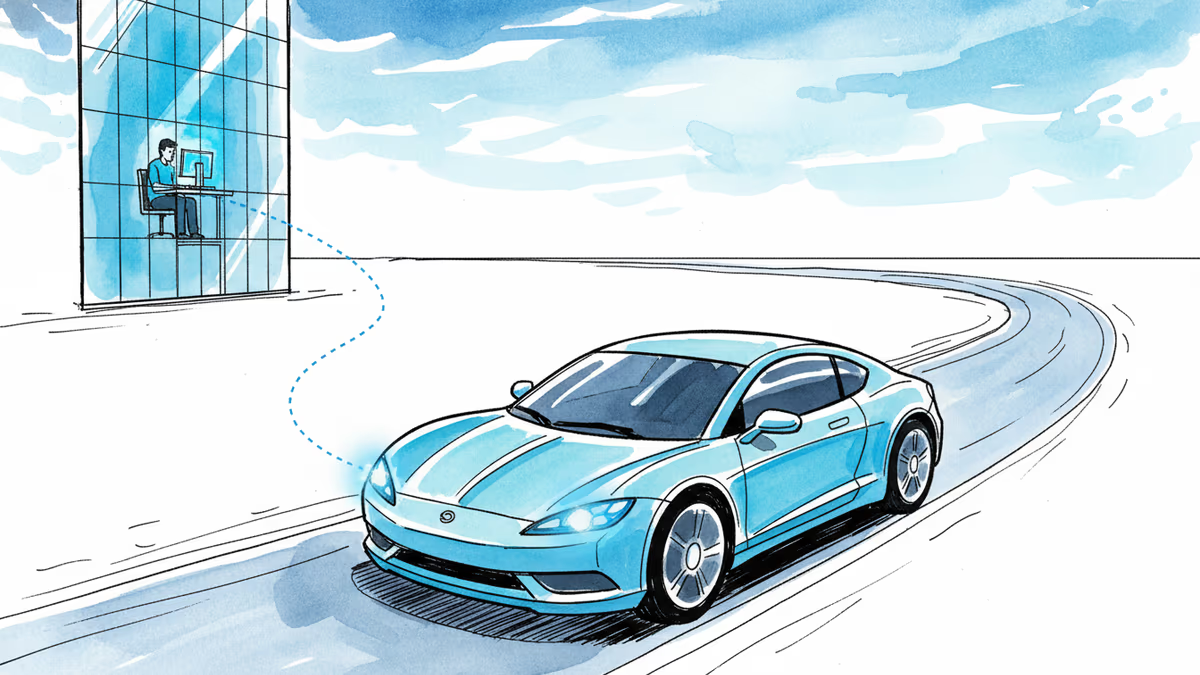
A U.S. Senate investigation found that seven autonomous vehicle companies — including Waymo and Tesla — refused to disclose how often remote operators intervene in their vehicles. Here's why that silence matters.
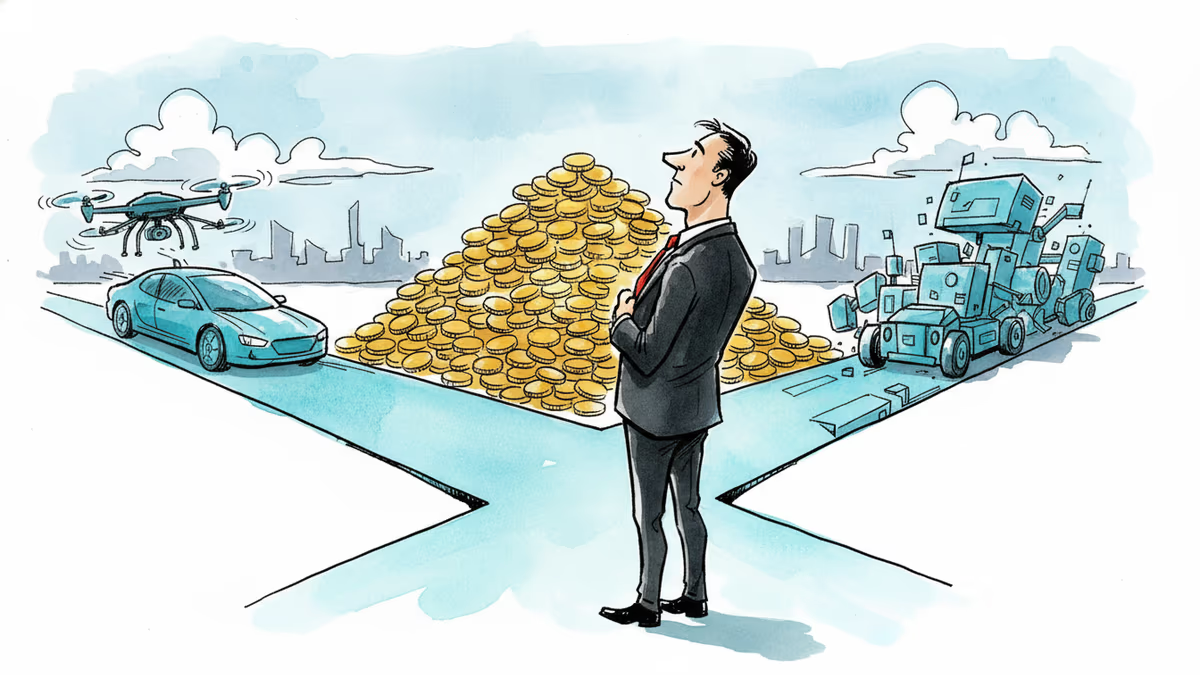
Alphabet's new pay deal for Sundar Pichai links his compensation to Waymo and Wing performance—signaling where Google is placing its biggest bets. Here's what investors should actually read into it.
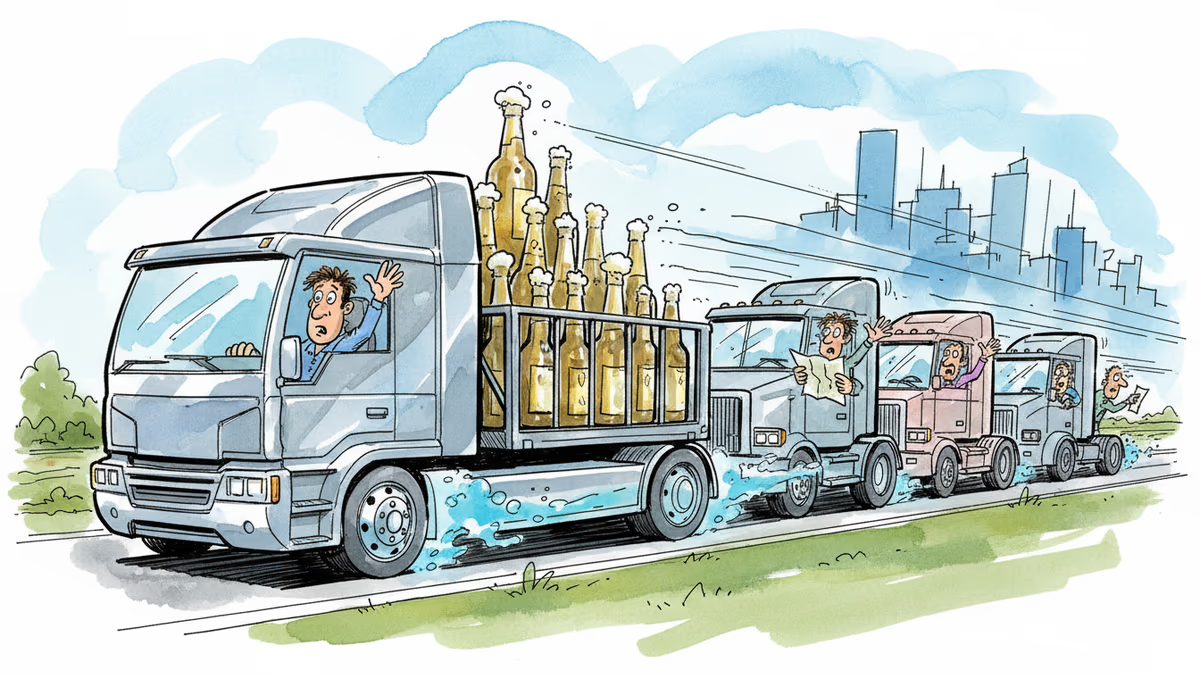
Swedish startup Einride raises $113M ahead of NYSE debut, deploying 200 autonomous trucks for major brands. The logistics revolution accelerates.
Waymo's new Ojai robotaxi isn't just a vehicle upgrade. It's the company's most serious attempt yet at cracking the cost problem that has kept autonomous vehicles from scaling. Here's what's really at stake.
A U.S. Senate investigation found that seven autonomous vehicle companies — including Waymo and Tesla — refused to disclose how often remote operators intervene in their vehicles. Here's why that silence matters.
Alphabet's new pay deal for Sundar Pichai links his compensation to Waymo and Wing performance—signaling where Google is placing its biggest bets. Here's what investors should actually read into it.
Swedish startup Einride raises $113M ahead of NYSE debut, deploying 200 autonomous trucks for major brands. The logistics revolution accelerates.
Thoughts
Share your thoughts on this article
Sign in to join the conversation