
Why Uber's Betting on Self-Driving Cars Again
Toronto-based autonomous driving startup Waabi pivots from trucking to robotaxis, partnering with Uber. Analyzing the strategic shift and market implications for autonomous vehicle development.
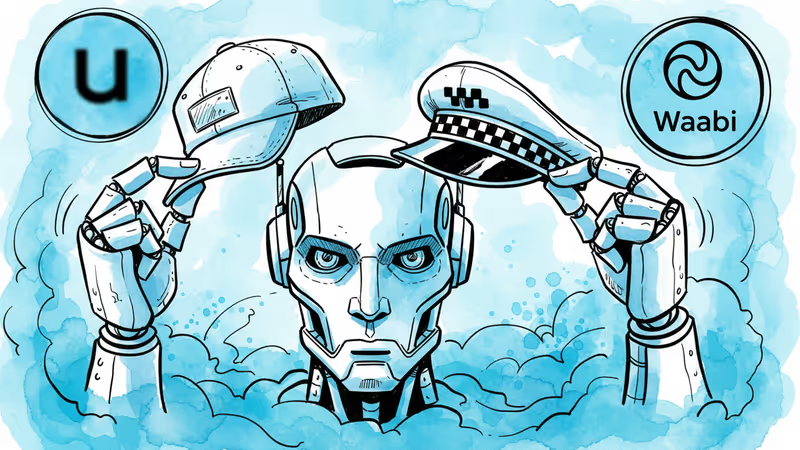
Self-driving trucks turned out to be harder than anyone expected. Now companies are quietly shifting gears, and Toronto-based startup Waabi is the latest to make the pivot—from autonomous trucking to robotaxis. This time, Uber is coming along for the ride.
From Highways to City Streets
Raquel Urtasun, former chief scientist at Uber's now-defunct Advanced Technologies Group, founded Waabi in 2021 with what she called a "more AI-centric approach" to autonomous vehicles. The company initially focused on trucking, using proprietary software to automate commercial delivery routes in Texas.
The logic seemed sound: highways are more predictable than city streets, and the trucking industry desperately needs solutions for driver shortages. But reality proved more complex. The weight and size of commercial trucks, combined with stringent safety requirements for freight operations, created technical challenges that weren't easily solved.
Meanwhile, robotaxis have been having their moment. Waymo operates commercial services across multiple cities, and even Cruise—despite its setbacks—demonstrated that autonomous passenger vehicles could work in real-world conditions. Waabi's strategic shift reflects this changing landscape.
Uber's Second Act in Self-Driving
When Uber sold its Advanced Technologies Group to Aurora for $4.1 billion in 2020, it seemed like the end of the company's self-driving ambitions. COVID-19 had strained finances, and autonomous vehicle development was burning cash with no clear timeline for returns.

So why is Uber back in the game? The answer lies in existential economics. If robotaxis become mainstream, traditional ride-hailing companies face a stark choice: adapt or become irrelevant. Companies that own autonomous fleets could potentially offer rides at a fraction of current costs, cutting out driver payments entirely.
For Uber, partnering with Waabi represents a hedge against this future. Rather than developing the technology in-house—an expensive and risky proposition—the company can leverage external innovation while maintaining its platform dominance.
The Broader Market Dynamics
This partnership reflects broader shifts in the autonomous vehicle ecosystem. Pure-play AV companies like Waabi bring focused technical expertise but need distribution channels and operational scale. Platform companies like Uber have the infrastructure and customer base but lack cutting-edge AV technology.
The trucking-to-robotaxis pivot also highlights how AI companies are becoming more pragmatic about market opportunities. While long-haul trucking remains a massive market, the regulatory and technical hurdles are proving higher than anticipated. Consumer robotaxis, despite their own challenges, offer clearer paths to commercialization.
What This Means for Consumers
If successful, the Waabi-Uber partnership could accelerate robotaxi deployment beyond current leaders like Waymo. More competition typically means better services and lower prices for consumers. However, it also raises questions about market concentration—will a handful of tech companies ultimately control urban transportation?
There's also the employment angle. Every autonomous vehicle potentially displaces human drivers, and the scale of ride-hailing platforms could amplify this impact. The transition period will be crucial for determining whether this technology creates new opportunities or simply eliminates existing jobs.
Authors
Related Articles

Uber and WeRide have launched fully driverless robotaxi service in Dubai — no safety operator, real fares. Here's what it means for the global AV race and your next ride.
Uber partners with China's Pony AI and Croatia's Verne to launch Europe's first commercial robotaxi service. Is this a survival strategy or a sign that the ride-hail giant is ceding its future to others?
Swedish startup Einride raises $113M ahead of NYSE debut, deploying 200 autonomous trucks for major brands. The logistics revolution accelerates.
Dubai signs deals with three unproven US transport companies after previous $450M Hyperloop failure and GM Cruise debacle. Will underground tunnels, flying pods, and air taxis work?
Uber and WeRide have launched fully driverless robotaxi service in Dubai — no safety operator, real fares. Here's what it means for the global AV race and your next ride.
Uber partners with China's Pony AI and Croatia's Verne to launch Europe's first commercial robotaxi service. Is this a survival strategy or a sign that the ride-hail giant is ceding its future to others?
Swedish startup Einride raises $113M ahead of NYSE debut, deploying 200 autonomous trucks for major brands. The logistics revolution accelerates.
Dubai signs deals with three unproven US transport companies after previous $450M Hyperloop failure and GM Cruise debacle. Will underground tunnels, flying pods, and air taxis work?
Thoughts
Share your thoughts on this article
Sign in to join the conversation