
Waymo's Airport Win Signals Robotaxi Maturity—But Safety Questions Linger
Waymo finally launches San Francisco Airport service after years of negotiations, marking a crucial milestone for robotaxi viability while facing fresh safety investigations.
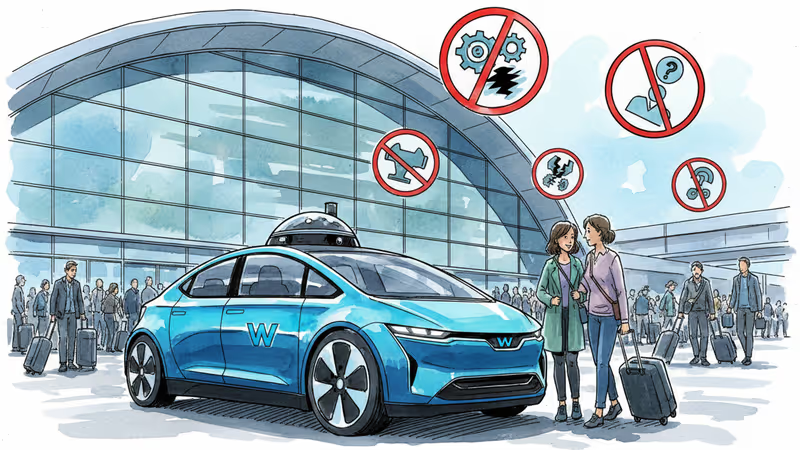
After years of bureaucratic battles and false starts, Waymo has finally cracked the code to one of autonomous driving's most coveted prizes: San Francisco International Airport. The Alphabet-owned company announced Thursday it's launching robotaxi service to and from SFO, starting with select riders before rolling out to all customers in the coming months.
This isn't just another route expansion—it's a strategic victory that could define the future of urban mobility.
Why Airports Are Robotaxi Gold Mines
Airports represent the holy grail for autonomous vehicle companies, and for good reason. They offer predictable routes, high-value customers willing to pay premium fares, and consistent demand. "Serving rides to and from San Francisco International Airport delivers one of the most requested features for our riders," said Waymo co-CEO Tekedra Mawakana.
The numbers tell the story. Airport rides typically command 2-3x higher fares than regular city trips, and passengers are less price-sensitive when they're racing to catch a flight or arriving exhausted from travel. For Waymo, which already serves San Jose Airport and Phoenix Sky Harbor, SFO represents access to one of the world's busiest airports—a gateway to proving robotaxis can handle real-world commercial viability.
Pickups and dropoffs will occur at the SFO Rental Car Center, accessible via AirTrain. It's a controlled environment that plays to autonomous vehicles' strengths: structured routes, clear signage, and predictable traffic patterns.
The Expansion-Safety Tension

Waymo's aggressive growth trajectory over the past year tells a story of a company racing toward scale. The service now covers most of the San Francisco Bay Area, Silicon Valley, and operates in Atlanta, Austin, Los Angeles, Miami, and Phoenix. They've added freeways to their operational domain and significantly expanded their fleet size.
But this rapid expansion comes with growing pains that raise uncomfortable questions about the technology's readiness. On the same day Waymo announced its SFO victory, the company revealed that one of its robotaxis struck a child near a Santa Monica elementary school on January 23. The child sustained minor injuries, and the National Highway Traffic Safety Administration has launched an investigation.
This incident adds to mounting regulatory scrutiny. NHTSA and the National Transportation Safety Board are already investigating Waymo's robotaxis for illegal behavior around school buses. The timing is particularly awkward—celebrating airport access while defending safety incidents creates an uncomfortable narrative tension.
The Long Road to SFO
Waymo's path to SFO wasn't smooth. The company tried and failed to secure a mapping permit in 2023—the first step toward bringing robotaxis to the airport. After rebooting negotiations with city and airport authorities, Waymo finally received a permit in March 2025 with data-sharing requirements attached.
By September, SFO and Waymo signed a testing and operations pilot permit, setting the stage for commercial operations. This three-year journey highlights the complex regulatory landscape autonomous vehicle companies must navigate, especially for high-stakes locations like major airports.
What This Means for the Industry
Waymo's SFO breakthrough signals that robotaxis are moving from experimental curiosity to practical transportation option. For competitors like Cruise, Zoox, and traditional rideshare companies, this represents both validation of the market opportunity and increased pressure to secure their own airport partnerships.
The broader implications extend beyond just autonomous vehicles. Traditional taxi companies, airport shuttles, and even public transit systems will need to adapt to this new competitive landscape. If robotaxis can reliably serve airports—historically one of the most challenging transportation scenarios—it suggests the technology is approaching genuine commercial viability.
Authors
Related Articles
Waymo's new Ojai robotaxi isn't just a vehicle upgrade. It's the company's most serious attempt yet at cracking the cost problem that has kept autonomous vehicles from scaling. Here's what's really at stake.
Tesla expanded its driverless robotaxi to Dallas and Houston, even after reporting 14 crashes in Austin. What does this tell us about how autonomous vehicles actually get built?
A U.S. Senate investigation found that seven autonomous vehicle companies — including Waymo and Tesla — refused to disclose how often remote operators intervene in their vehicles. Here's why that silence matters.
Uber and WeRide have launched fully driverless robotaxi service in Dubai — no safety operator, real fares. Here's what it means for the global AV race and your next ride.
Waymo's new Ojai robotaxi isn't just a vehicle upgrade. It's the company's most serious attempt yet at cracking the cost problem that has kept autonomous vehicles from scaling. Here's what's really at stake.
Tesla expanded its driverless robotaxi to Dallas and Houston, even after reporting 14 crashes in Austin. What does this tell us about how autonomous vehicles actually get built?
A U.S. Senate investigation found that seven autonomous vehicle companies — including Waymo and Tesla — refused to disclose how often remote operators intervene in their vehicles. Here's why that silence matters.
Uber and WeRide have launched fully driverless robotaxi service in Dubai — no safety operator, real fares. Here's what it means for the global AV race and your next ride.
Thoughts
Share your thoughts on this article
Sign in to join the conversation