
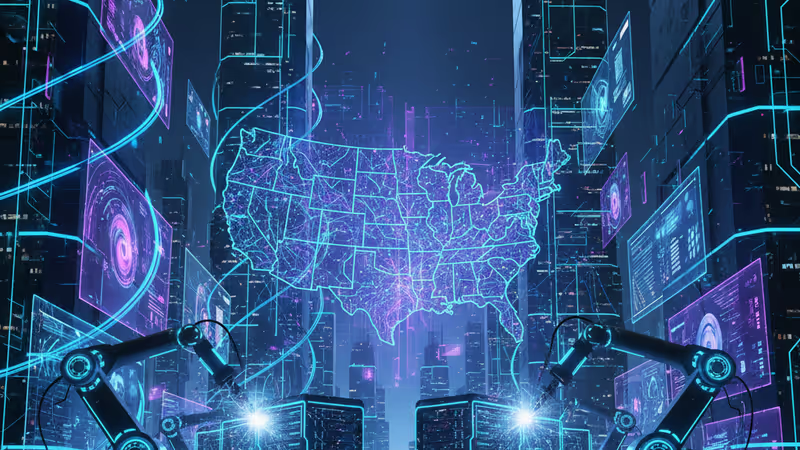
OpenAI Targets U.S. AI Supply Chain Dominance with New RFP
OpenAI launches a strategic RFP to bolster the U.S. AI supply chain, focusing on manufacturing, job creation, and infrastructure scaling by 2026.
AI infrastructure is a trillion-dollar race, and OpenAI just made a massive move to secure the home turf. The company has launched a new Request for Proposal (RFP) specifically designed to strengthen the U.S. AI supply chain. It's not just about code anymore; it's about bricks, mortar, and silicon.
Accelerating OpenAI U.S. AI Supply Chain RFP 2026 Goals
According to Reuters, the initiative focuses on accelerating domestic manufacturing and scaling infrastructure at an unprecedented rate. By January 2026, OpenAI aims to have a concrete framework for job creation and industrial scaling. This move aligns with broader national interests to reduce dependency on foreign hardware components.

From Jobs to Massive Infrastructure Scaling
The RFP doesn't just look for vendors; it seeks partners to build the foundation of the next industrial era. While critics point to the billions of dollars in required capital, proponents argue that domestic control over the AI stack is essential for national security and economic resilience.
Authors
Related Articles
Snowflake's new $6 billion AWS contract is about more than cloud spending. It signals a shift in AI infrastructure—away from Nvidia GPUs and toward cheaper, homegrown chips for the agent era.

OpenAI has reorganized for the second time in a month, merging ChatGPT and Codex into a single agentic platform under president Greg Brockman's unified product leadership.

After two weeks of witnesses calling him a liar, OpenAI CEO Sam Altman testified in his own defense, claiming Elon Musk tried to kill the company twice.

Sam Nelson, 19, died after following ChatGPT's advice to mix Kratom and Xanax. His parents are suing OpenAI for wrongful death, raising urgent questions about AI trust, liability, and design.
Snowflake's new $6 billion AWS contract is about more than cloud spending. It signals a shift in AI infrastructure—away from Nvidia GPUs and toward cheaper, homegrown chips for the agent era.
OpenAI has reorganized for the second time in a month, merging ChatGPT and Codex into a single agentic platform under president Greg Brockman's unified product leadership.
After two weeks of witnesses calling him a liar, OpenAI CEO Sam Altman testified in his own defense, claiming Elon Musk tried to kill the company twice.
Sam Nelson, 19, died after following ChatGPT's advice to mix Kratom and Xanax. His parents are suing OpenAI for wrongful death, raising urgent questions about AI trust, liability, and design.
Thoughts
Share your thoughts on this article
Sign in to join the conversation