
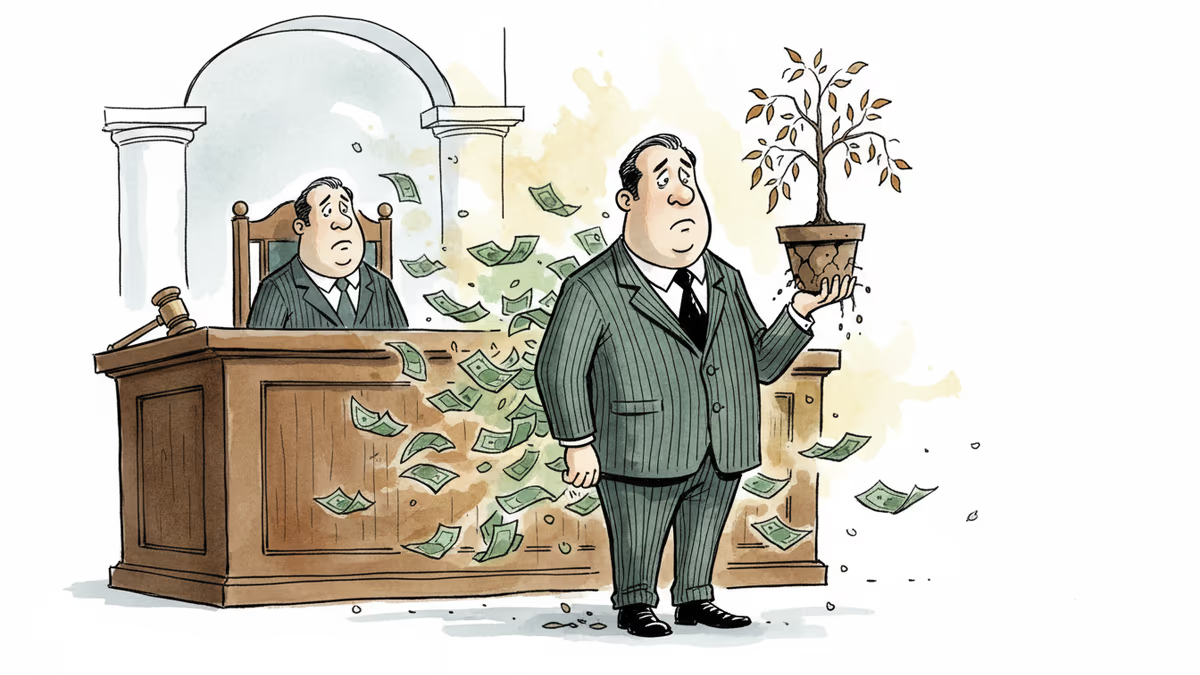
The $60 Million Letter Steve Ballmer Didn't Have to Write
Former Microsoft CEO Steve Ballmer publicly admitted losing $60 million to green fintech startup Aspiration Partners, whose founder pleaded guilty to wire fraud. What the case reveals about ESG investing and Silicon Valley's culture of founder mythology.
"I was duped and feel silly about that."
Billionaires rarely say that out loud. Steve Ballmer—former Microsoft CEO, owner of the LA Clippers, one of the wealthiest sports franchise owners in the world—posted those words publicly on X on April 23, 2026. He didn't have to. He chose to.
The occasion: a victim impact letter submitted ahead of the sentencing of Joseph Sanberg, co-founder of green fintech startup Aspiration Partners, who pleaded guilty in August 2025 to two counts of wire fraud. Each count carries up to 20 years in prison.
What Aspiration Promised—and What It Actually Had
Aspiration looked like the perfect startup for the ESG moment. It offered sustainable banking products—credit cards and investment accounts that screened out fossil fuels—and made a pledge that sounded almost too good: it would "automatically plant trees with every card purchase." In 2021, the company announced a SPAC merger that valued it at $2.3 billion. That deal never closed.
The U.S. Department of Justice alleges the reasons why are now clear. Sanberg allegedly booked revenue from entities he controlled to make Aspiration appear to have a steady stream of real customers. When showing investors a fabricated letter from the company's audit committee, the document claimed Aspiration held $250 million in available cash. The actual balance: less than $1 million. Working with a board member who also pleaded guilty, Sanberg allegedly falsified financial records to secure $145 million in loans.
Ballmer's letter states he invested a total of $60 million in the company. He lost all of it. Beyond the equity stake, he had contracted with Aspiration to run carbon-offsetting programs for the Clippers, Intuit Dome, and the Kia Forum. Aspiration became a major Clippers sponsor. The relationship was deep—and, it turns out, built on fabricated numbers.
The Collateral Damage Nobody Predicted
The financial loss is the headline. But Ballmer's letter spends considerable space on something harder to quantify: reputational damage.

Sports podcast Pablo Torre Finds Out produced a multi-part investigative series examining the Clippers-Aspiration relationship, raising allegations that Aspiration was used to help a star player circumvent NBA salary cap rules. Ballmer's lawyers dismissed those claims as "misapprehension or intentional disregard of the facts." The NBA, however, isn't dismissing them—it has opened its own investigation. According to ESPN, Sanberg has been cooperating and providing evidence.
Ballmer has also been named in lawsuits stemming from the association. "Everyone who believed in Aspiration, including employees, customers and investors, was also duped," he wrote. "Everyone is still tallying the losses."
The fact that Ballmer published the letter at all—rather than quietly absorbing the loss—signals something. Whether it's a legal strategy, a genuine desire for accountability, or both, the public posture of a $60 million victim changes the narrative gravity around Sanberg's sentencing.
Three Things This Case Actually Reveals
First, values-driven investing has a blind spot. Aspiration's pitch worked precisely because it aligned with what investors wanted to believe. Environmental sustainability, fossil-fuel-free finance, trees planted with every swipe—these weren't just features, they were identity signals. Ballmer himself noted the cause was "deeply important" to him and his family. That emotional alignment appears to have shortened the due diligence runway. The more compelling the mission, the more rigorous the financial scrutiny needs to be. This case is a stress test that ESG investing, as a category, has largely avoided until now.
Second, the "visionary founder" halo is a structural risk. Silicon Valley has long tolerated founder exaggeration as the cost of ambitious storytelling. The line between "selling a vision" and fraud is legally clear—fabricating documents crosses it—but culturally, the tolerance for inflated claims creates conditions where that line gets tested constantly. Aspiration didn't fail because its environmental mission was wrong. It failed because its financials were invented.
Third, celebrity investor endorsement is not due diligence. If Steve Ballmer couldn't catch a forged audit committee letter, what does that say about the information asymmetry facing smaller investors? The presence of a famous name on a cap table has always carried implicit credibility. That credibility, this case shows, can be weaponized.
Who's Watching This Closely
Venture investors are the obvious audience. The mechanics of the fraud—fabricated revenue, forged audit documents, inflated cash balances—are not exotic. They are the basic building blocks of financial verification that LPs and lead investors are supposed to catch. The question isn't whether VCs will tighten processes after this. It's whether the incentive structures of competitive deal-making allow them to.
Regulators have a different read. The SEC and DOJ have been sharpening enforcement around ESG claims for several years. Aspiration's case is a clean example of greenwashing taken to criminal extremes—not just misleading marketing, but fabricated financials in service of a sustainability narrative. Expect this case to be cited in future enforcement actions and rulemaking around ESG disclosure.
Founders get the clearest message: falsifying financial documents to raise capital leads to prison. The DOJ's press release was unambiguous. Whatever latitude exists for optimistic projections, there is none for forged paperwork.
Authors
Related Articles
Lucra Sports CEO Dylan Robbins landed Cathie Wood's ARK Invest as a Series B lead without building AI. The story behind his unconventional fundraising playbook.

SolarSquare is raising $55-60M at a $450-500M valuation, more than doubling its worth in 18 months. Here's what's driving investor conviction in India's residential solar market.
Indian venture capital has quietly displaced Silicon Valley in its own backyard. Only one American VC made India's top 10 investor list last year. Here's why that matters beyond India.

Cerebras Systems IPO yields a $5.3 billion return for Benchmark. Explore the 8.5-year journey from a reluctant first meeting to challenging Nvidia's AI dominance.
Lucra Sports CEO Dylan Robbins landed Cathie Wood's ARK Invest as a Series B lead without building AI. The story behind his unconventional fundraising playbook.
SolarSquare is raising $55-60M at a $450-500M valuation, more than doubling its worth in 18 months. Here's what's driving investor conviction in India's residential solar market.
Indian venture capital has quietly displaced Silicon Valley in its own backyard. Only one American VC made India's top 10 investor list last year. Here's why that matters beyond India.
Cerebras Systems IPO yields a $5.3 billion return for Benchmark. Explore the 8.5-year journey from a reluctant first meeting to challenging Nvidia's AI dominance.
Thoughts
Share your thoughts on this article
Sign in to join the conversation