
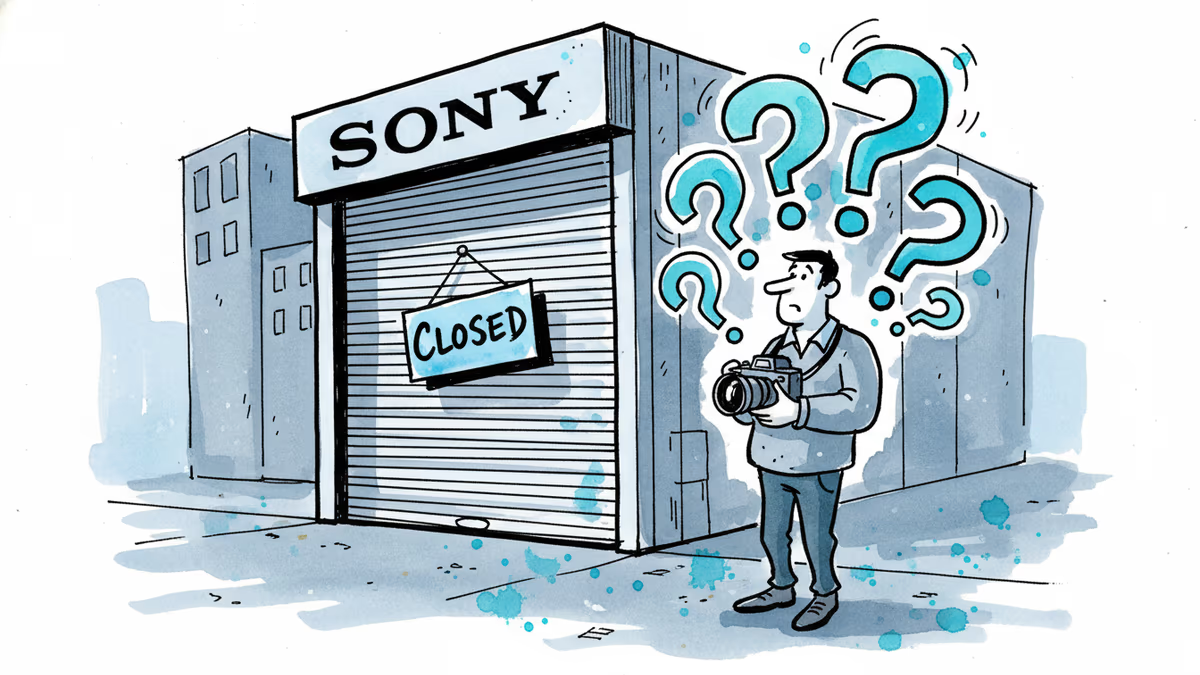
Sony Quietly Exits the Memory Card Business
Sony halted orders for most of its CFexpress and SD card lineup on March 27, 2026 — the same day it raised PS5 prices. What does this mean for photographers, consumers, and Sony's broader strategy?
When a company delivers two pieces of bad news in a single day, it's worth asking: is this a coincidence, or a strategy?
What Happened
On March 27th, 2026, Sony quietly announced it would stop accepting new orders for nearly its entire memory card lineup — CFexpress Type A, Type B, and SDXC/SDHC cards included. The halt applies to both authorized dealers and general consumers, with no clear end date attached. A handful of Type B models and entry-level SF-UZ series SD cards remain in production, but for most of the lineup, once current shelf stock is gone, it's gone.
The same day, Sony announced a price increase for the PS5.
Two product decisions. One day. That's not a press cycle — that's a signal.
Who Gets Hurt First

For casual consumers swapping out SD cards in a point-and-shoot, this is a mild inconvenience. But for professional photographers and videographers shooting on Sony's Alpha mirrorless cameras, this is a more serious disruption. The CFexpress Type A format was effectively a Sony-exclusive standard — engineered specifically for its high-end camera bodies. Professionals who built their workflows around these cards now face a supply cliff with no guaranteed replacement timeline.
The ripple effects extend to retailers and authorized dealers who stocked Sony memory products as reliable, recurring revenue. Memory cards are consumables — they get lost, corrupted, or simply fill up. Pulling that supply doesn't just affect one purchase; it breaks a recurring relationship between brand and buyer.
For consumers still holding Sony Alpha gear, the practical math is straightforward: prices on remaining stock will likely climb as supply tightens, particularly for Type A cards, which were already priced at a premium compared to competing formats.
The Bigger Shift Sony Isn't Advertising
Memory cards are a low-margin, high-competition commodity. Samsung, Lexar, SanDisk — the field is crowded, and differentiation is hard. For a company like Sony, which has been visibly reorienting toward higher-margin businesses — image sensors, entertainment, financial services — the math on maintaining a full memory card product line may simply no longer add up.
But there's an uncomfortable irony here. Sony has long leaned into vertical integration as a competitive advantage. They make the camera. They make the sensor inside the camera. They made the memory card that goes inside the camera. That closed-loop approach builds loyalty and, arguably, justifies premium pricing. Walking away from one piece of that loop doesn't just affect revenue — it chips away at the logic of the whole system.
The question competitors are already asking: does this open a lane? CFexpress Type A adoption has been slow outside the Sony ecosystem precisely because Sony controlled both ends of the equation. If Sony steps back from the media side, third-party manufacturers have a cleaner path to fill the gap — potentially with faster, cheaper alternatives.
Authors
Related Articles
Sony is pulling its major single-player PlayStation games from PC. After six years of multiplatform expansion, the reversal raises hard questions about exclusivity, hardware sales, and who really controls gaming's future.

Taiwan's Thunder Tiger became the first Asian firm to win US military drone clearance with a China-free supply chain. As Trump meets Xi, the drone arithmetic reshapes defense strategy.

Apple quietly removed the entry-level $599 Mac Mini, raising the starting price to $799 — just one day after Tim Cook warned of chip supply constraints on the earnings call.

As the Strait of Hormuz closure traps 1,900 vessels, abandoned seafarers reveal a structural flaw at the heart of global trade—no single authority is responsible when things go wrong.
Sony is pulling its major single-player PlayStation games from PC. After six years of multiplatform expansion, the reversal raises hard questions about exclusivity, hardware sales, and who really controls gaming's future.
Taiwan's Thunder Tiger became the first Asian firm to win US military drone clearance with a China-free supply chain. As Trump meets Xi, the drone arithmetic reshapes defense strategy.
Apple quietly removed the entry-level $599 Mac Mini, raising the starting price to $799 — just one day after Tim Cook warned of chip supply constraints on the earnings call.
As the Strait of Hormuz closure traps 1,900 vessels, abandoned seafarers reveal a structural flaw at the heart of global trade—no single authority is responsible when things go wrong.
Thoughts
Share your thoughts on this article
Sign in to join the conversation