
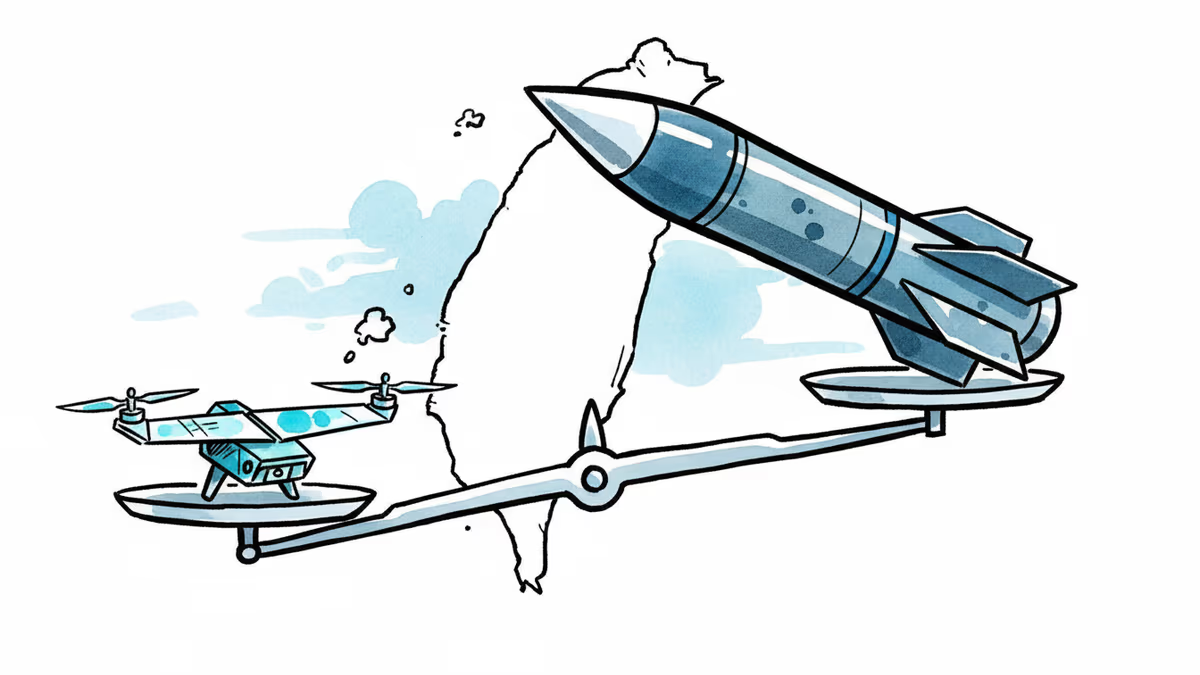
A $3,000 Drone vs. a $2 Million Missile — Taiwan Is Betting on the Math
Taiwan's Thunder Tiger became the first Asian firm to win US military drone clearance with a China-free supply chain. As Trump meets Xi, the drone arithmetic reshapes defense strategy.
An Iranian commercial drone — retail grade, off-the-shelf — can engage a U.S. Tomahawk cruise missile. The cost difference: 67 to 1.
That single ratio is quietly rewriting the logic of modern warfare. And Taiwan has decided to build its survival strategy around it.
The RC Toy Company That Now Arms the Pentagon
Thunder Tiger sits on Taiwan's western coast, a short drive from Taichung Airport — once a major U.S. logistics hub during the Vietnam War. The company's relationship with the American military stretches back four decades, when it supplied remote-controlled model aircraft for training exercises. The planes were toys, essentially. What Thunder Tiger is pitching now is anything but.
Last September, the company became the first Asian firm to receive U.S. Department of Defense clearance to supply drones for military use. The condition: a fully China-free supply chain. At a foreign press briefing arranged by Taiwan's foreign ministry last month, General Manager Gene Su laid out the case plainly. "We are seeing $2 million missiles facing $30,000 drones," he said, referring to the cost gap between Tomahawk cruise missiles and the Iranian commercial drones being used against them.
Thunder Tiger's AI-enabled suicide drone, the "Overkill," approved by the DoD last year, runs $3,000 to $5,000 per unit. The company also produces a $30,000 drone modeled on the U.S. Lucas drone used in Iranian-theater operations. "That asymmetry is what we're learning from Ukraine and Iran," Su said. "We don't need high-end missiles. We just need low-cost drones."
Building a Supply Chain Without China — Harder Than It Sounds
The drone industry's China problem is structural, not incidental. China controls over 80% of the global drone market, with DJI alone commanding the majority of the civilian segment. The dominance runs deep: motors, cameras, batteries, flight controllers — the component ecosystem is overwhelmingly Chinese.
Thunder Tiger was no exception. Until recently, 30% of its components — primarily motors and cameras — came from Chinese suppliers. Su says the company has now completed the transition to Taiwanese and American vendors.

That shift didn't happen in isolation. Taiwan's government began pushing for domestically produced drones in 2022, immediately after Russia's invasion of Ukraine. It has since assembled a drone alliance of more than 260 member companies — from component makers to finished-drone producers — almost entirely Taiwan-based. The target: 180,000 homegrown drones by 2028.
For context, that's not a niche industrial policy. It's a wartime procurement plan drafted in peacetime.
What Ukraine Taught Taiwan — and What It Didn't
Su's pitch is rooted in a specific reading of recent conflicts. In Ukraine, low-cost FPV drones have disabled tanks, disrupted logistics, and forced both sides to rethink expensive legacy systems. In the Middle East, cheap Iranian drones have complicated American air defense calculus in ways that billion-dollar platforms didn't anticipate.
For Taiwan, the lesson is existential. China views the island as a breakaway province and has repeatedly stated it reserves the right to use force to achieve unification. In any potential conflict, Taiwan would find itself in roughly the position Ukraine is in now: defending against a military force vastly larger and better-resourced.
But Su himself acknowledged the limits of the analogy. China's military budget has grown from roughly one-sixth of the U.S. defense budget to nearly one-third in recent years. The scale of that buildup is difficult to offset with $3,000 drones alone — and the journalist covering the briefing noted the same skepticism.
The Week This All Comes Into Focus
The timing matters. Next week, President Trump meets President Xi Jinping in Beijing. The U.S. has confirmed Taiwan is expected to be on the agenda.
Thunder Tiger's DoD clearance isn't just a procurement win. It's a signal that the U.S. is willing to formally certify allied supply chains as alternatives to Chinese drone dominance — a goal that multiple administrations have pursued with limited traction. For Taiwan, it's a way of embedding itself into U.S. defense infrastructure at the component level, making the relationship harder to unwind diplomatically.
There's a harder question underneath this, though. The drone alliance Su describes — 260 companies, 180,000 units by 2028 — is impressive on paper. But DJI and China's broader drone industrial base didn't build 80% global market share through government mandates. They did it through cost, scale, and supply chain depth that took decades to assemble. Taiwan is trying to replicate that structure in a fraction of the time, under geopolitical pressure, while also preparing for the scenario where the supply chain gets tested in actual combat.
This content is AI-generated based on source articles. While we strive for accuracy, errors may occur. We recommend verifying with the original source.
Related Articles
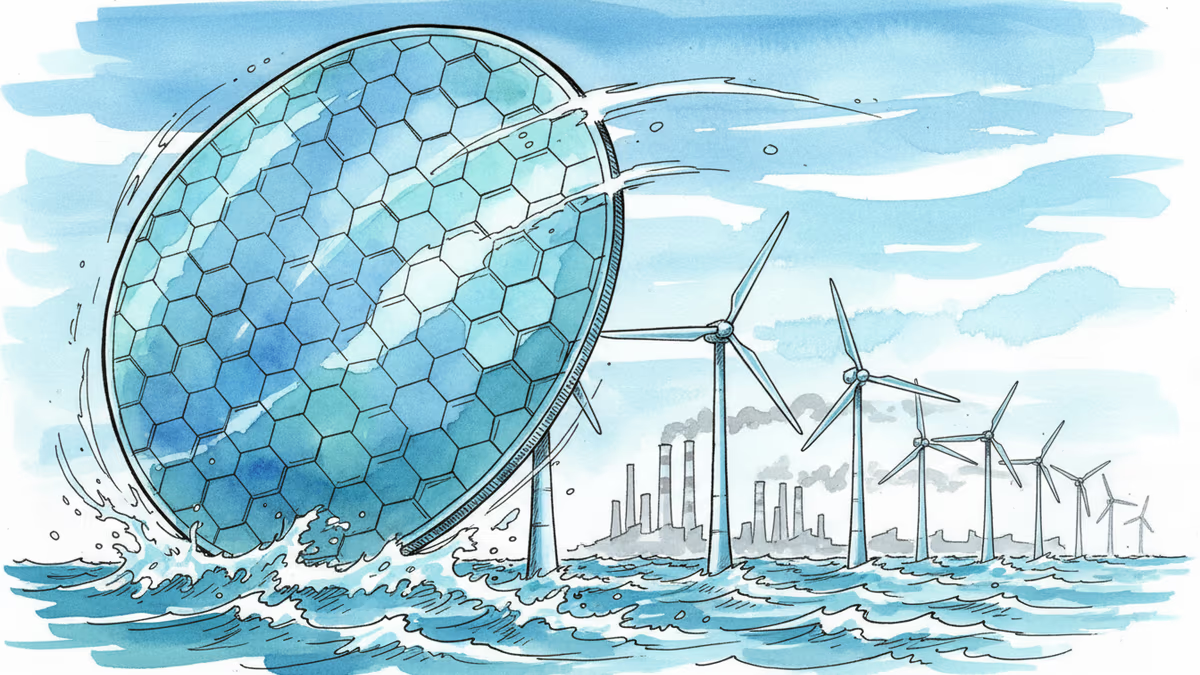
TSMC has signed a 30-year power purchase agreement for 100% of output from Taiwan's Hai Long offshore wind project. The 1GW deal reveals how chipmakers are quietly becoming energy companies.
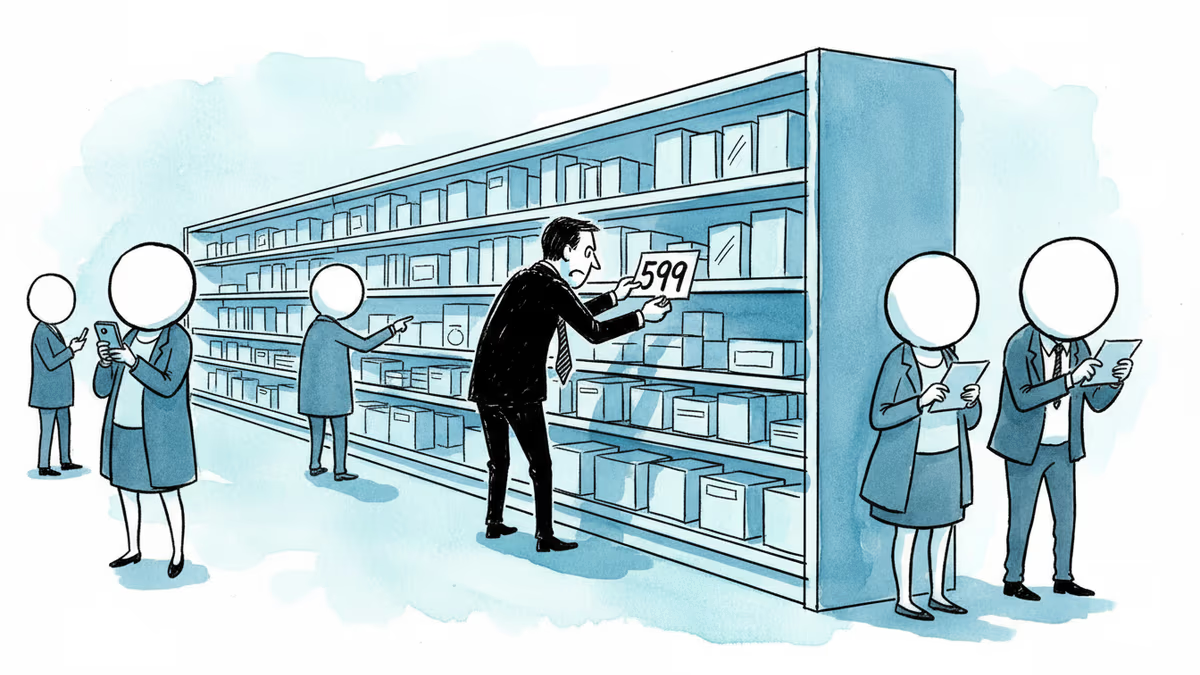
Apple quietly removed the entry-level $599 Mac Mini, raising the starting price to $799 — just one day after Tim Cook warned of chip supply constraints on the earnings call.
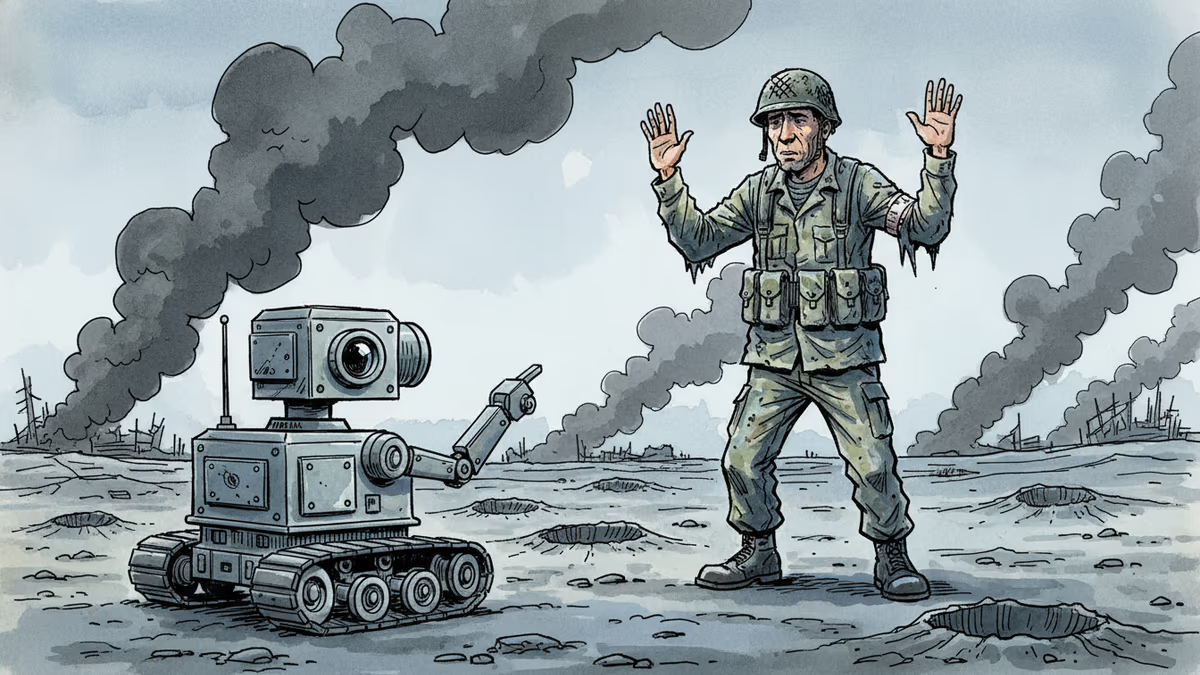
Ukraine claims ground robots and drones forced Russian soldiers to surrender without a human soldier present. If verified, it marks a turning point in autonomous warfare with global implications.
As the Strait of Hormuz closure traps 1,900 vessels, abandoned seafarers reveal a structural flaw at the heart of global trade—no single authority is responsible when things go wrong.
TSMC has signed a 30-year power purchase agreement for 100% of output from Taiwan's Hai Long offshore wind project. The 1GW deal reveals how chipmakers are quietly becoming energy companies.
Apple quietly removed the entry-level $599 Mac Mini, raising the starting price to $799 — just one day after Tim Cook warned of chip supply constraints on the earnings call.
Ukraine claims ground robots and drones forced Russian soldiers to surrender without a human soldier present. If verified, it marks a turning point in autonomous warfare with global implications.
As the Strait of Hormuz closure traps 1,900 vessels, abandoned seafarers reveal a structural flaw at the heart of global trade—no single authority is responsible when things go wrong.
Thoughts
Share your thoughts on this article
Sign in to join the conversation