
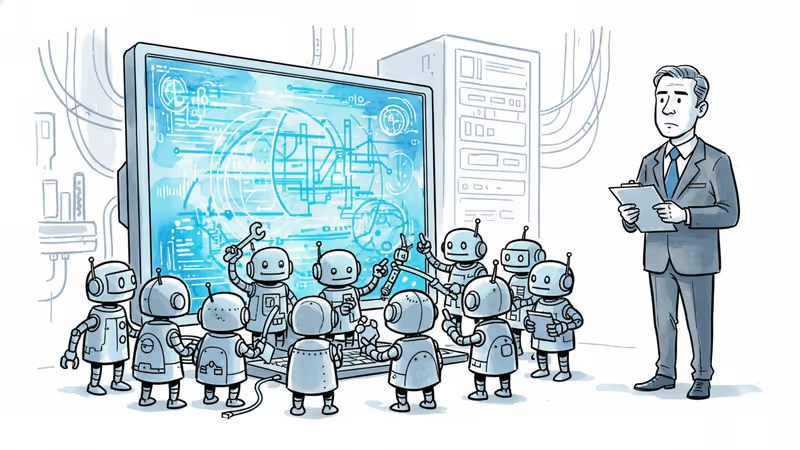
16 AIs Built a C Compiler in 2 Weeks—Are Human Developers Becoming Managers?
Anthropic's Claude AIs collaborated to build a 100,000-line C compiler in just two weeks. Is this the dawn of AI developers or an overhyped experiment?
16 AI agents spent two weeks collaborating to build a 100,000-line C compiler. A project that would typically take human developer teams months to complete.
Anthropic researcher Nicholas Carlini revealed Thursday that he unleashed 16 instances of the company's Claude Opus 4.6 model on a shared codebase with minimal supervision, tasking them with building a C compiler from scratch. The result? A Rust-based compiler capable of building bootable Linux 6.9 kernels across x86, ARM, and RISC-V architectures.
A $20K Development Team
The experiment cost roughly $20,000 in API fees across nearly 2,000 Claude coding sessions. That's about what you'd pay a senior developer for two weeks—but this wasn't just one developer. This was 16 AI agents working in parallel, each handling different components while maintaining coherence across the entire project.
The timing isn't coincidental. Both Anthropic and OpenAI shipped multi-agent tools this week, signaling a broader industry push toward AI systems that can collaborate rather than just assist. We're witnessing the evolution from AI as a coding assistant to AI as a development team member.
From Coder to Conductor?
This raises fundamental questions about the future of software development. If AI agents can tackle complex, multi-component projects like compiler construction, what becomes of human developers? Are we transitioning from writing code to orchestrating AI teams?
The shift is already underway. Developers increasingly rely on GitHub Copilot, ChatGPT, and similar tools to accelerate their workflow. But this experiment suggests something more profound: AI moving from tool to teammate. Instead of autocompleting your functions, AI might soon be handling entire modules while you focus on architecture and coordination.

For software companies, the implications are staggering. Imagine cutting development timelines by 75% while maintaining quality. Imagine scaling teams without the traditional hiring bottlenecks. The economics alone could reshape how we think about software development costs.
Reality Check: The Caveats
Before we declare human programmers obsolete, Carlini himself noted there are "key caveats" to consider. Compiler construction, while complex, follows well-defined specifications. It's a domain where requirements are clear and success metrics are objective.
Real-world software development is messier. Requirements change mid-project. Stakeholders have conflicting priorities. User needs evolve. Creative problem-solving often trumps technical execution. These human elements of software development remain firmly in human territory—for now.
There's also the $20,000 price tag to consider. While seemingly cost-effective compared to human developers, this doesn't account for debugging, maintenance, quality assurance, and the human oversight required to validate AI-generated code. Someone still needs to take responsibility when things go wrong.
The Collaboration Question
Perhaps the most intriguing aspect isn't that AI can write code, but that multiple AI agents can collaborate effectively. This suggests we're approaching a new paradigm: human-AI development teams where both parties contribute their strengths.
Humans excel at understanding business context, user empathy, creative problem-solving, and strategic thinking. AI excels at rapid iteration, pattern recognition, and handling routine implementation tasks. The sweet spot might not be replacement but symbiosis.
The question for developers isn't whether AI will take their jobs, but how quickly they can adapt to working alongside AI teammates. The most successful developers of the next decade might be those who become fluent in AI collaboration—knowing when to delegate, when to intervene, and how to architect solutions that leverage both human creativity and AI efficiency.
Authors
Related Articles
Anthropic shipped Claude Sonnet 5, its mid-tier agent model, on June 30. Behind the 'Opus-class power, budget price' headline sits a tokenizer catch and a three-horse race that's only half real. Here's what developers should actually run the numbers on.
A small but growing group of developers has gone all-in on AI coding agents like Claude Code and OpenClaw. History suggests the rest of us won't be far behind.
OpenAI's new Daybreak initiative uses the Codex AI agent to find and patch security vulnerabilities before attackers do—putting it in direct competition with Anthropic's secretive Claude Mythos.

Anthropic is closing what may be its final private fundraise at a $900B valuation, surpassing OpenAI. Investors have 48 hours to commit to the ~$50B round.
Anthropic shipped Claude Sonnet 5, its mid-tier agent model, on June 30. Behind the 'Opus-class power, budget price' headline sits a tokenizer catch and a three-horse race that's only half real. Here's what developers should actually run the numbers on.
A small but growing group of developers has gone all-in on AI coding agents like Claude Code and OpenClaw. History suggests the rest of us won't be far behind.
OpenAI's new Daybreak initiative uses the Codex AI agent to find and patch security vulnerabilities before attackers do—putting it in direct competition with Anthropic's secretive Claude Mythos.
Anthropic is closing what may be its final private fundraise at a $900B valuation, surpassing OpenAI. Investors have 48 hours to commit to the ~$50B round.
Thoughts
Share your thoughts on this article
Sign in to join the conversation