
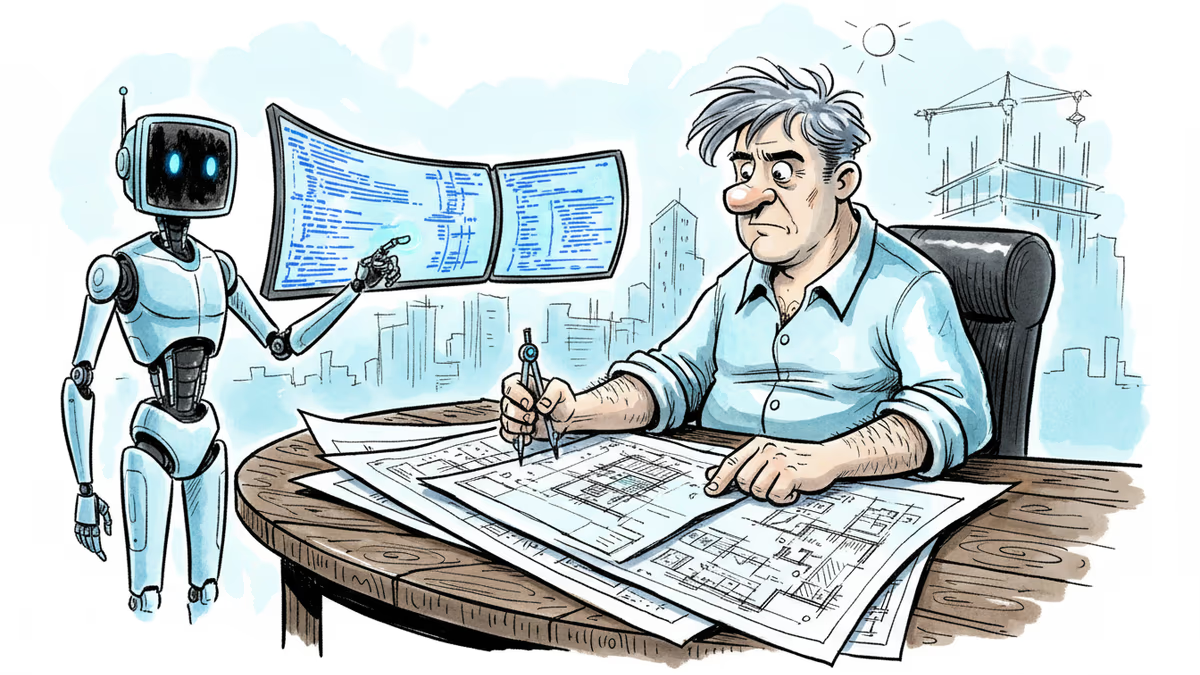
When AI Writes Code, What Do Developers Actually Do?
A major US retailer automated their entire software development lifecycle with AI. Here's what they learned about the future of programming.
From 3 Days to 30 Minutes: The Code Review Revolution
At a major US retail organization, something remarkable happened. Prasad Banala, Director of Software Engineering, led his team through a complete AI transformation of their development process. Code reviews that once took 3 days now finish in 30 minutes. Test case creation time dropped by 80%.
But here's the twist: the real story isn't about speed. It's about how fundamentally the role of software developers is changing.
What AI Actually Does: Beyond Writing Code
Prasad's team deployed AI across the entire software development lifecycle, not just coding:
Requirements Validation: When business requirements come in, AI immediately flags inconsistencies and gaps. "To implement this feature, you'll need integration between System A and System B—what's the security protocol?" The AI asks questions human reviewers might miss.
Test Case Generation: Developers write code, AI automatically creates dozens of test scenarios, including edge cases that would take hours to think through manually.
Accelerated Issue Resolution: Bug reports trigger AI analysis of related code and historical similar cases, providing solution pathways before developers even start debugging.
The key insight? AI isn't replacing developers—it's freeing them to focus on higher-value work.
The Human-in-the-Loop Imperative
Here's what separates successful AI adoption from failure: governance. Prasad's team established strict "human-in-the-loop" review processes. Every AI-generated output requires human validation. Every AI tool usage follows clear guidelines.

"Trust but verify" became their operating principle. AI might suggest code or test cases, but developers must review and approve everything.
This approach addresses a critical concern in enterprise AI: accountability. When AI-generated code causes issues, who's responsible? By maintaining human oversight, organizations preserve both quality control and legal clarity.
The Skills Gap Reality
While AI handles routine tasks, demand for certain developer skills is actually increasing:
System Architecture: Someone needs to design how AI tools integrate with existing systems.
Business Translation: Developers who can translate business requirements into AI-understandable specifications become invaluable.
AI Prompt Engineering: Writing effective prompts for AI tools is becoming a specialized skill.
The irony? As AI makes coding easier, the premium on non-coding skills grows.
What This Means for Software Teams
Prasad's experience offers three key lessons for organizations considering AI adoption:
Start Small, Scale Smart: They began with test case generation before expanding to requirements validation and issue resolution.
Governance First: Establishing review processes and guidelines before deploying AI tools prevented quality issues.
Measure Everything: They track not just speed improvements but quality metrics—defect rates, customer satisfaction, team productivity.
The results speak for themselves: measurable quality improvements alongside dramatic efficiency gains.
Authors
Related Articles

Raycast launches Glaze, a platform that lets Mac users build, share, and discover AI-generated apps without touching code. Is this the tipping point for no-code development?
Anthropic's Claude AIs collaborated to build a 100,000-line C compiler in just two weeks. Is this the dawn of AI developers or an overhyped experiment?

Anthropic releases Claude Code 2.1.0 with 1,096 commits. Featuring agent hooks, session teleportation, and Vim motions, it's a major leap for autonomous AI development.

NTT Data Group unveils plans to automate nearly all IT system development using generative AI by fiscal 2026 to solve Japan's labor shortage. Learn about the 'AI-native' shift.
Raycast launches Glaze, a platform that lets Mac users build, share, and discover AI-generated apps without touching code. Is this the tipping point for no-code development?
Anthropic's Claude AIs collaborated to build a 100,000-line C compiler in just two weeks. Is this the dawn of AI developers or an overhyped experiment?
Anthropic releases Claude Code 2.1.0 with 1,096 commits. Featuring agent hooks, session teleportation, and Vim motions, it's a major leap for autonomous AI development.
NTT Data Group unveils plans to automate nearly all IT system development using generative AI by fiscal 2026 to solve Japan's labor shortage. Learn about the 'AI-native' shift.
Thoughts
Share your thoughts on this article
Sign in to join the conversation