
Anthropic's $380B Valuation Reshapes AI Power Dynamics
Anthropic raises $30B at $380B valuation, doubling its worth in months. As OpenAI seeks $100B more, the AI arms race intensifies with profound implications for enterprise users and market competition.
$30 billion in a single funding round. That's what Anthropic just raised in its Series G, catapulting the company's valuation to $380 billion—more than double its previous $183 billion valuation from just months ago.
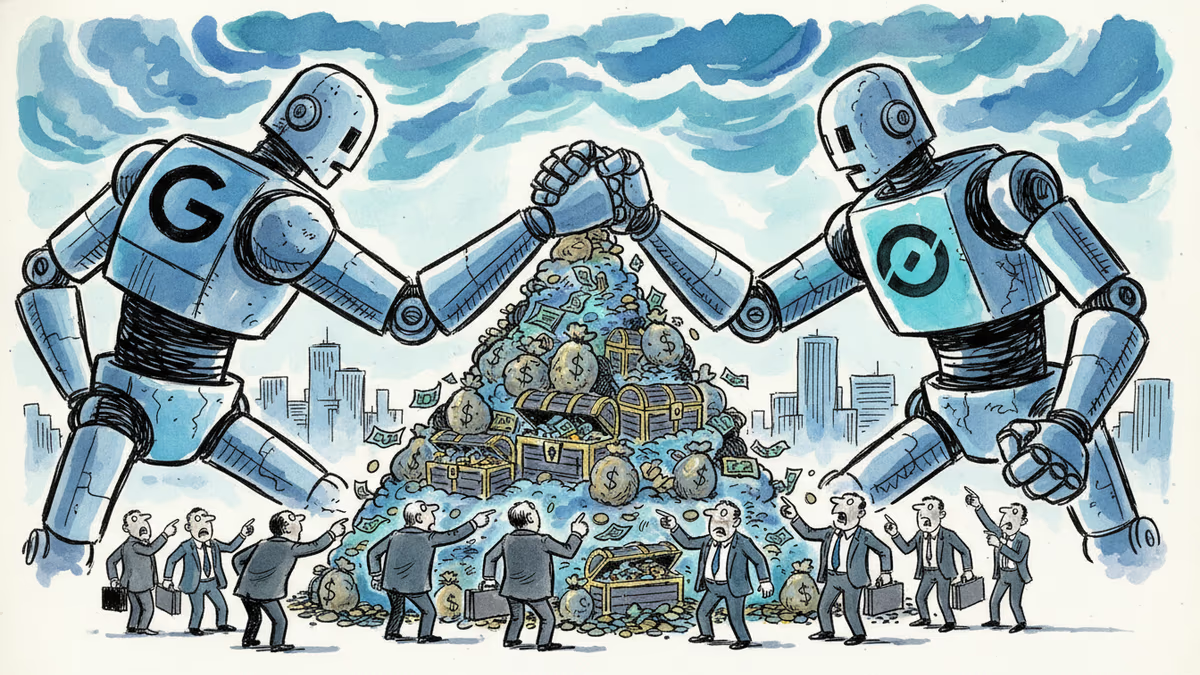
But the real story isn't the numbers. It's the timing. As OpenAI pursues its own $100 billion fundraise that could value it at $830 billion, we're witnessing something unprecedented: an AI arms race where the weapons are dollars, and the battlefield is enterprise trust.
The Enterprise Bet That's Paying Off
Singapore's GIC and Coatue led this massive round, joined by heavy hitters like Peter Thiel's Founders Fund, Abu Dhabi's MGX, and the Qatar Investment Authority. These aren't typical tech investors throwing money at the latest shiny object. They're institutional players betting on a specific thesis: that enterprise AI adoption will favor safety and reliability over flashy consumer features.
"Claude is increasingly becoming more critical to how businesses work," said Krishna Rao, Anthropic's CFO. That's not marketing speak—it's a strategic positioning statement. While OpenAI dominates consumer mindshare with ChatGPT, Anthropic has quietly built a reputation as the "responsible AI" choice for enterprise customers.
The difference matters more than you might think. When a Fortune 500 company deploys AI, they're not looking for viral moments or creative writing assistance. They want predictable, auditable, and safe AI that won't generate embarrassing headlines or regulatory scrutiny.
The Trillion-Dollar Question
Here's where it gets interesting: we now have two AI companies potentially worth over $1 trillion combined. For context, that's more than the GDP of most countries. But what are investors actually buying?

The optimistic view: They're funding the infrastructure for humanity's next technological leap. The skeptical view: They're inflating a bubble that makes the dot-com era look quaint.
The reality likely sits somewhere between. These valuations assume AI will fundamentally transform how we work, create, and solve problems. But they also assume these specific companies will capture and monetize that transformation—a much riskier bet.
What This Means for Everyone Else
For enterprise customers, this funding war is mostly good news. Competition drives innovation and keeps prices competitive. Companies can now choose between OpenAI's broad capabilities and Anthropic's safety-first approach, with both backed by virtually unlimited resources.
For smaller AI companies, the picture is grimmer. How do you compete when your rivals can lose billions annually without blinking? The funding gap isn't just about money—it's about talent acquisition, compute resources, and market credibility.
For regulators, the concentration of AI power in a few ultra-wealthy companies raises obvious concerns. When two companies control this much of the AI landscape, traditional antitrust frameworks start looking inadequate.
The Sustainability Question
Both Anthropic and OpenAI face the same fundamental challenge: their business models don't yet justify their valuations. Training and running large language models costs enormous amounts, while competitive pressure keeps prices low. Neither company has proven they can generate profits commensurate with their billion-dollar valuations.
This creates a peculiar dynamic where success might be measured not by profitability, but by market dominance and strategic positioning. In other words, these companies are playing a winner-take-all game where second place might mean irrelevance.
Authors
Related Articles
Anthropic shipped Claude Sonnet 5, its mid-tier agent model, on June 30. Behind the 'Opus-class power, budget price' headline sits a tokenizer catch and a three-horse race that's only half real. Here's what developers should actually run the numbers on.

A small but growing group of developers has gone all-in on AI coding agents like Claude Code and OpenClaw. History suggests the rest of us won't be far behind.

OpenAI's new Daybreak initiative uses the Codex AI agent to find and patch security vulnerabilities before attackers do—putting it in direct competition with Anthropic's secretive Claude Mythos.
Anthropic is closing what may be its final private fundraise at a $900B valuation, surpassing OpenAI. Investors have 48 hours to commit to the ~$50B round.
Anthropic shipped Claude Sonnet 5, its mid-tier agent model, on June 30. Behind the 'Opus-class power, budget price' headline sits a tokenizer catch and a three-horse race that's only half real. Here's what developers should actually run the numbers on.
A small but growing group of developers has gone all-in on AI coding agents like Claude Code and OpenClaw. History suggests the rest of us won't be far behind.
OpenAI's new Daybreak initiative uses the Codex AI agent to find and patch security vulnerabilities before attackers do—putting it in direct competition with Anthropic's secretive Claude Mythos.
Anthropic is closing what may be its final private fundraise at a $900B valuation, surpassing OpenAI. Investors have 48 hours to commit to the ~$50B round.
Thoughts
Share your thoughts on this article
Sign in to join the conversation