
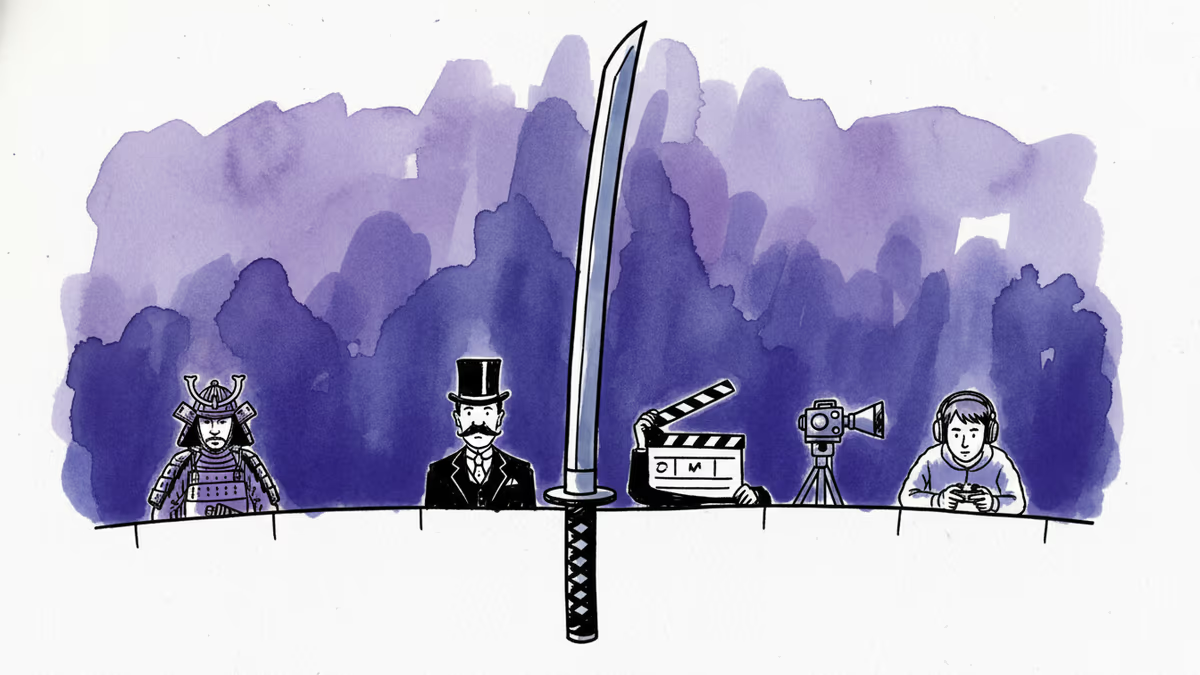
The Sword That Outlived Its Purpose
From battlefield weapon to status symbol, from banned relic to pop culture icon — the katana's shifting meanings reveal how objects become mirrors of the societies that use them.
The most famous sword in the world may never have drawn blood.
Stand in front of a Japanese katana in a museum case long enough and something strange happens. You know it was made to kill. You can see the edge, the curvature, the layered steel folded hundreds of times by a craftsman who spent years learning how to shape a weapon. And yet what you feel, almost involuntarily, is something closer to awe than dread. Why?
That question sits at the heart of a recent documentary essay from Aeon Video, "From Weapon to Icon," which traces the long, shape-shifting life of the samurai sword. It's a history lesson, yes — but also something rarer: a meditation on how objects accumulate meaning, shed it, and accumulate it again, until the thing itself almost disappears beneath the weight of what we've projected onto it.
Born for Battle, Perfected in Peace
The katana as we recognize it emerged somewhere between the 10th and 12th centuries, its distinctive curve engineered for a specific purpose: a mounted warrior needed to draw and slash in a single fluid motion. The metallurgy that followed — tamahagane, the process of folding high- and low-carbon steel together dozens of times — wasn't mysticism. It was engineering, solving the problem of a blade that needed to be both hard enough to hold an edge and flexible enough not to shatter.
But here's the paradox that defines the katana's history: the sword reached its artistic peak precisely when it stopped being used in battle.
Under the Tokugawa shogunate (1603–1868), Japan entered an era of enforced peace. Actual combat became rare. The katana transformed from a tool of war into a grammar of social rank. Only samurai could wear two swords — the long katana and the shorter wakizashi — and the length, decoration, and manner of wearing them communicated status as precisely as any uniform. How you wore your sword mattered more than how well you could use it.
In this strange vacuum, sword-makers flourished. Freed from purely functional demands, craftsmen turned their attention to beauty: the undulating hamon pattern along the blade's edge, the intricate carving of the tsuba (handguard), the wrapped silk of the handle. The sword became a canvas. Swordsmanship schools multiplied — not because wars were being fought, but because the idea of the sword needed to be perpetually performed.
The Moment the Sword Was Taken Away
1876. The Meiji government issues the Haitōrei — the sword-abolition edict. No more carrying blades in public. For samurai, this wasn't a weapons regulation. It was an identity amputation.

What happened next is instructive. The physical sword disappeared from daily life, and almost immediately, its mythology intensified. Nitobe Inazō's "Bushido: The Soul of Japan" (1900), written in English for a Western audience, romanticized the samurai code into something universal and timeless — loyalty, honor, self-sacrifice. The book was enormously influential abroad. It gave the West a framework for understanding Japan, and it gave Japan a way to narrate its own past to outsiders.
When you can no longer hold a thing, you begin to idealize it.
This dynamic — prohibition generating mythology — is hardly unique to Japan. But the katana is a particularly clean case study because the timeline is so compressed and the documentation so rich.
The Icon Goes Global
The second half of the 20th century sent the katana far beyond Japan's borders. Akira Kurosawa's films introduced samurai to international audiences with a visual language so powerful it rewired Hollywood's imagination. The lightsaber in Star Wars. The showdowns in Kill Bill. The blade-wielding antiheroes of countless video games and manga series.
In Demon Slayer, one of the highest-grossing anime franchises in history, the sword is everywhere — but it carries almost none of the Edo-period social weight that once defined it. It's been refilled with new meaning: chosen-one destiny, emotional inheritance, the will to protect. A 14th-century craftsman and a 21st-century teenager can both feel something profound about the same object, for entirely different reasons.
Is this cultural dilution, or is it proof that the symbol is alive? The question divides people. Critics of the katana's pop-culture proliferation point to the erasure of context — the class system, the ritual obligations, the decades of apprenticeship behind each blade. Defenders argue that symbols have always traveled, mutated, and found new hosts. The katana didn't start as a purely Japanese invention either; Korean and Chinese metalworking traditions fed into its development over centuries.
What's harder to argue with are the numbers. Fewer than 300 licensed swordsmiths remain in Japan today. Each is permitted to forge no more than 24 blades per year under cultural preservation rules. The living craft is becoming rare. The image, meanwhile, is reproduced billions of times across screens, merchandise, and tattoos worldwide.
What a Sword Tells Us About Ourselves
The katana's long journey — from battlefield tool to status symbol to banned relic to global icon — raises a question that goes well beyond Japanese history: who gets to decide what an object means?
At different moments, the answer has been warriors, aristocrats, a modernizing state, a novelist writing for foreign readers, a filmmaker, and now, collectively, a global audience that has never set foot in Japan. Each group has layered its own needs and narratives onto the same steel.
For cultural historians, this is the sword's most interesting property — not its edge, but its capacity to absorb meaning. For the craftsmen still forging blades in traditional workshops, it may look different: a technique requiring 15 or more years to master, slowly becoming invisible behind an avalanche of imagery that has nothing to do with what they actually do.
Different cultures read the katana differently, too. In Japan, attitudes range from reverence to indifference depending on generation. In the West, it often carries an orientalist charge — the exotic, the disciplined, the ancient. In South Korea, where the history of Japanese imperialism is never far from the surface, the same object can carry an entirely different emotional weight. The sword doesn't change. The beholder does.
This content is AI-generated based on source articles. While we strive for accuracy, errors may occur. We recommend verifying with the original source.
Related Articles
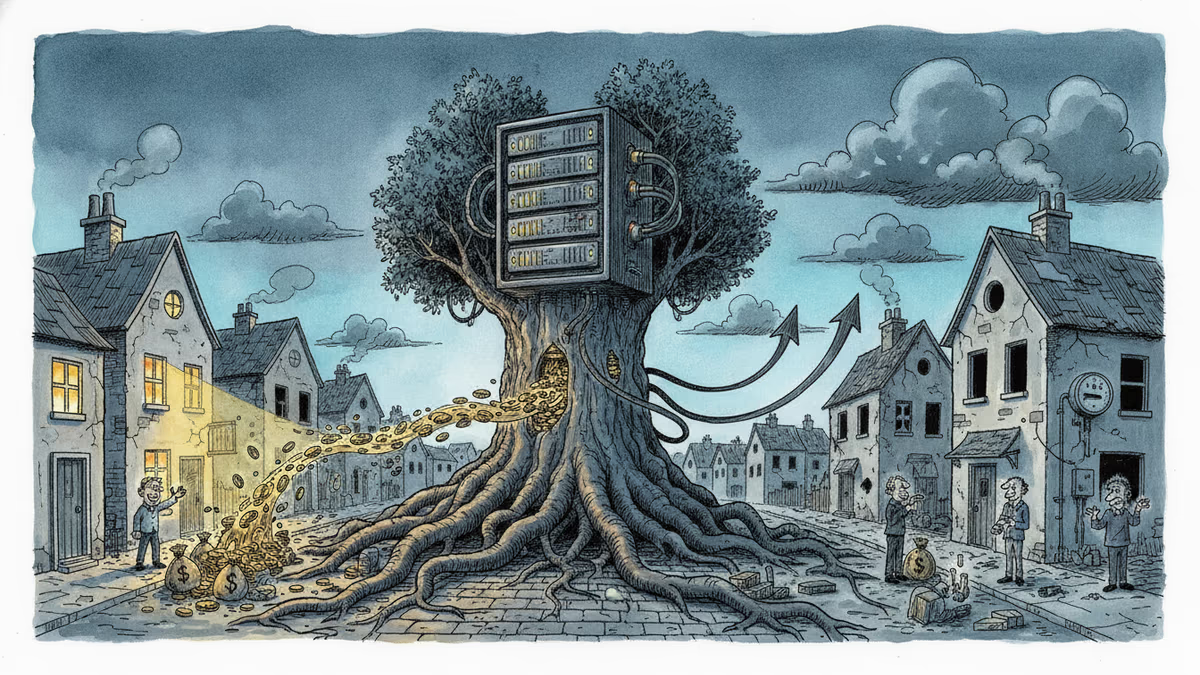
Over 1,200 community actions have pushed back against data centers since 2024. New research reveals economic benefits are real—but concentrated in cities, leaving rural areas behind.
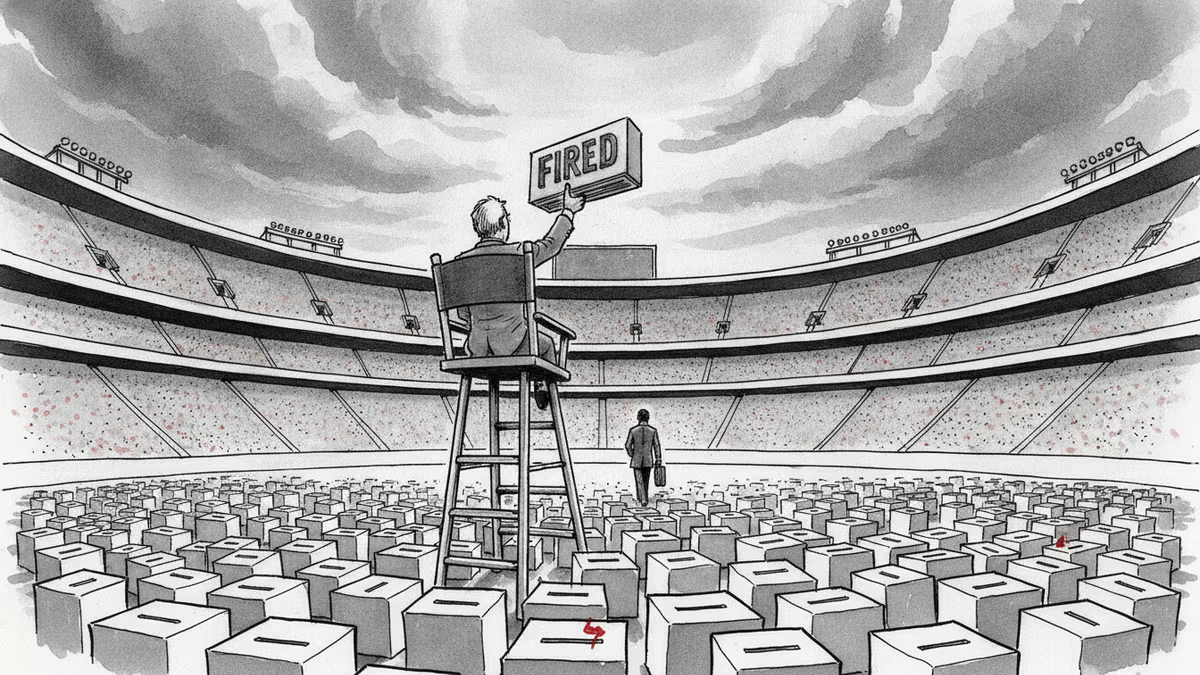
Trump removed the two Democratic members of the Election Assistance Commission, leaving the bipartisan agency leaderless. A Supreme Court ruling made it legal. Here's why a non-crisis can still be a warning sign.

Lebanon and Israel signed a framework agreement in June 2026. Hezbollah rejected it. Israel kept fighting. History suggests this moment is real—and fragile.
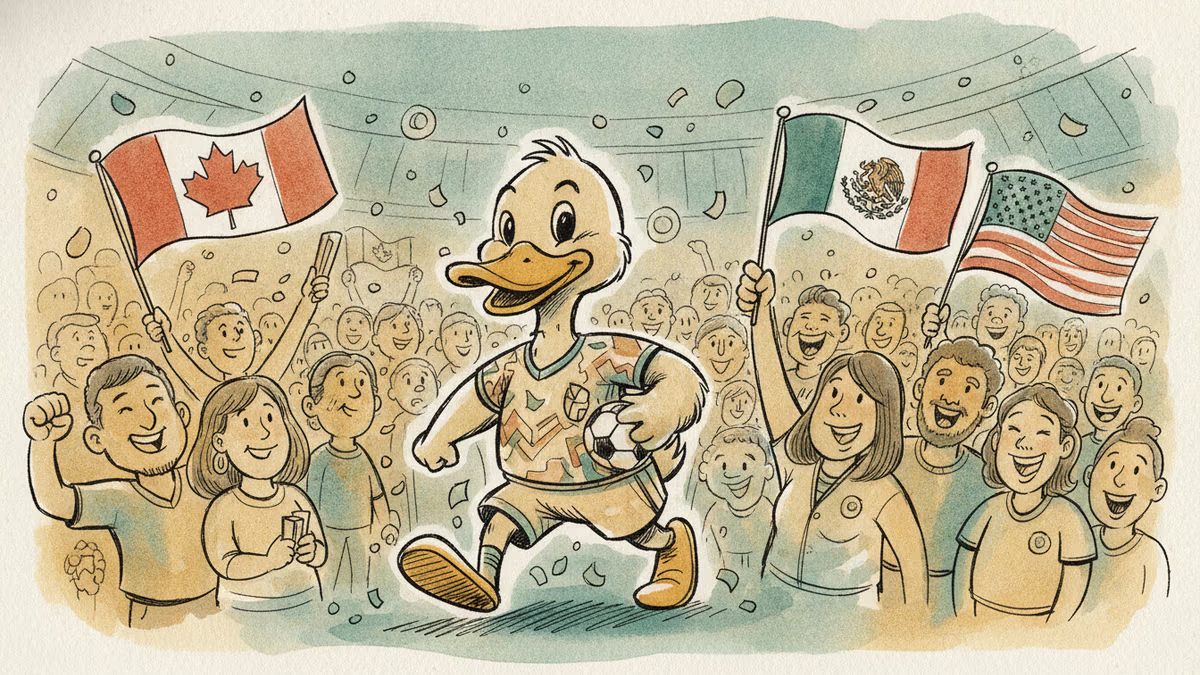
A three-nation World Cup turned fan culture into viral gold — Merlin the duck, Japan's cleanup, and Korea-Mexico bromance top every goal scored.
Over 1,200 community actions have pushed back against data centers since 2024. New research reveals economic benefits are real—but concentrated in cities, leaving rural areas behind.
Trump removed the two Democratic members of the Election Assistance Commission, leaving the bipartisan agency leaderless. A Supreme Court ruling made it legal. Here's why a non-crisis can still be a warning sign.
Lebanon and Israel signed a framework agreement in June 2026. Hezbollah rejected it. Israel kept fighting. History suggests this moment is real—and fragile.
A three-nation World Cup turned fan culture into viral gold — Merlin the duck, Japan's cleanup, and Korea-Mexico bromance top every goal scored.
Thoughts
Share your thoughts on this article
Sign in to join the conversation