
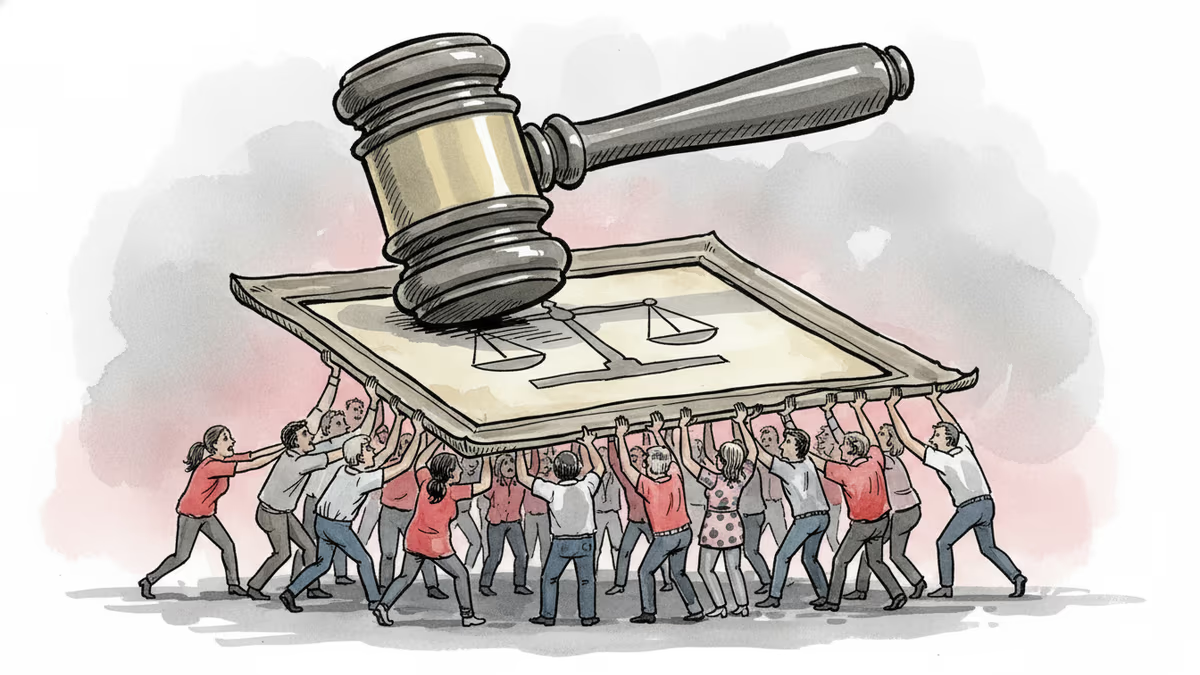
The Court Didn't Kill the Voting Rights Act. It Just Made It Toothless.
The Supreme Court's 6-3 ruling in Louisiana v. Callais rewrites how Section 2 of the Voting Rights Act applies to redistricting—with major consequences for minority representation and the 2026 midterms.
The Supreme Court didn't repeal the Voting Rights Act on April 29, 2026. It did something subtler—and in some ways, more consequential.
In a 6-3 ruling along ideological lines, the court's conservative majority struck down Louisiana's second Black-majority congressional district as "an unconstitutional gerrymander" and rewrote the rules for how Section 2 of the Voting Rights Act applies to redistricting. The law itself still stands. But the legal tools minorities have used for 39 years to challenge discriminatory maps have been significantly blunted.
How a Louisiana Map Became a National Turning Point
The case, Louisiana v. Callais, traces back to the 2020 Census—the decennial ritual that forces every state to redraw its congressional districts. Louisiana's legislature redrew its six districts in 2022 with minimal changes. The problem: Black residents made up 31% of the state's population, but only one of the six districts had a Black majority.
A group of Black voters sued, citing Section 2 of the Voting Rights Act, which prohibits voting practices that discriminate on the basis of race. Federal courts agreed, ordering Louisiana to create a second Black-majority district. Their legal foundation was a 1986 Supreme Court precedent, Thornburg v. Gingles, which held that redistricting must allow large, compact, and politically cohesive racial minorities to elect representatives of their choice.
The Louisiana legislature complied in January 2024, passing Senate Bill 8. The new map produced two Black-majority districts—both elected Democrats in the 2024 congressional elections, while Republicans won the remaining four.
Then a group of white voters sued, arguing the race-conscious map violated the 14th Amendment's equal protection clause and the 15th Amendment. A three-judge district court sided with them 2-1 in 2024. Louisiana and the original Black plaintiffs appealed. The Supreme Court took the case, heard arguments twice, and ruled this week.
Two Visions of Equality—and the Court That Chose Between Them
Justice Samuel Alito, writing for the majority, insisted the court was upholding Section 2—not dismantling it. His argument: historical developments since Gingles require a new interpretive framework. The majority didn't overrule the 1986 precedent outright. Instead, it narrowed how plaintiffs can use it, making it harder to prove a redistricting plan discriminates under the act.

Justice Elena Kagan, joined by the two other liberal justices, called it "the latest chapter in the majority's now-completed demolition of the Voting Rights Act." Her dissent argued the ruling makes it "effectively impossible" to use race in redistricting as Congress intended and strips voters of the most powerful legal tool left to challenge discriminatory maps.
The philosophical fault line here isn't new. It's the same tension that fractured the court's 2023 affirmative action rulings: does equal protection mean treating everyone identically regardless of history, or does it require accounting for structural disadvantage to achieve genuine equality? The majority chose the former. The dissenters chose the latter. Neither side is arguing in bad faith—they're operating from genuinely different premises about what the Constitution demands.
What Actually Changes—and for Whom
The practical stakes are substantial. Section 2 was already carrying enormous weight. In 2013, the Supreme Court gutted the Voting Rights Act's preclearance provision—which had required states with histories of discrimination to get federal approval before changing election laws. That left Section 2 as the primary legal weapon against discriminatory redistricting. This ruling dulls that weapon.
For the 2026 midterm elections, the timing is pointed. Politico has reported that Democrats could lose as many as 19 House seats if maps are redrawn under the new legal framework—a figure that could shift control of the chamber. Because minority voters, particularly Black voters, lean heavily Democratic, maps that dilute minority voting power tend to benefit Republicans.
The ruling also hands Republican-controlled state legislatures a clearer legal path to draw partisan gerrymanders that happen to reduce minority representation. The court's interpretation doesn't require intent to discriminate to be proven—but it raises the bar for what plaintiffs must show to win.
This decision connects directly to a 2024 Alito-authored ruling that overturned a lower court's finding of racial vote dilution in South Carolina. The pattern is deliberate and cumulative.
The Perspectives That Don't Make Headlines
Conservative legal scholars argue the ruling restores constitutional coherence: if the 14th Amendment prohibits racial classifications by government, then drawing districts explicitly by race—even to remedy past discrimination—is itself a form of discrimination. The individual right to equal treatment, in this view, cannot be subordinated to group-based outcomes.
Civil rights advocates counter that this logic is historically blind. The Voting Rights Act was designed precisely to correct the legacy of systematic exclusion. Removing race from the equation doesn't create a level playing field—it cements the advantages built by decades of suppression.
From a comparative democracy standpoint, the U.S. single-member district system makes this conflict uniquely acute. Countries using proportional representation sidestep the problem partly by design—minority communities don't need geographic concentration to earn representation. That structural difference is worth noting when evaluating whether the U.S. court's ruling reflects a universal principle or a very American dilemma.
What remains genuinely open: which states will move first to redraw maps under the new framework, whether Congress has the political will to legislate a stronger replacement for Section 2, and how lower courts will interpret the majority's new standard in the wave of redistricting litigation that's almost certain to follow.
This content is AI-generated based on source articles. While we strive for accuracy, errors may occur. We recommend verifying with the original source.
Related Articles
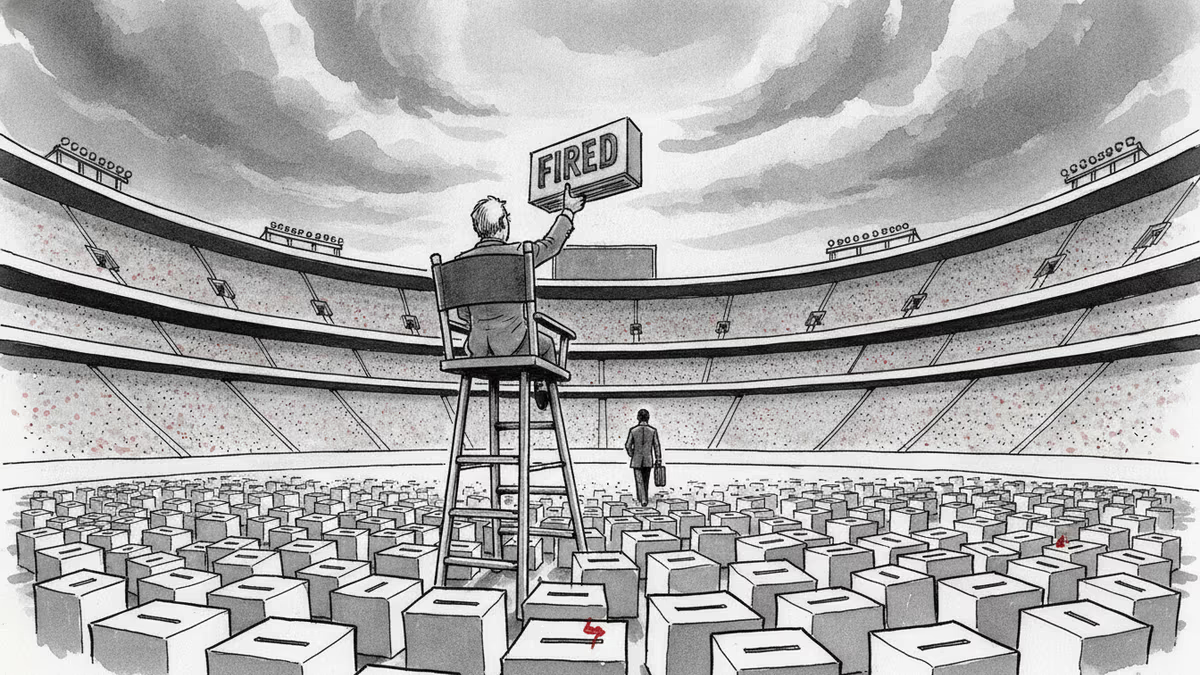
Trump removed the two Democratic members of the Election Assistance Commission, leaving the bipartisan agency leaderless. A Supreme Court ruling made it legal. Here's why a non-crisis can still be a warning sign.
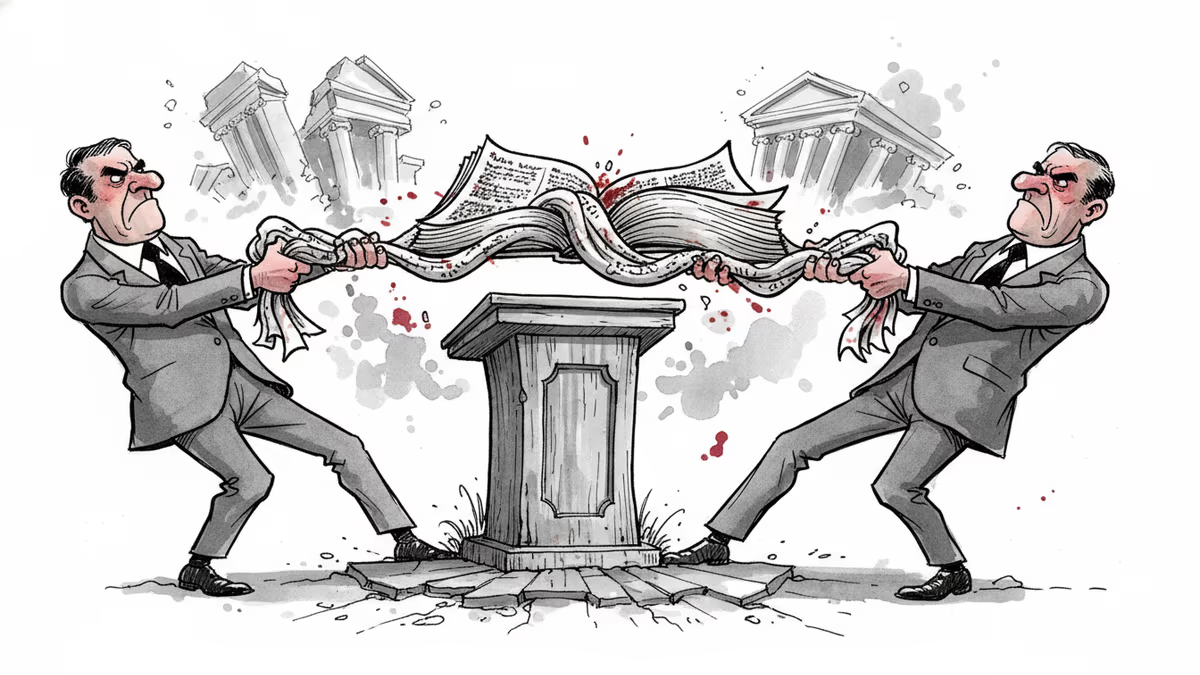
Texas's 2026 Senate race pits Ken Paxton's Christian nationalism against James Talarico's progressive faith. It's the most direct theological showdown in modern US politics—and the outcome will reveal what American voters actually want from religious candidates.
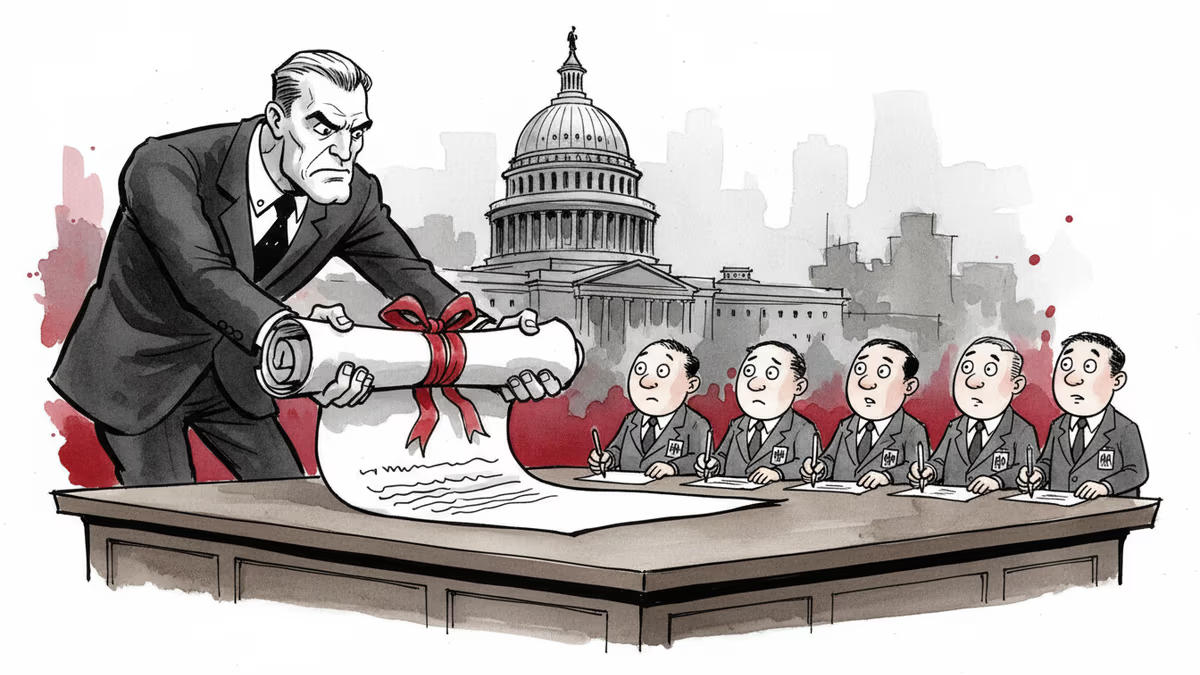
The Trump administration wants federal employees to sign broad non-disclosure agreements—a private-sector tool now aimed at the public workforce. What happens when government runs like a corporation?
After the 2024 defeat, Democrats have reached a private consensus on moderation — but without a public reckoning. Can a 'vibe shift' actually rebuild a party brand?
Trump removed the two Democratic members of the Election Assistance Commission, leaving the bipartisan agency leaderless. A Supreme Court ruling made it legal. Here's why a non-crisis can still be a warning sign.
Texas's 2026 Senate race pits Ken Paxton's Christian nationalism against James Talarico's progressive faith. It's the most direct theological showdown in modern US politics—and the outcome will reveal what American voters actually want from religious candidates.
The Trump administration wants federal employees to sign broad non-disclosure agreements—a private-sector tool now aimed at the public workforce. What happens when government runs like a corporation?
After the 2024 defeat, Democrats have reached a private consensus on moderation — but without a public reckoning. Can a 'vibe shift' actually rebuild a party brand?
Thoughts
Share your thoughts on this article
Sign in to join the conversation