
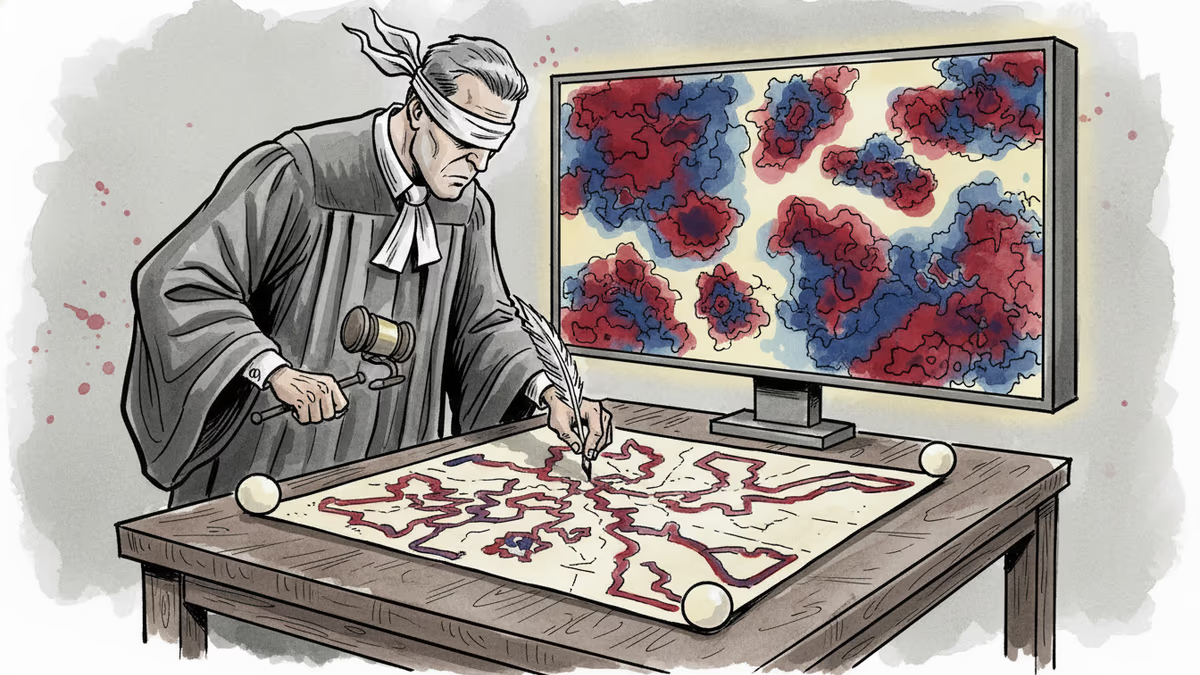
The Court Said 'Ignore Race.' The Data Won't Let You.
A Supreme Court ruling bans race in redistricting. But new political science research shows race is actually a more reliable predictor of voting than party—making "race-neutral" gerrymandering a statistical fiction.
The Supreme Court just told mapmakers to stop seeing race. The data scientists drawing those maps can't.
In a 6-3 ideologically split decision, the U.S. Supreme Court struck down Louisiana's majority-Black congressional district as an unconstitutional racial gerrymander. Critics say the ruling guts the Voting Rights Act—a law that, until recently, commanded rare bipartisan support and had protected Black political representation in the South for over half a century. Some analysts are invoking Jim Crow. Others see a more surgical kind of disenfranchisement, one dressed in the neutral language of partisan strategy.
But here's the twist that makes this ruling more complicated than either side's talking points: two political scientists have published research showing that the Supreme Court's vision of "race-blind" gerrymandering may be mathematically impossible—at least in the South.
How We Got Here
To understand why Louisiana v. Callais matters, you need two prior decisions as context.
In 2019, the Supreme Court ruled that partisan gerrymandering—drawing districts to favor one political party—cannot be challenged under federal law. Both parties took full advantage. Republicans, who control more state legislatures, benefited most, but Democrats played the same game wherever they could.
That ruling left one guardrail standing: even if you were gerrymandering for partisan gain, you couldn't excessively dilute the voting power of racial minorities in the process. Dozens of lawsuits used exactly this argument to challenge maps across the South.
Callais removes that guardrail. The court's majority opinion, written along conservative lines, holds that mapmakers must now ignore race entirely. Gerrymandering is fine. Just make sure it's race-neutral.
The immediate fallout has been swift. Several Southern states have already begun redrawing legislative maps aimed at securing Republican supermajorities. Multiple Black incumbents—all Democrats—are expected to lose their seats in the 2026 midterms. Democrats are threatening retaliatory redistricting in states they control.
The Research That Complicates Everything
Political scientists Jordan Ragusa and Claire Wofford were motivated to investigate a specific claim made by Justice Samuel Alito in a related case, Alexander v. South Carolina NAACP. Alito argued that when drawing districts for partisan advantage, mapmakers only need to look at party affiliation—race would be irrelevant to securing partisan control.
It's an intuitive claim. It also turns out to be empirically wrong.

Using precinct-level election data from South Carolina spanning 2010 to 2020, the researchers tested how well a precinct's racial composition and partisan history predicted future voting behavior. Their findings complicate the court's assumptions in two important ways.
First, while past partisan vote share was the strongest single predictor of future results, roughly a quarter of voters in any given precinct didn't behave as their partisan history suggested. For anyone engineering a gerrymander, that's a substantial margin of error.
Second, partisan lean is surprisingly volatile. It shifts with election cycles, presidential approval ratings, and the gradual realignment of party coalitions. A precinct that leaned Republican before redistricting might swing Democratic in a midterm wave—precisely the kind of election coming in November 2026, when a second-term president's party typically suffers.
Race, by contrast, proved a more stable predictor than party. In the South, the alignment is stark: the vast majority of Black voters support Democrats; most white voters support Republicans. And that alignment has held with remarkable consistency across election cycles, economic conditions, and national political climates.
The practical implication is stark. A heavily Democratic precinct that is predominantly Black will vote Democratic far more reliably than a heavily Democratic precinct that is predominantly white. Two precincts that look identical on a partisan map can behave very differently on election day.
The Paradox of Race-Blind Mapping
Consider the scenario Ragusa and Wofford lay out. South Carolina's Republican-controlled legislature wants to flip the congressional seat long held by Jim Clyburn, the prominent African American Democrat. The straightforward approach: identify precincts that voted for Donald Trump in 2024 and redraw the district to pack in enough of them.
It backfires. Clyburn holds his seat. A neighboring district flips Democratic. The legislature used imperfect data—past partisan returns—and got an imperfect result.
The more reliable route, the research suggests, is to identify which voters will consistently support the Democratic candidate and draw them out of the district. In the South, those voters are disproportionately Black. Not because of their race, the researchers are careful to note, but because of the near-perfect correlation between race and party loyalty in the region.
Ragusa and Wofford acknowledge the distinction feels thin to many people. Targeting Black voters because they're reliable Democrats rather than because they're Black may be legally different. Whether it's morally different is a question the research leaves deliberately open.
Legal exposure still exists. If litigants can show that race was the "predominant" factor driving redistricting, or that mapmakers deliberately targeted Black voters because of their race, courts can still intervene. But proving intent in a data-driven process—where a GIS algorithm optimizing for partisan outcomes automatically incorporates racial patterns—is extraordinarily difficult.
What Different Stakeholders See
Voting rights advocates see the ruling as the latest step in a decades-long erosion of the VRA's protections, pointing out that the law was designed specifically to prevent the kind of outcome now unfolding in Louisiana and South Carolina.
Republican state legislators argue they're simply doing what the court has now explicitly permitted: drawing competitive districts based on political data, not race.
Democratic strategists face their own uncomfortable calculus. In states they control—like Maryland or Illinois—they've drawn maps that critics called racial gerrymanders too, though for the opposite partisan purpose. Callais constrains everyone.
International observers watching American redistricting debates often note what domestic coverage underplays: the U.S. system, where the party in power draws the districts its candidates will run in, is unusual among established democracies. Most peer nations use independent commissions. The current crisis is, in part, a structural one.
This content is AI-generated based on source articles. While we strive for accuracy, errors may occur. We recommend verifying with the original source.
Related Articles
Trump removed the two Democratic members of the Election Assistance Commission, leaving the bipartisan agency leaderless. A Supreme Court ruling made it legal. Here's why a non-crisis can still be a warning sign.
Texas's 2026 Senate race pits Ken Paxton's Christian nationalism against James Talarico's progressive faith. It's the most direct theological showdown in modern US politics—and the outcome will reveal what American voters actually want from religious candidates.
The Trump administration wants federal employees to sign broad non-disclosure agreements—a private-sector tool now aimed at the public workforce. What happens when government runs like a corporation?
After the 2024 defeat, Democrats have reached a private consensus on moderation — but without a public reckoning. Can a 'vibe shift' actually rebuild a party brand?
Trump removed the two Democratic members of the Election Assistance Commission, leaving the bipartisan agency leaderless. A Supreme Court ruling made it legal. Here's why a non-crisis can still be a warning sign.
Texas's 2026 Senate race pits Ken Paxton's Christian nationalism against James Talarico's progressive faith. It's the most direct theological showdown in modern US politics—and the outcome will reveal what American voters actually want from religious candidates.
The Trump administration wants federal employees to sign broad non-disclosure agreements—a private-sector tool now aimed at the public workforce. What happens when government runs like a corporation?
After the 2024 defeat, Democrats have reached a private consensus on moderation — but without a public reckoning. Can a 'vibe shift' actually rebuild a party brand?
Thoughts
Share your thoughts on this article
Sign in to join the conversation