
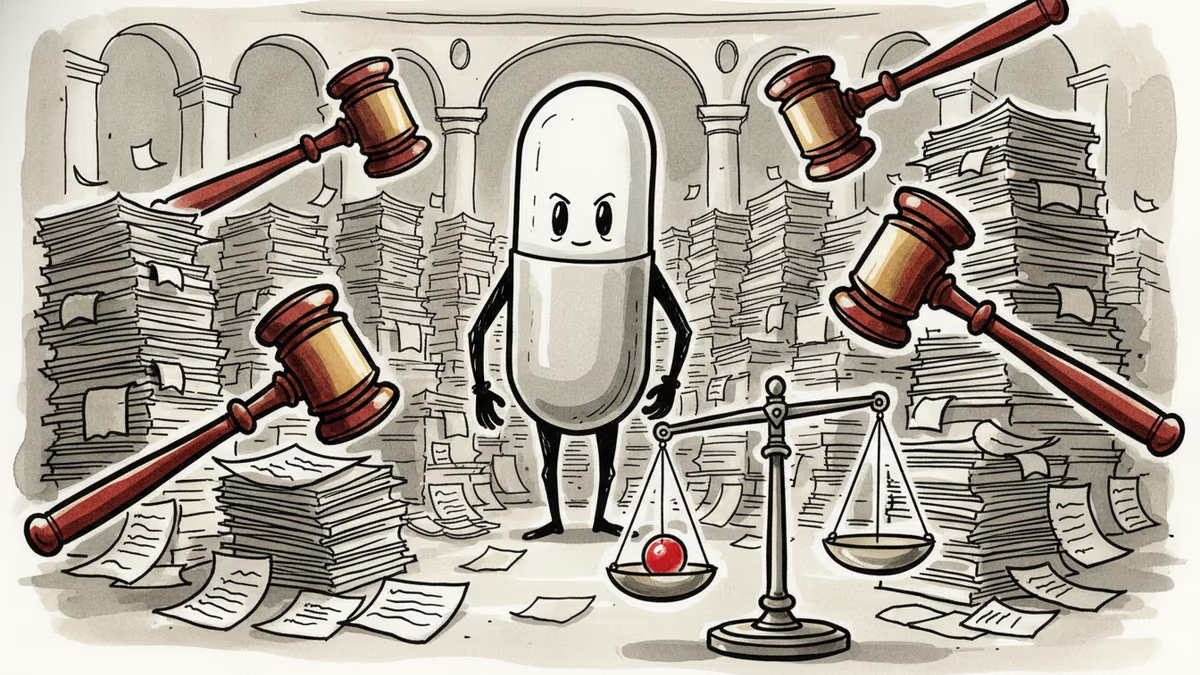
The Court That Keeps Saving the Abortion Pill
The 5th Circuit tried to ban mifepristone again. The Supreme Court blocked it again. Why does a conservative court keep protecting abortion pill access — and how long will it last?
The same court. The same drug. The same legal argument. Rejected once by the Supreme Court — unanimously — and now back again.
Late Friday, the far-right 5th Circuit Court of Appeals moved to cut off mail access to mifepristone, the most commonly used abortion medication in the United States. Within hours, two pharmaceutical companies — Danco Laboratories and GenBioPro — asked the Supreme Court to intervene. Justice Samuel Alito, who handles emergency appeals from the 5th Circuit, issued a temporary block on the ruling through May 11.
For abortion providers, that's a small but meaningful exhale. For everyone else watching, it raises a deeper question: why does a court dominated by Republican-appointed justices keep standing between the 5th Circuit and a mifepristone ban?
What the 5th Circuit Actually Did — and Why It Matters More Than It Sounds
Technically, the 5th Circuit's ruling in Danco Laboratories v. Louisiana only targets the FDA's 2021 rule changes — the ones that allowed patients to consult doctors via telemedicine and receive mifepristone by mail, rather than requiring in-person pickup. That sounds limited. It isn't.
The FDA only permits mifepristone to be dispensed under a specific protocol called a Risk Evaluation and Mitigation Strategy, or REMS. When the 5th Circuit struck down the current REMS, it didn't replace it with anything. That leaves pharmacists and physicians in legal limbo: no one knows which actions could expose them to civil or criminal liability. As Danco explained to the justices, there has never been a court-enjoined REMS before. Drug companies would need to revise labels, packaging, recertify providers, and renegotiate supplier contracts — a process that typically takes months.
If the Supreme Court doesn't step in, the practical effect is a nationwide suspension of mifepristone access — including in states where abortion is fully legal. That's not a modest ruling. That's a ban wearing a procedural disguise.
The Standing Problem — Again
The last time the 5th Circuit tried this, in 2023, the Supreme Court swatted it down 9–0. The issue was standing: the anti-abortion doctors who brought the case didn't prescribe mifepristone, weren't harmed by its availability, and their claimed injury — that someday, maybe, a patient might show up in their ER after a complication — was too speculative to count.
This time, the plaintiff is the state of Louisiana. Its argument: a Medicaid patient might take mifepristone, might have a complication, might go to a Louisiana emergency room, and the state might then pay for that care. The 5th Circuit accepted this chain of hypotheticals as sufficient standing.
The Supreme Court almost certainly won't. That logic is more attenuated than what the Court unanimously rejected in FDA v. Alliance for Hippocratic Medicine (2024). The Court has also previously held, in Haaland v. Brackeen (2023), that states can't sue the federal government simply because federal law differs from state law — otherwise every state would have standing to challenge every federal policy it dislikes.

Louisiana also points to two actual Medicaid patients who sought care after taking mifepristone. But under City of Los Angeles v. Lyons (1983), past injury alone isn't enough to justify an injunction. You have to show likely future harm. Two cases doesn't clear that bar.
So Why Hasn't This Court Just Let the Ban Happen?
This is the puzzle at the center of both the Alliance case and Danco. The Republican supermajority on the Supreme Court has been consistently hostile to abortion rights. It overturned Roe v. Wade. It allowed Texas to deputize private citizens as abortion bounty hunters. It recently appeared to reverse a two-year-old precedent to cut Medicaid funding to Planned Parenthood in Medina v. Planned Parenthood (2025).
And yet: mifepristone keeps surviving.
One explanation is political. The Trump administration, despite its anti-abortion base, has quietly resisted the most aggressive moves. It declined to appoint prominent social conservative Roger Severino to a senior HHS role, reportedly over concerns his views were too inflammatory. It hasn't ordered the FDA to ban mifepristone. It hasn't revived the Comstock Act — an 1873 law that could theoretically be used to ban mailing anything abortion-related — despite sustained pressure from anti-abortion groups. The Republican Party, it seems, has concluded that going all-in on abortion is an electoral liability.
The justices may be reading the same room.
The second explanation is more principled, and more interesting. Several Republican justices appear genuinely committed to the idea that abortion policy should be decided by states, not the federal government. Every major abortion ruling from this Court has expanded state power: states can ban abortion, states can defund abortion providers, states can let private citizens enforce abortion restrictions.
Mifepristone is different. A federal ban on the drug — or a ruling that effectively makes it unavailable — would override the policy choices of blue states that have explicitly chosen to protect abortion access. It would be the federal government imposing an abortion restriction on California, New York, and Illinois. That cuts directly against the "leave it to the states" logic the Court has used to justify everything else it's done on abortion.
If the justices are being consistent — and that's a genuine if — protecting mifepristone access in blue states is actually the coherent position.
What Comes Next
Alito's temporary order runs only through May 11. After that, the full Court must decide whether to extend the block while the case proceeds, or let the 5th Circuit's ruling take effect. The drug companies' legal arguments are, by most assessments, extremely strong. But this Court has overruled its own recent precedents before, sometimes within two years of issuing them.
The Danco case is still early. A final Supreme Court ruling could be months away. And the Trump administration's posture — whether it would even issue a new REMS if the old one were invalidated — remains an open variable.
What's clear is that the 5th Circuit has now attempted to ban mifepristone twice, using arguments the Supreme Court has already rejected, and is apparently prepared to keep trying. The legal doctrine of standing exists precisely to prevent courts from becoming venues for political grievances dressed up as legal injuries. Whether that doctrine holds is the real test of Danco.
This content is AI-generated based on source articles. While we strive for accuracy, errors may occur. We recommend verifying with the original source.
Related Articles
The Supreme Court has blocked a lower court's attempt to restrict mifepristone for the second time. Justices Thomas and Alito dissented sharply, invoking an 1873 law. The drug is safe until at least 2027 — but what comes next is far from settled.
A Supreme Court ruling bans race in redistricting. But new political science research shows race is actually a more reliable predictor of voting than party—making "race-neutral" gerrymandering a statistical fiction.
The Supreme Court's 6-3 ruling in Louisiana v. Callais rewrites how Section 2 of the Voting Rights Act applies to redistricting—with major consequences for minority representation and the 2026 midterms.
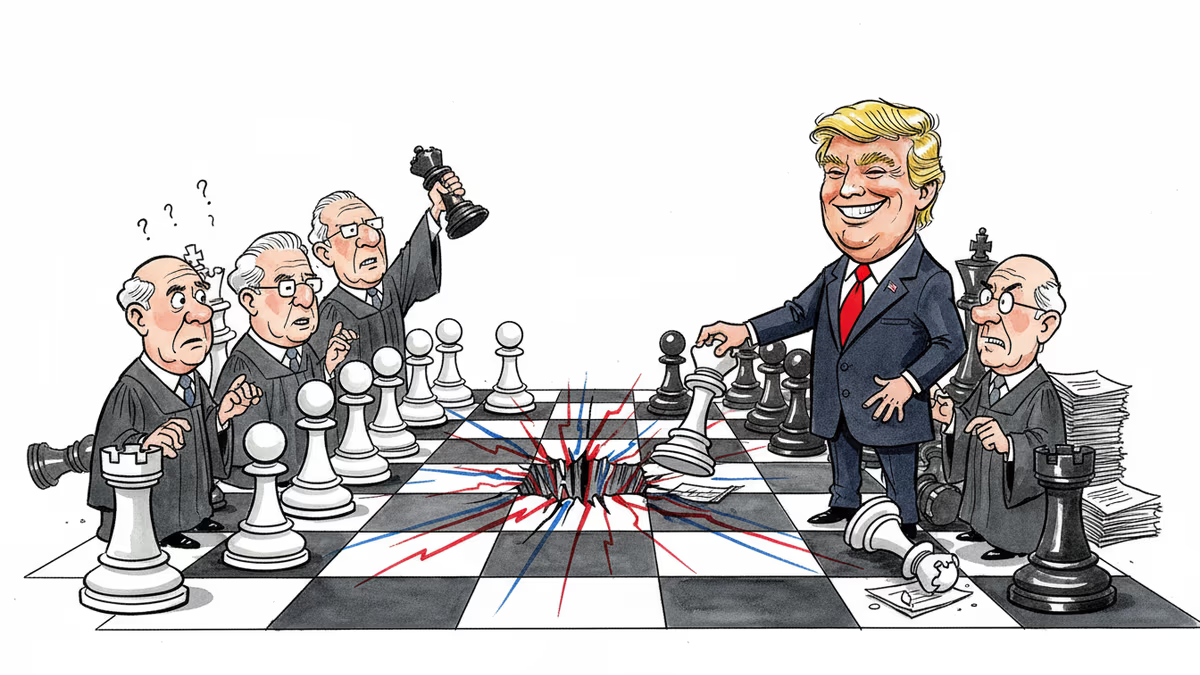
The Supreme Court's tariffs ruling against Trump reveals a complex political calculus where both the judiciary and the president benefit from this apparent defeat
The Supreme Court has blocked a lower court's attempt to restrict mifepristone for the second time. Justices Thomas and Alito dissented sharply, invoking an 1873 law. The drug is safe until at least 2027 — but what comes next is far from settled.
A Supreme Court ruling bans race in redistricting. But new political science research shows race is actually a more reliable predictor of voting than party—making "race-neutral" gerrymandering a statistical fiction.
The Supreme Court's 6-3 ruling in Louisiana v. Callais rewrites how Section 2 of the Voting Rights Act applies to redistricting—with major consequences for minority representation and the 2026 midterms.
The Supreme Court's tariffs ruling against Trump reveals a complex political calculus where both the judiciary and the president benefit from this apparent defeat
Thoughts
Share your thoughts on this article
Sign in to join the conversation