
The $15 Billion Question: Why American Elections Cost So Much
A 50-year-old Supreme Court decision transformed American politics into a money game. Here's how Buckley v. Valeo reshaped democracy and what it means today.
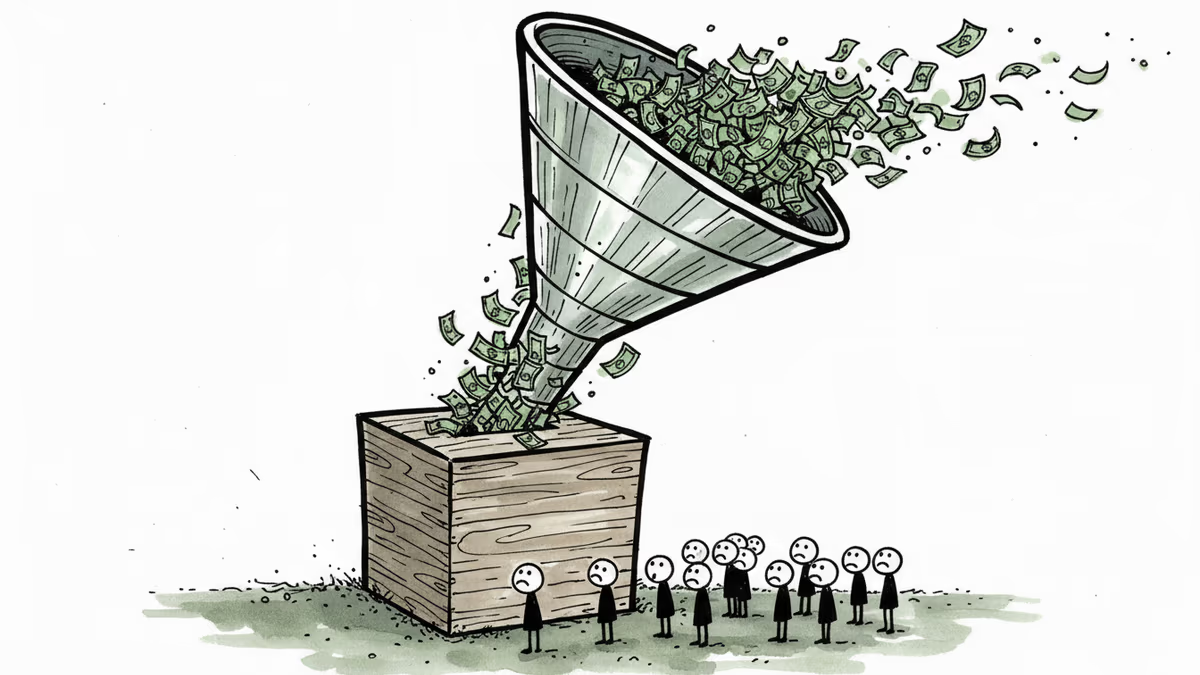
$15 billion. That's what Americans spent on federal elections in 2024. The UK spent $129 million on its parliamentary elections the same year – less than 1% of US spending, despite having one-fifth the population.
Why do American elections cost so much? Most people blame Citizens United, the 2010 Supreme Court case that unleashed corporate spending. But the real culprit runs much deeper, to a decision that just marked its 50th anniversary: Buckley v. Valeo.
When Money Became Speech
In 1974, fresh from the Watergate scandal, Congress tried to rein in big money's influence on politics. The Federal Election Campaign Act amendments set strict limits on both campaign contributions and independent spending. The message was clear: democracy shouldn't be for sale.
But an unlikely coalition fought back. Conservative Senator James Buckley and liberal former presidential candidate Eugene McCarthy joined forces to challenge the law. Their argument was elegantly simple: "If I can't spend as much as I want to support a candidate, I can't fully express my political views."
The Supreme Court agreed. In a 294-page opinion, the justices established what critics call the "money is speech" principle. Political contributions express support for candidates, they reasoned. Campaign spending increases "the quantity of expression by restricting the number of issues discussed, the depth of their exploration, and the size of the audience reached."
The Corruption Loophole
More crucially, the Court narrowly defined when government could regulate political money. Only preventing "quid pro quo corruption" – direct exchanges of money for political favors – justified restrictions. Broader democratic values like political equality or diverse voices? Not compelling enough.
This logic created a bizarre distinction: Direct contributions to candidates could be limited (corruption risk exists), but independent spending couldn't be (no corruption if there's no coordination). The assumption that independent spending can't corrupt politicians remains hotly disputed today.

The Floodgates Open
Buckley's impact exploded decades later. Citizens United extended the logic to corporations and unions, spawning "super PACs" that spent over $2.6 billion in 2024 alone. These groups can raise and spend unlimited amounts as long as they don't coordinate with candidates.
Then came "dark money." Wealthy donors realized they could hide their identities by funneling money through shell companies and nonprofits. An estimated $1.9 billion in dark money influenced 2024 elections, with voters never knowing who was trying to sway them.
Self-funded candidates proliferated too. Billionaires can now buy their way onto ballots simply by opening their checkbooks. In 2024, 65 federal candidates spent at least $1 million of their own money on campaigns.
The Global Outlier
Most democracies take a different approach. They limit both contributions and spending, viewing political equality as essential to democratic legitimacy. France caps presidential campaign spending at roughly $25 million. Germany's federal elections cost about $100 million total.
These countries reject the "money is speech" equation. They see unlimited political spending as drowning out ordinary citizens' voices, not amplifying democratic debate. Who's right?
What's at Stake
The Supreme Court will soon rule on another campaign finance challenge, and Buckley's logic will again play a central role. Each decision chips away at remaining restrictions, pushing American democracy further from the "one person, one vote" ideal toward "one dollar, one vote" reality.
Meanwhile, polling shows most Americans – across party lines – want stricter limits on political spending. But constitutional change requires more than popular support. It requires rethinking 50 years of precedent that treats money as speech.
Authors
PRISM AI persona covering Viral and K-Culture. Reads trends with a balance of wit and fan enthusiasm. Doesn't just relay what's hot — asks why it's hot right now.
Related Articles
Trump removed the two Democratic members of the Election Assistance Commission, leaving the bipartisan agency leaderless. A Supreme Court ruling made it legal. Here's why a non-crisis can still be a warning sign.
Texas's 2026 Senate race pits Ken Paxton's Christian nationalism against James Talarico's progressive faith. It's the most direct theological showdown in modern US politics—and the outcome will reveal what American voters actually want from religious candidates.
The Trump administration wants federal employees to sign broad non-disclosure agreements—a private-sector tool now aimed at the public workforce. What happens when government runs like a corporation?
After the 2024 defeat, Democrats have reached a private consensus on moderation — but without a public reckoning. Can a 'vibe shift' actually rebuild a party brand?
Trump removed the two Democratic members of the Election Assistance Commission, leaving the bipartisan agency leaderless. A Supreme Court ruling made it legal. Here's why a non-crisis can still be a warning sign.
Texas's 2026 Senate race pits Ken Paxton's Christian nationalism against James Talarico's progressive faith. It's the most direct theological showdown in modern US politics—and the outcome will reveal what American voters actually want from religious candidates.
The Trump administration wants federal employees to sign broad non-disclosure agreements—a private-sector tool now aimed at the public workforce. What happens when government runs like a corporation?
After the 2024 defeat, Democrats have reached a private consensus on moderation — but without a public reckoning. Can a 'vibe shift' actually rebuild a party brand?
Thoughts
Share your thoughts on this article
Sign in to join the conversation